Facebook
 Google
 GitHub
 Linkedin
New IGBT, SiC Power Modules Meet High-Voltage Needs
Infineon, Mitsubishi, and Navitas have released new power modules for high-voltage applications.
High-power applications, such as industrial and automotive, require power module solutions that offer performance under intense temperatures and high voltages.
Infineon and Mitsubishi have each released IGBTs for electric vehicles and industrial use, while Navitas has introduced 1200 V SiC modules for EV chargers and energy storage. The refined modules target efficiency and robustness.
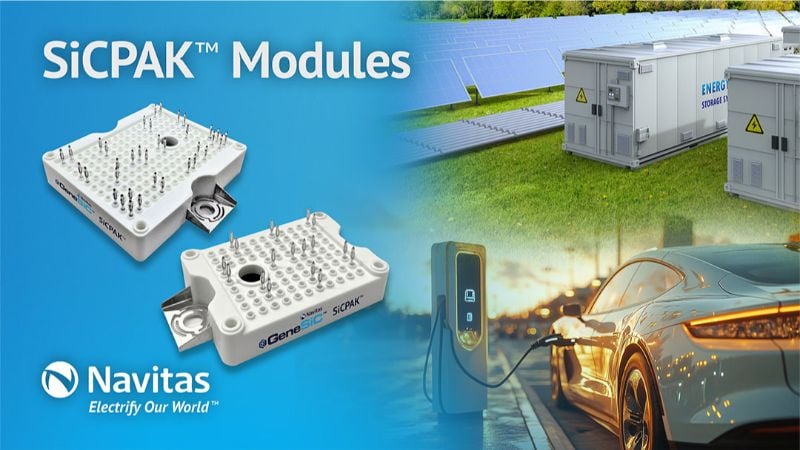
Navitas’ new SiCPAK products. Image used courtesy of Navitas Semiconductor
Infineon’s EDT3
Infineon has announced a new generation of IGBT and RC-IGBT bare die chips for electric drivetrain systems in 400 V and 800 V electric vehicle architectures. The EDT3 series, designed for both 750 V and 1200 V systems, delivers up to 20% lower total power losses under high load compared to the previous EDT2 generation. These improvements result from architectural refinements that reduce switching and conduction losses while increasing maximum junction temperature up to 185°C. According to Infineon, these attributes allow automotive engineers to create more efficient and thermally robust power modules that extend EV range and reduce consumption.

Laboratory worker with an Infineon IGBT Bare Die wafer. Image used courtesy of Infineon
The 1200 V RC-IGBT die integrates diode and IGBT functionality on a single chip to increase current density and reduce packaging overhead. By consolidating components, Infineon claims to lower assembly complexity and reduce overall silicon usage per ampere. Due to these benefits, the RC-IGBT is best for high-performance 800 V main inverter systems and facilitates custom module integration.
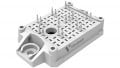
Infineon also announced that its EDT3 die portfolio has been incorporated into the HybridPACK Drive G2 platform, which supports output power up to 250 kW. The module class introduces new diagnostic and integration features, including support for on-chip temperature and current sensing and compatibility with advanced phase current sensors. Overall, these features reduce system cost and allow more precise powertrain control.
Mitsubishi’s XB Series
Mitsubishi will release a sample of its new XB Series high-voltage IGBT module.
Rated at 3.3 kV and 1,500 A, the module is designed for railway traction and other large-scale industrial applications. The module integrates Mitsubishi’s proprietary carrier-stored trench-gate bipolar transistor (CSTBT) structure with a relaxed field of cathode (RFC) diode to reduce total switching losses by approximately 15% compared to the company’s CM1500HC-66R offering. The CSTBT structure uses a carrier storage layer to suppress tail current and improve turn-off characteristics, while the RFC diode improves reverse-recovery behavior and broadens the reverse-recovery safe operating area by around 25%.
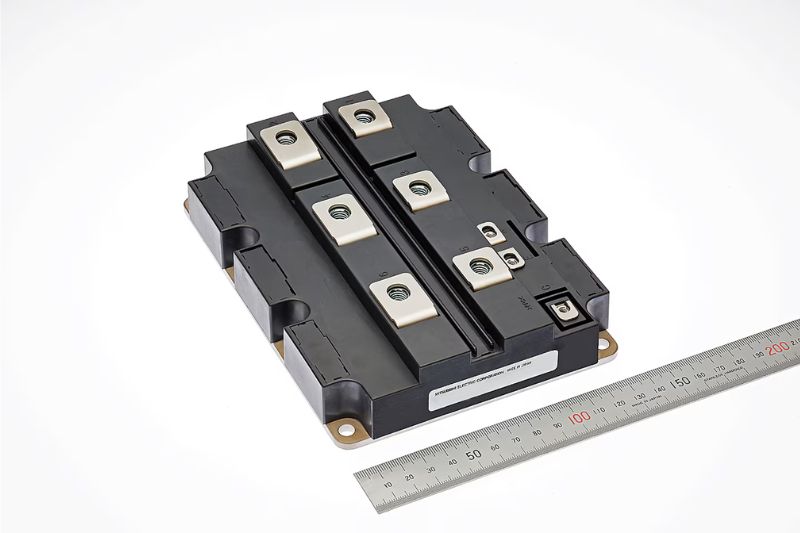
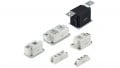
XB Series HVIGBT Module (3.3kV/1500A Type). Image used courtesy of Mitsubishi
To increase environmental robustness, Mitsubishi introduced a new chip termination structure that includes an electric field relaxation layout and a surface charge control layer. These design choices reduce the termination region by 30% and improve moisture resistance by a factor of 20. The chip layout helps stabilize surface electric fields and direct charge dissipation through the interface between a semi-insulating film and the semiconductor body for reduced leakage and potential voltage degradation during condensation events.
Notably, the XB Series maintains physical compatibility with prior H-Series and R-Series modules. Mitsubishi plans to exhibit the new module at PCIM 2025 and will begin sample shipments on May 1.
Navitas SiCPAK Power Modules
Navitas Semiconductor introduced a new series of 1200 V SiCPAK power modules incorporating several architectural advances for improved performance specifications.
The devices use a proprietary epoxy-resin potting compound to improve thermal stability and environmental robustness. Additionally, the modules leverage GeneSiC trench-assisted planar SiC MOSFETs to reduce on-resistance degradation under temperature stress. As a result, the resistance variation is minimized across wide operating temperatures. The modules deliver up to 20% lower conduction losses compared to competitive planar or trench-only SiC solutions. Each module integrates NTC thermistors and comes in half-bridge, full-bridge, and three-level topologies with RDS(on) options from 4.6 mΩ to 18.5 mΩ.
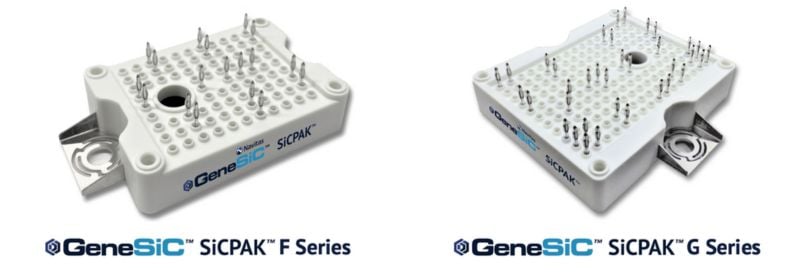
SicPAK modules. Image used courtesy of Navitas
According to Navitas, adopting epoxy-resin potting also significantly improves isolation reliability and thermal cycling durability. After 1,000 thermal shock cycles between -40°C and +125°C, the modules showed a 5x lower increase in thermal resistance than silicone-gel-filled alternatives. While competing gel-based modules failed isolation tests under these conditions, Navitas' devices maintained electrical isolation.
The GeneSiC devices also exhibit avalanche capability at 100% tested conditions and withstand short-circuit energy with a 30% advantage over comparable products. Navitas claims that the narrow threshold voltage spread supports module paralleling without performance mismatch.
Integration, Efficiency, and Reliability
The latest releases from Infineon, Mitsubishi, and Navitas all trend toward greater integration and system-level efficiency. As electrification efforts intensify across industries, design teams continue to face tighter thermal constraints and the need to reduce volume and cost without sacrificing performance. Manufacturers are optimizing every power stack layer by using high-temperature-capable die, improved co-packaging strategies, and advanced isolation techniques.