Facebook
 Google
 GitHub
 Linkedin
Help or Hindrance? Navigating High-Voltage ICs for EVs
Electric vehicles adopt high battery voltage to speed up charging times, extend range, and increase energy capture. Advanced integrated circuits underpin this shift, creating challenges.
Electric vehicle (EV) drivers who already own a zero-emission car or want to graduate from an internal combustion engine are demanding more. In response, electric vehicle makers are transitioning from 400-V to 800-V systems. Environmentally conscious fleet owners may even seek architectures exceeding 800 V.
More engineers consider higher battery voltage the most viable solution to various EV performance issues, such as slow charging times, short ranges, limited acceleration, and low regenerative braking energy capture. Changing the operating voltage is complicated, forcing automakers to rethink everything, especially power integrated circuits (ICs), while dealing with the prevailing issues plaguing the EV industry.
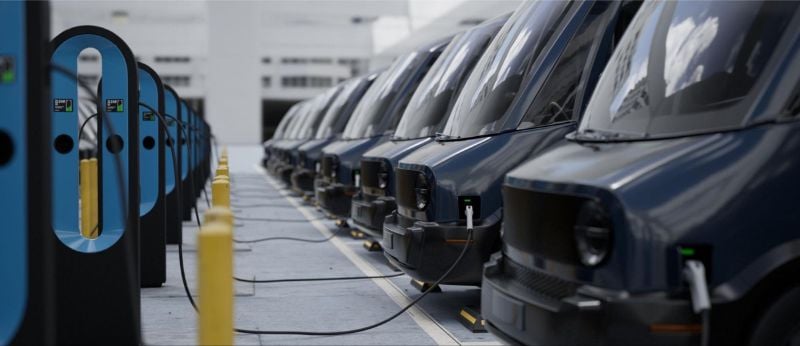
Electric vehicle fleet. Image used courtesy of Adobe Stock
Paths to 800-V Architecture Transition
Shifting to the 800-V internal EV architecture is achievable in various ways. Making the entire vehicle operate on 800 V is one approach. An EV’s high-voltage system handling 800 V eliminates the need for intercomponent voltage conversion. This design can translate to hyper-efficiency and lightning-quick charging.
However, making a full-blown 800-V structure means reimagining everything, including power ICs and failsafe systems.
Bigger capacitors are necessary, requiring more physical space to meet the minimum creepage distance between polarities to prevent arcing. The low current in an 800-V architecture can also require thicker wires and links to deliver more power. These design considerations are significant headaches for EV manufacturers wanting to make components as small and lightweight as possible.
Testing experimental EV designs is painstaking. Procedures must prove the components can be reliable in worst-case scenarios whose conditions are multiple times higher than 800-Venvironments.
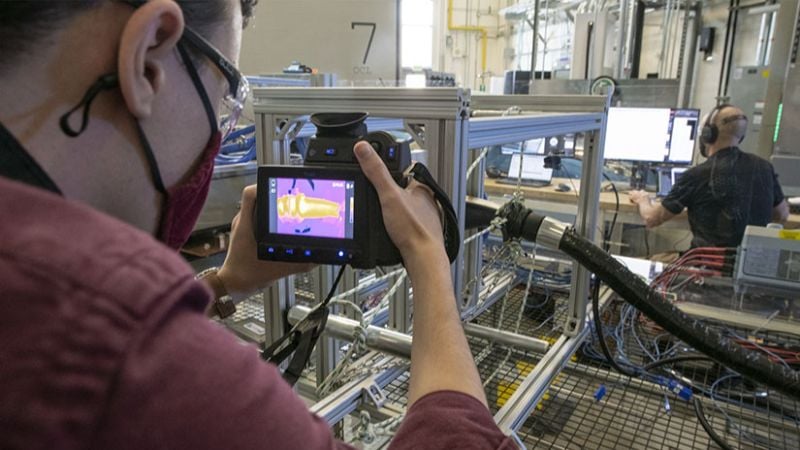
Testing electric truck charging. Image used courtesy of National Renewable Energy Laboratory/Dennis Schroeder
Redesigning EV elements drives up equipment costs. Using more silicon carbide (SiC)—proven to outperform insulated-gate bipolar transistors at high frequencies—is vital to ensure improved switching frequency and minimal energy losses in high-voltage machines. This sought-after semiconductor used in EV ICs is expensive. Sharp SiC demand growth can inflate manufacturing costs and sticker prices.
Alternatively, automakers can limit 800 V to some high-voltage components only. This approach can reduce redesign and equipment price spikes. It promises faster charging but does little to mitigate conversion power losses.
Developing a battery optimized for switching between 800 V when charging and 400 V when discharging is also worth exploring to minimize the cascading impacts of EV design changes. Such a battery can solve charging problems but not energy efficiency woes.
The jury is still out on the most feasible approach, but EV manufacturers will consider all options when embracing higher battery voltage.
DC/DC Converters as EV Staples
Most high-voltage EVs have DC/DC converters to render them compatible with most charging stations. Otherwise, these new zero-emission vehicles can’t use the existing public charging infrastructure primarily designed to power 400-V EVs.
Designing DC/DC converters for EVs is challenging. High-speed energy switching requires an accurate converter layout, which provides minimal latitude in creating ICs. These power conversion circuits must be super-efficient, small, lightweight, and have less electromagnetic interference. They must strike a healthy balance between circuitry size and efficiency to build the converter with a small footprint without sacrificing performance.
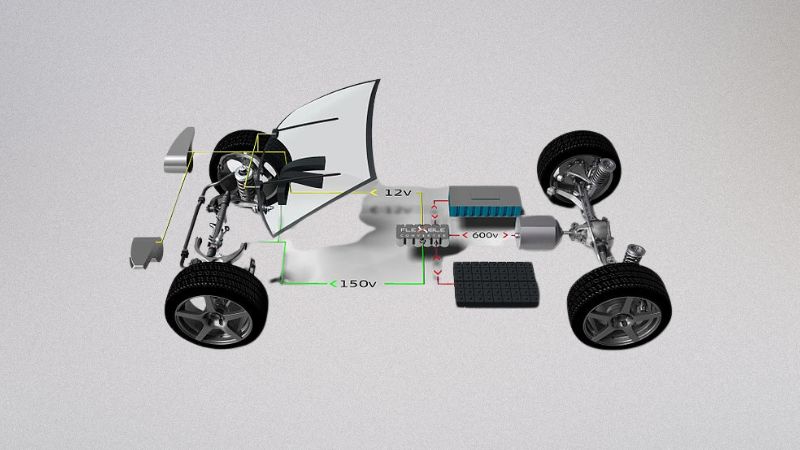
DC-DC converter in a 600 V electric vehicle. Image used courtesy of Wikimedia Commons
Moreover, designers must consider the hardware’s efficiency when incorporating heat sinks into the battery design and regulating temperature levels. Selecting apt materials to keep the battery cool is paramount to prolonging its life while the converter adjusts the voltage accordingly and produces heat.
Considering how unlikely the 800-V public charging network is to expand to accommodate more high-voltage EVs on the road, the DC/DC converter will remain a staple of these more powerful emissions-free vehicles.
This reality puts upward pressure on EV prices because the circuits used in such additional hardware are in high demand across a broad range of tech segments. Design improvements can only do so much to build ICs cost-effectively. Suppliers must step up their game to address inefficiency issues on their end.
SiC Screening Must Accelerate
The EV industry’s pivot to high-voltage systems has caused the SiC demand to surge. While manufacturers welcome this market opportunity, this trend has shown an inability to deliver. They’re ill-equipped to screen SiC power ICs for defects because traditional silicon test systems have been ineffective.
Keeping SiC products intact throughout production requires rigorous testing and meticulous attention. They may develop flaws during manufacturing, impacting their basic functionality and performance. This compound is brittle, making it susceptible to pits and scratches, compromising a wafer’s integrity. SiC wafers are also prone to breakage during handling. Sawing them into die increases the chances of cracking.

SiC wafers. Image used courtesy of Wikimedia Commons
So far, current SiC high-current and high-voltage test methods have been good enough to screen low volumes of units. Manufacturers have also found success employing optical inspection techniques throughout the assembly process and leveraging photoluminescence and X-ray for metrology.
However, manufacturers have struggled to scale up their quality and reliability testing capabilities to ramp up production, especially since switching from 150 mm to 200 mm wafers.
Experts are evaluating various innovations to address screening inefficiencies. For example, slashing the chuck stray inductance from 600 microhenry to sub-100 nanohenry can enable dynamic wafer testing.
Another method is putting various data types—defect inspection and review insights, electrical test results, and inline metrology feedback—from geographically fragmented factories and tools into one platform. Only then can manufacturers feed data into predictive analytics software and build reliable models to identify bottlenecks and take steps to maximize efficiency.
Greater Traceability—An Increasing Need
Traceable auto chips empower EV manufacturers and suppliers to investigate new and unknown issues impacting circuit performance. Uncovering the culprits in common problems—such as board solder bumps and package failures—can be puzzling because they can arise from SiC production processes or temperature and mechanical stresses EVs experience.
Back-end devices have electronic IDs, but power ICs don’t. Nontraceable circuits make assembly and testing more taxing. Losing device-level traceability can cause mix-ups since it’s impossible to correlate nondescript wafers and batches.
Fortunately, some suppliers are adding granularity to chip traceability. These vendors maintain their databases, giving clients access to module data and providing digital trails down to wafer sort.
Siloed data isn’t desirable since the EV industry will benefit more from decentralized information, such as data warehouse repositories. Still, proactive product tracing is a step in the right direction.
It Gets Worse Before It Gets Better
The EV industry’s pivot to high battery voltage is burdensome yet necessary. While automotive supply chains have been ill-prepared for this shift, innovation can’t transpire without pressure. Although costly mistakes are inevitable, power IC suppliers will benefit from today’s failed attempts to devise proper solutions and help propel the EV revolution where it should go.