Facebook
 Google
 GitHub
 Linkedin
5-Year Forecast: Battery Innovations, Markets Drive BESS
Energy storage is being driven by intermittent renewable energy, the growing demand for electrification in transport and industry, and the surge in hyperscalers and artificial intelligence.
Energy storage is a lucrative and growing sector. The rise of intermittent renewable energy, the growing demand for electrification in transport and industry, and the surge in hyperscalers and artificial intelligence are pushing the industry toward accelerated deployment of storage solutions. Industry leaders recognize the potential for storage to capture off-peak surplus renewable energy, stabilize the grid, and provide affordable, reliable power when it's needed most.
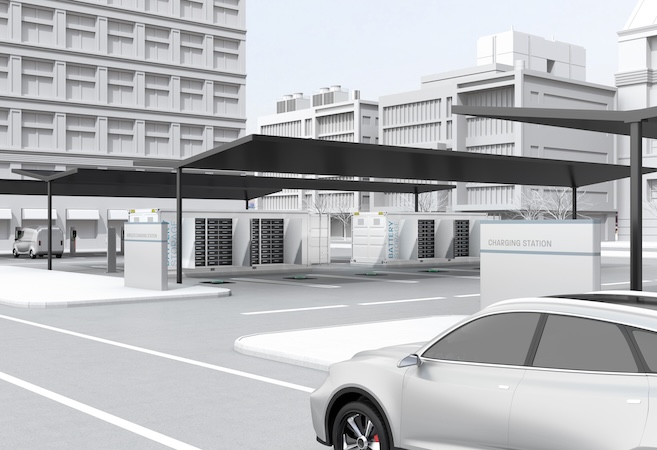
Image used courtesy of Adobe Stock
The global energy market expanded nearly three-fold between 2022 and 2023, marking a record-breaking leap that underscores the critical role of energy storage. The adoption of energy storage technologies is accelerating, with the price of two-hour energy storage systems from China dropping to a record low of $115 per kWh in 2023. The bar has been set, and the U.S. is ready to respond.
Energy storage installations are growing faster than wind and solar as the sector strives to balance renewables and bolster grid resilience. The Solar Energy Industries Association (SEIA) reports the U.S. has 83 GWh of energy storage capacity online. Industry forecasts suggest that the U.S. will reach about 450 GWh of storage by 2030. However, the SEIA predicts the nation will need 700 GWh by then. The bulk of that storage capacity will occur at the utility level, while about 20 percent of all capacity will materialize in residential, commercial, and community settings.
Established technologies, such as lithium-ion batteries, and emerging solutions, like organic water-based flow batteries, will drive this eight-fold increase in energy storage capacity over the next five years.
Self-Sustaining, Market-Driven Growth
The Trump administration has signaled deregulation across the entire energy sector, promising to ease regulations and expedite permitting processes. Energy storage technologies could benefit from this shift—some more than others. Those with very high supply chain exposure to China (especially LFP) may see increased costs from tariffs.
Apart from organic market growth, billions of federal dollars from the Inflation Reduction Act (IRA) and other keystone climate legislation have already entered the private sector and are likely to spark innovation and ramp up domestic manufacturing of energy storage solutions. For example, despite political headwinds, BMW Manufacturing announced a $1.7 billion investment in South Carolina, with $700 million earmarked for a new high-voltage battery assembly facility, underscoring the growing importance of energy storage.
The energy storage sector and EV value chains are closely linked, with innovations in one driving continued market expansion for both. OEMs and battery manufacturers have allocated around $112 billion in private funding toward building domestic battery manufacturing, representing nearly 1,200 gigawatt-hours of manufactured capacity before 2030 if each factory reaches maximum capacity. The combined scale of BESS and EV batteries will help attract more upstream supply partners and strengthen their shared supply chains, a combined force that bodes well for market-driven energy storage adoption. At the same time, the expansion of grid infrastructure to accommodate increased EV demand will help boost grid capacity and facilitate the deployment of new energy storage systems.
Onshoring the Energy Storage Value Chain
China is the undisputed leader in global energy storage manufacturing and deployment, and it will likely continue to be through 2030. However, gains are being made in domestic energy storage production. Bloomberg NEF estimates that the U.S. market—driven by state incentives and attractive merchant economies—will be the second largest energy storage market in the coming years.
The trend of onshoring, which began as a trickle during the COVID-19 pandemic, has taken the energy storage sector by storm. A robust energy storage manufacturing ecosystem needs both supply-side support and smart trade policy. The U.S. is increasingly focusing on “Made in USA” manufacturing, a trend that import tariffs on Chinese goods could accelerate. An “America-first” trade and manufacturing policy could provide favorable conditions to scale the domestic battery storage value chain.
Without a robust policy supporting domestic battery manufacturing, the U.S. risks losing a trade war with China. The onshoring movement is helping to build a strong domestic workforce to meet the demand for domestic energy storage production, ensuring that the U.S. retains more control over its battery supply chain.
Safer, More Affordable Battery Chemistries
Communities most vulnerable to climate disasters stand to benefit the most from battery energy storage systems (BESS). Microgrids will be leveraged to serve neighborhoods or multifamily housing better, disproportionately affected by power outages, extreme weather, and pollution. Alternative battery chemistries, such as water-based flow batteries, are low-cost, fire-safe, and made from abundant, safe materials, ensuring they can be deployed at scale quickly. In particular, water-based organic flow batteries, initially invented at Harvard University, use materials made from abundant sources easily supplied through domestic supply chains.
Compared to many other battery chemistries, redox flow batteries offer true fire safety because all the battery reactants are dissolved in water. Unlike many other kinds of flow batteries, they don’t produce hydrogen gas during charging.
One little-known fact: Flow batteries can achieve an energy density, in terms of land use, that is higher than LFP batteries by simply scaling vertically with larger and taller tanks. Some flow batteries use less corrosive electrolytes that will enable innovation on installation costs—a large and frequently overlooked project cost component—by being able to repurpose existing oil storage infrastructure.
With most energy transition technologies, cost is paramount. The flow battery space has been developing options to compete with lithium-ion and vanadium, the dominant flow battery chemistry.
An August 2024 U.S. Department of Energy (DOE) report, “Achieving the Promise of Low-Cost Long Duration Energy Storage,” found that flow batteries have the lowest levelized cost of storage (LCOS) compared to other technology that isn’t geologically constrained—with an LCOS of $0.055/kWh. To put that into perspective, lithium-ion batteries will only reach $0.070/kWh and need three times more money to do so.
So far, the market is mainly associated with vanadium-based systems. Vanadium is a critical mineral mined primarily in China and Russia. With zero primary domestic mine production of vanadium in the United States, domestic supplies mostly come from extracting and purifying vanadium from ash and other residues. Thus, vanadium has a high cost floor and supply chain challenges.
In fact, the DOE report mentioned earlier stated that new redox-active materials—not vanadium—are necessary to reach an LCOS under lithium-ion.
Flow batteries using domestically produced organic material would change the calculus and emerge as competitors to lithium-ion. However, organic materials typically degrade quickly during battery charging and discharging. The first to find a stable organic reactant manufactured at a large scale for low cost will make flow batteries the preferred energy storage technology for mid- and long-duration storage.
While Lithium-ion batteries are industry standard in many applications, including EVs, catastrophic battery fires and environmental concerns are tipping the scales of lithium-ion dominance in several key use cases, particularly for utility-scale storage.
The State of Energy Storage
Energy storage is a big part of the energy revolution and set to experience rapid expansion and transformation driven by innovative technologies, soaring load demand, and an evolving regulatory landscape. As the U.S. and global markets continue to scale up storage capacity, the increased reliance on renewables, EVs, and advanced battery chemistries will stabilize the grid and foster a cleaner, more resilient energy future. As new storage technologies like flow batteries gain traction and as the energy storage value chain becomes more localized and resilient, the future promises a more sustainable, flexible, and secure energy grid. The convergence of market demand, policy support, and technological breakthroughs ensures that energy storage will be a key enabler of a sustainable, low-carbon world.