Facebook
 Google
 GitHub
 Linkedin
Watching the Wind: AI Finds Faults Faster
MIT uses artificial intelligence to find malfunctioning wind turbines more quickly. How can this tech be applied in the real world?
As wind energy gains momentum worldwide, power engineers are refining methods to monitor wind farm performance. Data analysis is a significant research area, but it can prove prohibitively time-consuming and cumbersome, especially when finding a single faulty turbine in a sprawling wind farm.
Condition-monitoring efforts could produce too much information to analyze quickly enough, especially without interfering with engineers’ other duties. Relatedly, substantial time and financial resources are required to train deep-learning models to process that data.
However, an MIT research team recently explored possibilities in artificial intelligence, developing an alternative monitoring method using large language models (LLMs).
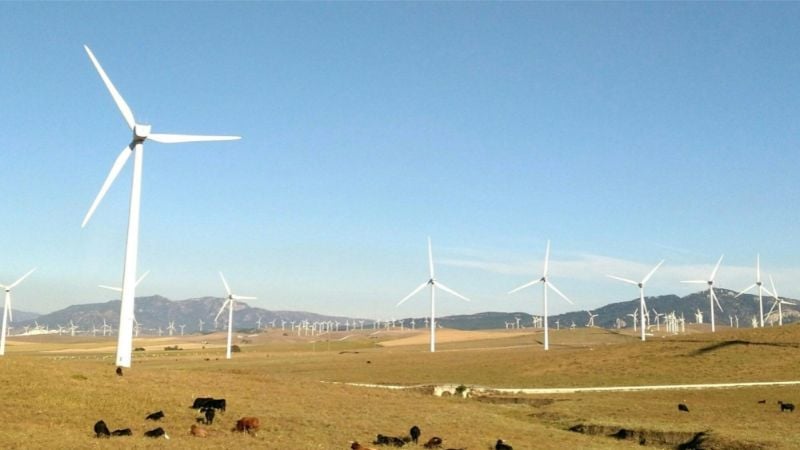
Wind farm in Spain. Image used courtesy of Unsplash
Developing a Framework for Time-Series Data
Power engineers usually analyze time-series data to identify unusual turbine behavior at wind farms, which organizes the events in the order they happen. This approach allows them to see when an anomaly first occurred and how often it repeated.
The MIT team created a framework called SigLLM, which converts time-series data into a format large language models can process. After feeding information into the framework to prepare it, users can ask the large language models to begin identifying anomalies or make forecasts for future data points.
Experiments showed the best deep-learning models still outperformed this approach. However, a big advantage is that the large language models were pre-trained, allowing people to deploy them immediately. That should appeal to engineers with little or no experience applying artificial intelligence to their work.
Another promising factor is that LLMs are still in the early stages of real-world use, and people are continually studying how to improve their performance. This method makes meaningful progress that could expand potential monitoring possibilities, including those related to satellites or heavy machinery. Moreover, the data could reveal predictive trends rather than merely alerting engineers to problems after they occur.
Other efforts to reduce time-consuming manual work with AI have produced similarly intriguing results. In one example, the U.S. Environmental Protection Agency achieved a 600% improvement in water pollution violation detection with machine learning algorithms.
Creating Two Anomaly Detection Methods
The MIT group determined that large language models work particularly well for time-series data because they are autoregressive. In other words, they recognize that the newest data in the sequence depends on previous information.
The research team also wanted to develop large language models to function well without fine-tuning, making them more practical for everyday use. Their first anomaly-detection method involved feeding data into the model and prompting it to find information that deviated from the norm.
_and_then_used_the_model_to_compare_the_generated_signal_to_previous_behavior_(bottom)._The_LLM_compared_the_expected_and_actual_signals_to_identify_the_anomaly_.jpg)
The team trained the LLM on data (top) and then used the model to compare the generated signal to previous behavior (bottom). The LLM compared the expected and actual signals to identify the anomaly. Image used courtesy of Alnegheimish et al.
The other approach turned the large language model into a forecaster when users prompted it to predict the next time-series value. Once it generated one, the researchers compared it to the actual data point. Outcomes showed the second detection method was more accurate than the first, which generated numerous false positives.
The researchers also evaluated how the LLMs compared to transformer-based models. Those results showed the large language models performed better on seven of the 11 data groups despite no fine-tuning or training. Additionally, future LLM developments may equip them to provide easy-to-understand explanations of identified problems, allowing engineers or other staff members to learn what is unusual about a particular flagged data point.
Exploring Other Progress in AI Anomaly Detection
Numerous other groups are also investigating AI anomaly detection for wind turbines. Since these assets are so massive and often found in the dozens at wind farms, manually checking for performance problems is prohibitively inefficient.
Annea, a German startup, has an AI solution that may increase turbines’ average yearly electricity by up to 15% via detecting component wear earlier to prevent downtime. The technology uses machine learning and physical models to create digital twins of wind turbines, predicting their operational health and performance up to a year in advance.
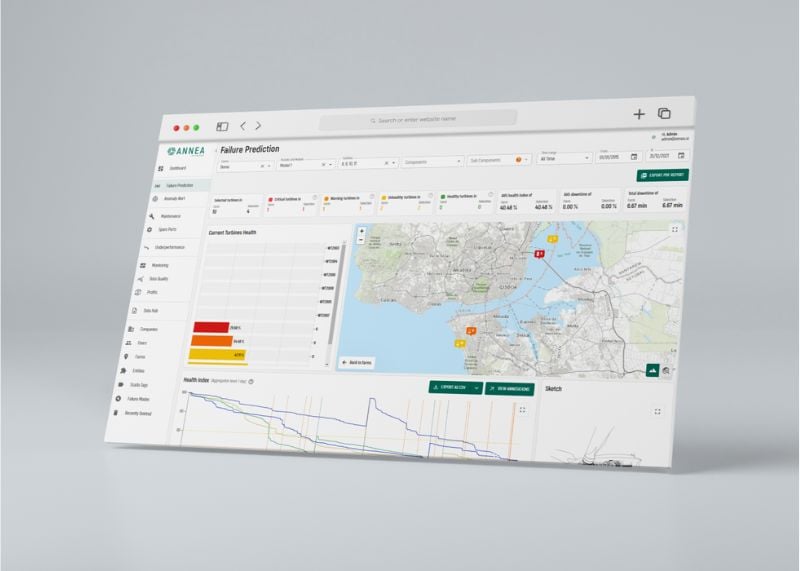
Predictive maintenance platforming using AI. Image used courtesy of Annea
It can also automate the data collection used for predictive maintenance, eliminating the need for manual processing. Company officials also say they could apply the technology to solar panels or hydropower equipment.
Elsewhere, an international collaboration between the University of Glasgow and EPFL in Switzerland combined patented radar technology with an AI assistant. This method can detect hidden defects beneath a turbine’s surface, potentially making it a valuable addition to manufacturers’ quality control processes. Additionally, it can find issues while being up to 15 centimeters away from the turbine, making it a no-contact, nondestructive method.
Renewable Energy Fault-Detection Progress
These turbine-monitoring examples could improve engineers’ workflows and help them find issues sooner. Even the solutions not yet commercialized will undoubtedly increase learning and development in this area.