Facebook
 Google
 GitHub
 Linkedin
How Can Smart EV Charging Manage Grid Load?
With EV adoption rising, utilities must decide between infrastructure upgrades or smart charge management to ease grid stress.
Inconsistent electric vehicle adoption, interoperability issues, and site-level constraints remain critical limitations to scaling up smart charge technology for EVs, according to an analysis by the Lawrence Berkeley National Laboratory (LBNL) and the National Renewable Energy Laboratory (NREL). Many of the nation’s 3,700-plus utilities are hesitant to take risks on unstandardized technology, especially in states with fewer EVs and uncertainty about future sales.
Smart charging regulates electricity flow and costs, allowing utilities to leverage newly connected charging infrastructure to balance loads. Today, most states have at least one such program, but activity is sparse in rural areas and states with low EV uptake. Although the market is relatively nascent, early adopters could spearhead national standards as utilities embrace strategies to accommodate surging EV charging demand.
NREL and LBNL surveyed the state of managed charging across the U.S., reviewing 110 state and local programs. Researchers also interviewed 17 utilities to gauge their confidence levels and technical priorities, including large electricity service providers like Dominion, National Grid, Pacific Gas and Electric, and Xcel Energy, alongside government agencies, third-party aggregators, and EV manufacturers like Tesla, Ford, GM, and BMW.
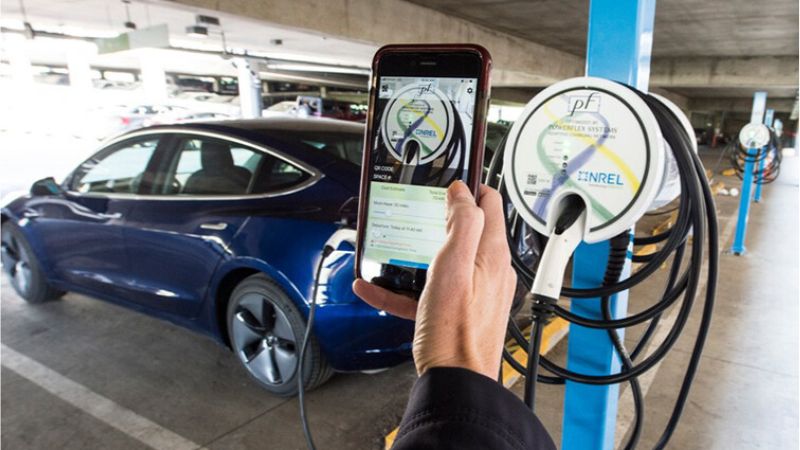
NREL’s smart charging app. Image used courtesy of NREL/by Dennis Schroeder
What Is Smart Charge Management?
Smart charge management facilitates communication between EVs, charging stations, and the local grid. Smart chargers use WiFi or cellular networks to exchange data on charging speed, time, and output between the vehicle’s battery and EV supply equipment (EVSE) connectors. Site owners can prioritize their energy capacity and schedule loads when grid demand is low, avoiding surge pricing.
By selectively distributing capacity across units, charging stations can optimize real-time charging more efficiently, ensuring that simultaneous connections don’t place undue stress on the grid. Likewise, utilities can defer expensive feeder and substation upgrades that would otherwise be required to counter demand from drivers recharging during peak hours before and after work.
NREL and LBNL reviewed over 100 smart charge management programs nationwide. Many use third-party aggregators to collect inputs and set charging limits, while others are coordinated directly by utilities, charging service providers, or EV manufacturers’ cloud software. Many programs are centralized in California—where EV adoption is highest—often involving tens to hundreds of participating EVs and EVSEs, with some venturing into the thousands. According to the Alternative Fuels Data Center, California’s EVs claimed a 3.4% market share of light-duty vehicle registrations last year, nearly triple the national rate (1.2%).
These programs could be the blueprint for standardized models to reduce costs for all parties in the transaction, from EV owners and charging stations to utilities and third-party aggregators.
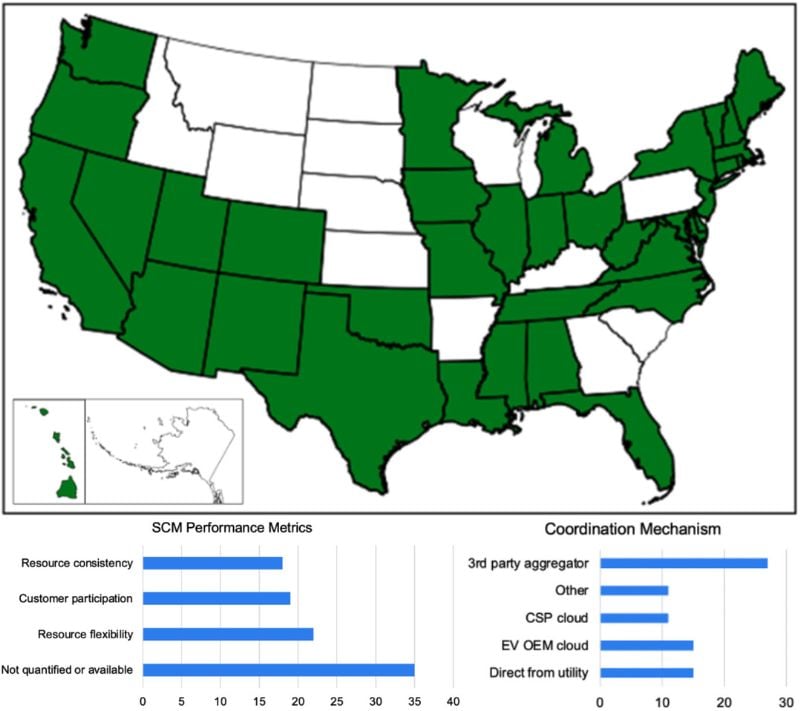
Map of smart charge management programs in the U.S. (top) and their reported characteristics and performance metrics (bottom). Image used courtesy of LBNL (Pages 8, 9, and 10)
Smart Charging Gaps and Solutions
NREL and LBNL flagged several major technical barriers to nationwide smart charge management implementation.
Some EV charging stations have limited capacity, and distribution systems are uncertain about the technology’s ability to maintain loads below those caps. In the meantime, they’re stuck with the less favorable option: increasing transformer capacities through costly substation and feeder upgrades, which delays the interconnection of new charging stations.
The researchers highlighted a solution in dedicated depot platforms for capacity-constrained locations. LBNL and NREL recommended programs validating local distribution system capacity management, particularly for medium-duty and heavy-duty EV fleets in constrained distribution systems with little headspace to expand loads. Future demonstrations could help distribution systems avoid replacing substation transformers, reconductoring primary lines, or upgrading voltage control devices.
Field demonstrations could also explore variable or dynamic site capacity in distribution systems with little flexibility between max-rated levels and existing loading. This could help charging sites operate units at less than full capacity while the load-serving entity boosts the upstream power supply.

A workplace charge management system distributes loads away from mid-day hours when solar energy is available. In the afternoon, loads ramp up as the solar peak fades. Image used courtesy of the Department of Energy
Once distribution capacity constraints are met, smart charge management could offer voltage regulation services. NREL and LBNL found a few small-scale deployments using volt/watt control, where the power EVs draw can be configured to support local distribution voltage.
Bulk system integration gaps are another critical charge management priority. Most existing programs were designed to accommodate bulk load profiles through time of use (TOU) block rates. Although this model has been effective for today’s incremental EV sales, widespread adoption must incorporate dynamic pricing or direct controls.
With smart charging integration, site-level load management could be scalable for other load types, such as industrial equipment, HVAC systems, or home appliances—opening opportunities at previously capacity-constrained locations. It could also lower costs by reducing EV charging according to other on-site peak loads, reducing the need to up-size breaker panels. The report suggested demonstrating end-to-end integration in places like university campuses with multiple distributed energy resources and load controls.
Standardization and Interoperability
NREL and LNBL cited standardization as a common theme in stakeholder interviews. Many products (especially home chargers) have unique interfaces, control capabilities, and data collection, making a standard control model complex. Likewise, while several EVs have charge controls, these capabilities are not standardized. EV manufacturers are out of the loop on how to integrate smart charge management features with no certification requirements.
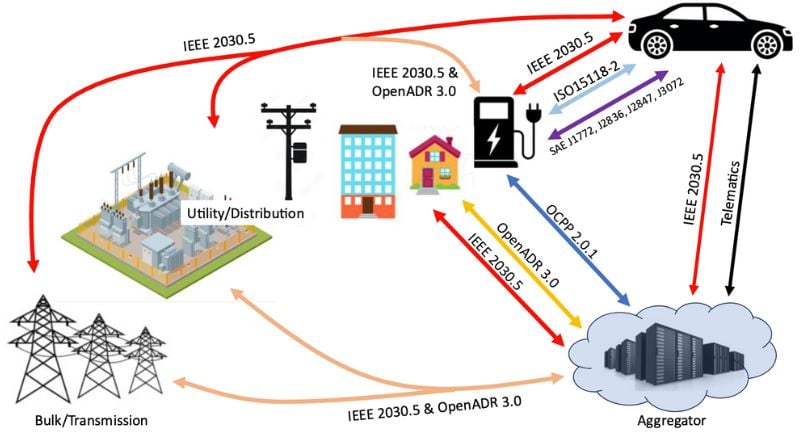
Many communication protocols coordinate connections between EVs, charging stations, load aggregators, buildings, and distribution and bulk power transmission systems. Image used courtesy of LBNL (Page 27, Figure 8)
Interoperability between EVs and charging stations is another area lacking functional testing and certification procedures for end-to-end smart charge management capabilities. There is no universal vehicle-grid integration standard for bidirectional communication, which governs the electricity flow between charging stations, EV batteries, and the grid.
Interview participants emphasized the need for consistent adoption guidance in standardized bidirectional communication protocols between EVs, EVSEs, and utilities. They cited the open charge point interface (OCPI) protocol as one opportunity to build consensus around implementation approaches. OCPI distributes power based on stations’ capacity limits and enables charging schedules and profiles. For instance, a fleet of five Level 2 chargers with 7 kW of maximum power per unit would ordinarily be bound to 35 kW of consumption. OCPI can set limits to 6 kW each when capacity falls below this level.