Facebook
 Google
 GitHub
 Linkedin
Tennessee Plans Fusion Power for Closed Coal Plant Site
The Tennessee Valley Authority and Type One Energy are working to install a nuclear fusion power plant by the mid-2030s.
Type One Energy has signed a letter of intent (LOI) with the Tennessee Valley Authority to deploy a nuclear fusion plant at a retired coal-fired power plant site.
Type One plans to develop a 350 MW baseload plant using its Infinity Two stellarator fusion technology at the TVA’s Bull Run Fossil Plant near Oak Ridge. Infinity Two and nuclear fusion are still in development phases, but the target date for project completion is the mid-2030s.
The agreement also covers future use of the facility for maintenance training for the Infinity Two.
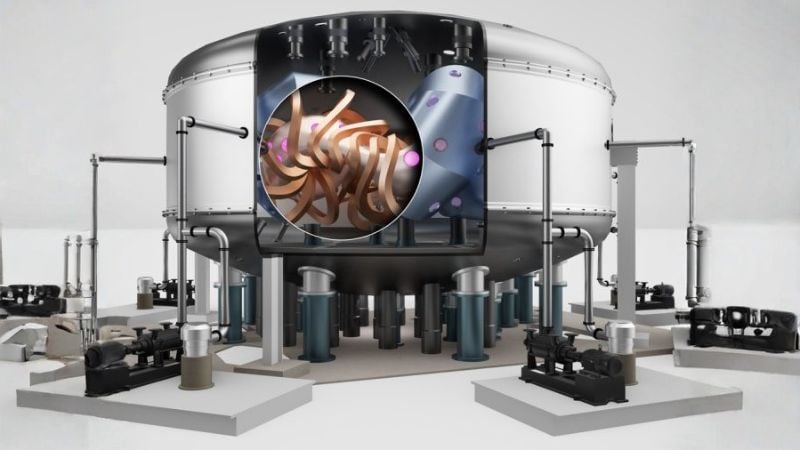
Concept of Type One Energy’s stellarator technology. Image used courtesy of Type One Energy
Nuclear Fusion in Tennessee
Nuclear fusion is the opposite of nuclear fission. Instead of splitting atoms, as fission does, fusion combines two atoms to form a single atom. The combined atom has less mass than the two individual atoms and releases considerable energy during the fusion process. This energy can be harnessed to produce electricity.
In February 2024, TVA and Type One Energy created joint plans for a fusion plant project in the Tennessee region using Type One’s technology. This was called Project Infinity, and the Infinity Two LOI builds on this agreement through power plant siting studies, environmental reviews, licensing, the development of project plans, and financing from various sources. In May 2025, the Infinity Two completed its first formal design review.
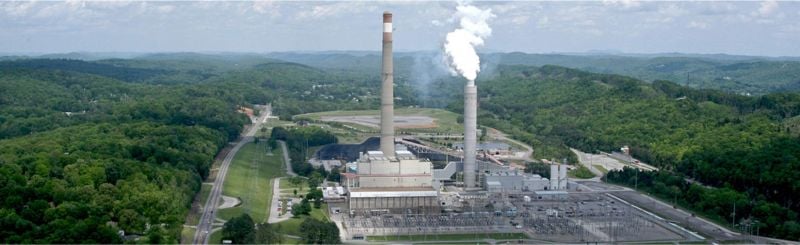
The former Bull Run Fossil Plant. Image used courtesy of TVA
The Bull Run Fossil Plant, located on 750 acres, was an 889 MW coal-fired steam plant. TVA retired it in December 2023. After decommissioning it, the TVA demolished the primary smokestack and scrubber stack.
Type One’s Stellarator Fusion Technology
Fusion involves two methods: the tokamak and the stellarator.
Tokamak is the most common fusion approach and confines the plasma generated during fusion using magnetic field coils in a donut shape called a torus. A set of coils induces an intense toroidal field to direct the torus’ longitudinal field, while a central solenoid magnet—a magnet that carries a current— acts as a transformer and creates a second magnetic field in the poloidal direction. This process confines the plasma around the short side of the torus.
Another set of coils creates an outer poloidal field that shapes and positions the plasma, keeping the plasma within the “donut” and forming the curved outer edges of the donut plasma shape. The multiple magnetic fields interact to create a twisted magnetic field that confines the particles within the plasma.
Type One Energy is among a few companies using the less-common stellarator approach. Stellarator technology is more complex to design and build, but has simpler operations than tokamak technology. Advances in supercomputers, artificial intelligence, and high-temperature superconducting (HTS) magnets have made it cheaper and easier to build stellarator technology designs—and that’s what One Type Energy is doing.
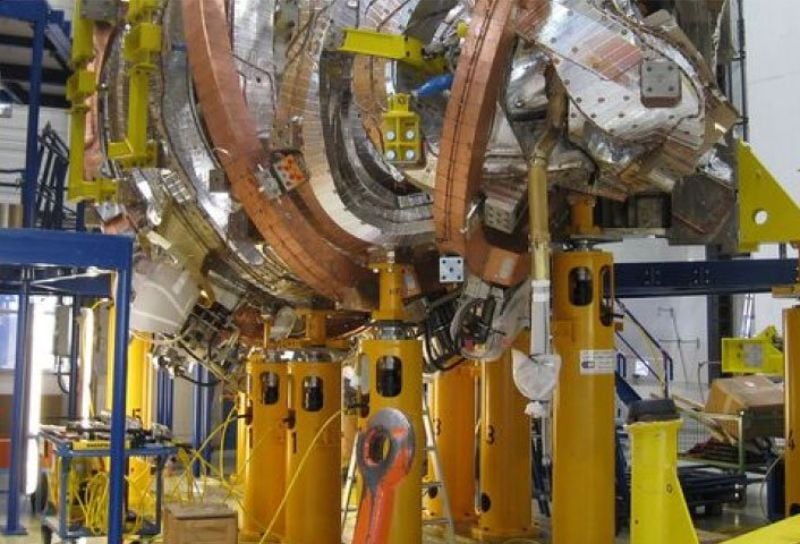
Stellarator equipment. Image used courtesy of Type One Energy
Instead of using multiple magnetic fields to confine the plasma, stellarators use strong external electromagnets to generate a twisting magnetic field that wraps the long way around the torus shape, without needing a transformer in the center of the torus. This way, the plasma is still confined in a helical shape, but it is a much simpler operation. It also allows a higher degree of control because it is a single 3D magnetic field, not multiple magnetic fields interacting with each other.
However, the operation requires magnets that can tailor a 3D magnetic field with the right shape to achieve a level of quasi-symmetry. Stellarators have been hard to design in the past due to the number of calculations required, but once in operation, they are much simpler to operate and have several benefits over tokamak fusion. They can include:
- Higher plasma stability
- Less injected power to sustain the plasma
- More design flexibility
- Better plasma control
- Less chance of plasma disruption
Another advantage is safety. Fusion will cease within a few seconds if the power plant is damaged.
Since the stellarator doesn’t need a transformer, it can operate continuously without needing a strong internal plasma current. However, tokamaks are better at keeping plasmas hot compared to stellarators.
Type One Energy uses a stellarator design combining HTS magnets, advanced manufacturing, and an optimized magnetic field to ensure plasma stability.
TVA’s Nuclear Future
The Bull Run site is located about 10 miles away from the Oak Ridge National Laboratory (ORNL), which has a Fusion Energy Division. TVA has worked with ORNL on fusion and other nuclear energy projects.
TVA is also exploring plans to build a small modular reactor plant at its 1,200-acre Clinch River site. The utility is coordinating with the Nuclear Regulatory Commission for permits to use GE Hitachi/Vernova BWRX-300 SMRs. It is expected to be operational in 2032.