Facebook
 Google
 GitHub
 Linkedin
GaN Motor Drive Evaluation Boards: EPC9186HC2/HC3 and EPC91202
Engineers need practical tools for evaluating GaN motor inverter architectures. The boards described in this article, EPC9186HC2/HC3 and EPC91202, integrate the power stage, sensing circuitry, and protection functions, which means that these platforms help engineers to prototype and assess GaN-based motor drive solutions under realistic operating conditions.
Article is co-authored by Maurizio Di Paolo Emilio, Director of Global Marketing Communications at EPC.
This article is published by EEPower as part of an exclusive digital content partnership with Bodo’s Power Systems.
Gallium nitride (GaN) power devices are enabling a new generation of high-efficiency, high-power-density motor drive systems. Compared with conventional silicon MOSFETs, GaN transistors offer significantly lower gate charge, reduced output capacitance, and very low on-resistance, allowing power converters to operate at much higher switching speeds. As a result, motor inverters based on GaN technology can achieve switching frequencies well above 100 kHz while reducing both conduction and switching losses. These characteristics enable smaller passive components, improved efficiency, and more compact system designs.
In addition to improving efficiency, the fast switching speed of GaN devices enables higher-bandwidth motor control and better dynamic performance. But the rapid changes in voltage that occur when GaN switches on and off pose new design challenges. High dv/dt switching edges can affect measurement circuits, control electronics, and electromagnetic behavior. This means that system-level design and layout must be done very carefully [1].
In practical motor drive systems, engineers must evaluate current-sensing accuracy, protection response time, control-loop stability, electromagnetic behavior, and thermal performance under realistic operating conditions. These aspects are essential for ensuring reliable operation when adopting GaN technology in motor inverter applications.
To support this development process, dedicated evaluation platforms are often used. In this work, two evaluation boards based on 100 V 750 μΩ EPC2361, developed by Efficient Power Conversion (EPC) for three-phase motor inverter applications, are considered: the EPC91202 and the EPC9186HC2/HC3. The EPC91202 platform enables evaluation of the EPC2361 in a relatively straightforward inverter configuration, making it suitable for analyzing the device›s intrinsic switching and conduction performance. In contrast, the EPC9186HCx platform serves as a reference design that enables the paralleling of multiple devices per switch position, allowing the investigation of higher current operation and the design considerations associated with device paralleling in GaN-based motor drive architectures.
GaN Motor Drive Evaluation Platforms
Wide bandgap devices, such as GaN transistors, significantly influence the behavior of modern motor inverter systems. Thanks to their high electron mobility and low parasitic capacitance, GaN FETs enable faster switching transitions than conventional silicon MOSFETs. These characteristics allow motor inverters to operate at higher switching frequencies while maintaining high efficiency.
The switching power loss of a device can be approximated by
Psw ≈ 0.5 · VDS · ID · (tr + tf ) · fsw
where VDS is the device voltage, ID is the current, tr and tf are the voltage rise and fall times, and fsw is the switching frequency.
Because GaN devices significantly reduce tr and tf, switching losses remain manageable even as switching frequency increases. This enables operation in the 100–150 kHz range for motor drives, reducing current ripple, shrinking passive component sizes, and enabling faster control loops.
Evaluation platforms such as the EPC9186 and EPC91202 boards provide useful reference implementations of GaN-based three-phase motor inverter systems. Both platforms integrate the key elements of a complete inverter stage, including gate drivers, sensing circuits, and protection features, enabling investigation of GaN device behavior under realistic motor-drive operating conditions. While both boards implement a full three-phase inverter topology, they target different operating regimes in terms of current capability and switching frequency, making them suitable for exploring different design approaches in GaN-based motor drive architectures.
EPC9186HC2/HC3 High‑Current Evaluation Platform
The EPC9186HC2/HC3 is a three-phase BLDC inverter evaluation board designed to demonstrate the performance of 100-V enhancement-mode GaN (eGaN) FETs for motor-drive applications. The board integrates the complete power stage required for a three-phase inverter and enables rapid evaluation of GaN devices in motor control systems.
The inverter stage is implemented using EPC2361 eGaN FETs, arranged in a three-phase bridge configuration. Multiple devices are paralleled at each switch position to support high current capability while maintaining a very low effective on-resistance. The board includes the key functional blocks required for motor inverter evaluation: integrated gate drivers, phase current sensing, voltage monitoring, housekeeping, power supplies, and protection circuitry.
These functions allow the EPC9186HC2/HC3 platform to operate as a standalone inverter stage when connected to an external controller. Phase current sensing enables the implementation of advanced control techniques such as field-oriented control (FOC). Because of its high current capability and integrated sensing features, the EPC9186HC2/HC3 board provides a platform for evaluating GaN-based motor drive architectures, including efficiency, current measurement behavior, and protection response [3].
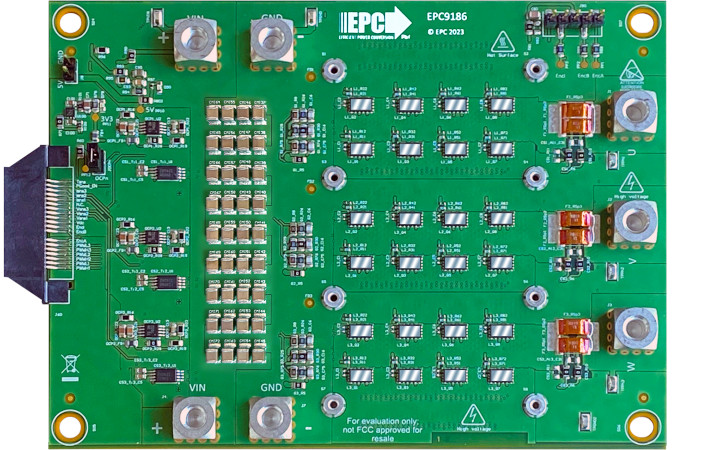
Figure 1. EPC9186HC2/HC3 evaluation board. Image used courtesy of Bodo’s Power Systems [PDF]
EPC91202 High‑Frequency Optimization Platform
The EPC91202 evaluation board is a three-phase motor drive inverter designed for applications requiring high switching frequency and high power density. The board demonstrates the capabilities of EPC eGaN FET technology in motor drive systems operating from low-voltage DC bus supplies.
The power stage is implemented using EPC2361 eGaN FETs, configured in a three-phase bridge topology. The design supports DC bus voltages up to approximately 76 V and output currents up to approximately 50 ARMS, depending on cooling conditions.
The EPC91202 integrates several key subsystems required for motor drive evaluation:
- gate driver circuitry for the GaN power devices
- current sensing for phase current measurement
- voltage monitoring and fault detection
- housekeeping power supplies
The board is intended to operate with an external motor controller, enabling rapid prototyping of GaN-based motor drive systems. The high switching speed achievable with the GaN devices allows operation at switching frequencies significantly higher than those typically used in silicon-based motor drives.
As a result, the EPC91202 platform provides a useful tool for evaluating high-frequency motor inverter operation and investigating the system-level behavior of GaN-based motor drive architectures [4].
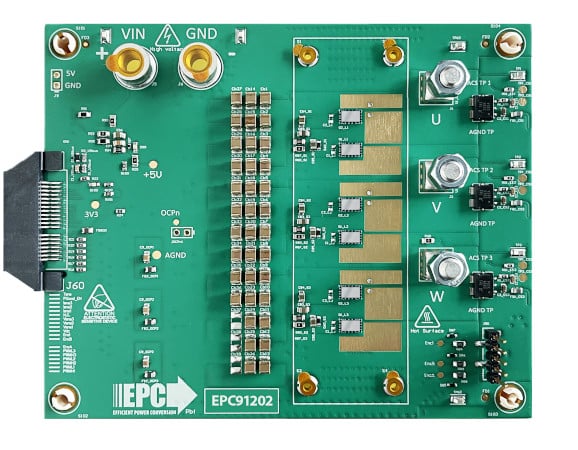
Figure 2. EPC91202 evaluation board. Image used courtesy of Bodo’s Power Systems [PDF]
Current Measurement and Protection Strategy
Accurate current measurement is essential for implementing modern motor control algorithms, particularly in field-oriented control (FOC)- based systems. Reliable phase current information is required to regulate torque production, maintain control loop stability, and detect abnormal operating conditions.
Both evaluation platforms have built-in current-sensing circuitry, which lets you monitor the inverter phase currents. You can connect these measurements to an external motor controller to use closed-loop control algorithms. The sensing circuitry is designed to have sufficient bandwidth and accuracy to handle switching frequencies much higher than those used in standard silicon-based motor drives.
Both reference designs include protection systems to keep the power stage safe. When there is a fault, the inverter stage needs fast protection systems that can detect abnormal current levels and shut down the power stage when needed. The protection functions include overcurrent detection, which ensures that the inverter can be safely tested during development and system integration.
Table 1. Comparison of the EPC9186HC2/HC3 and EPC91202 GaN motor inverter evaluation boards.
|
Feature |
EPC9186HC2/HC3 |
EPC91202 |
|
Application focus |
High-current motor drive evaluation |
High-frequency motor drive evaluation |
|
GaN device |
EPC2361 eGaN FET [5] |
|
|
Topology |
Three-phase inverter |
|
|
DC bus voltage |
Up to ~ 76 V |
|
|
Output current capability |
up to 150 ARMS (multiple GaN devices in parallel) |
Up to ~50 ARMS |
|
Switching frequency capability |
Up to 100 kHz |
Up to ~150 kHz |
|
Integrated functions |
Gate drivers, current monitoring, sensing, voltage protection |
|
|
Target applications |
Robotics, high-current motor drives, industrial actuators |
Compact high- frequency motor drives, battery-powered systems |
Thermal Performance
Thermal management plays a critical role in high-performance motor inverter designs, particularly when exploiting the high switching speeds enabled by GaN devices. Although GaN transistors typically exhibit lower switching losses compared with silicon MOSFETs, the high power density achievable with these devices requires careful thermal evaluation at the system level.
The thermal performance of the EPC9186HC2/HC3 motor drive inverter platform has been characterized under realistic motor drive operating conditions. Measurements were performed on a motor bench using a 48 V DC bus, with PWM switching frequencies of 20 kHz, 50 kHz, and 100 kHz, and a dead time of 75 ns. The tests were conducted at an ambient temperature of 25.5 °C, with both natural convection and forced-air cooling.
Under natural convection conditions, the EPC9186HC2/HC3 board can deliver approximately 40 ARMS per phase without a heatsink, while 70 ARMS per phase can be achieved with a heatsink, with a temperature rise from the eGaN FET case to ambient below 50 °C. When forced airflow of approximately 400 LFM (Linear Feet per Minute) is applied, the board can deliver currents up to 150 ARMS per phase under steady-state conditions.
The measured temperature rise of the GaN devices as a function of switching frequency and cooling configuration is illustrated in Figures 3 and 4, based on thermal characterization results for the EPC9186HC2/HC3 evaluation board.
A similar thermal characterization is reported for the EPC91202 three-phase inverter evaluation platform, as illustrated in Figure 5. The thermal performance summary of the EPC91202 board shows that, when operated on a motor bench at an ambient temperature of 24 °C, with a 48 V DC supply, 100 kHz PWM switching frequency, and natural convection cooling, the inverter can deliver approximately 25 ARMS per phase without a heatsink and up to 32.5 ARMS per phase with a natural-convection heatsink attached, while maintaining a temperature rise below 50 °C from the eGaN FET case to ambient. The temperature measurements were recorded under steady-state conditions.
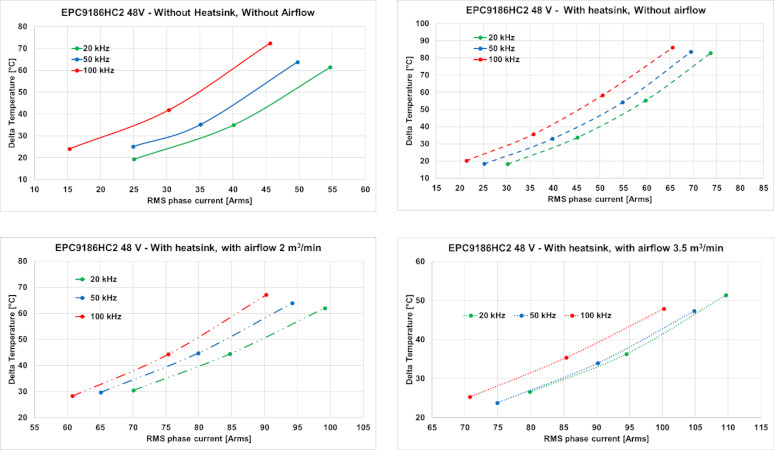
Figure 3. Temperature profile of the EPC9186HC2 under different conditions. Image used courtesy of Bodo’s Power Systems [PDF]
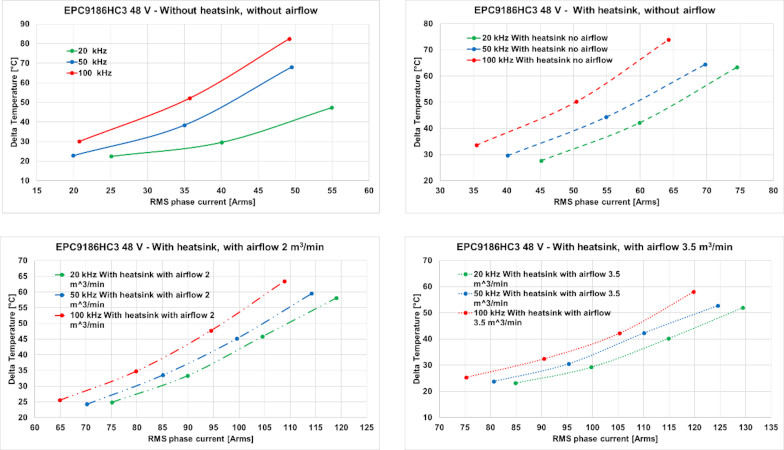
Figure 4. Temperature profile of the EPC9186HC3 under different conditions. Image used courtesy of Bodo’s Power Systems [PDF]
Conclusion
GaN power devices enable significant improvements in switching speed, efficiency, and power density compared with conventional silicon-based solutions. These characteristics make GaN technology particularly attractive for modern motor drive systems, including robotics, industrial automation, and battery-powered applications.
The EPC9186HC2/HC3 and EPC91202 boards provide practical tools for evaluating GaN motor inverter architectures. By integrating the power stage, sensing circuitry, and protection functions, these platforms allow engineers to rapidly prototype and assess GaN-based motor drive solutions under realistic operating conditions.
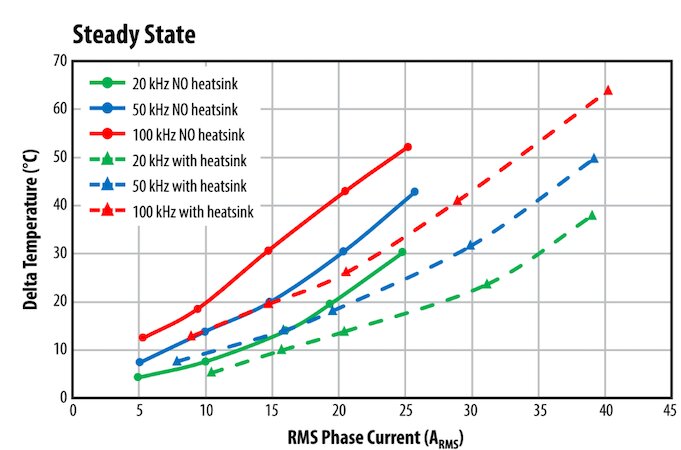
Figure 5. EPC91202 GaN FET temperature rise versus ambient temperature under steady-state conditions at different PWM switching frequencies. Image used courtesy of Bodo’s Power Systems [PDF]
Reference
[1] GaN Power Devices for Efficient Power Conversion, Fourth Edition – by Alex Lidow, Michael de Rooij, John Glaser, Alejandro Pozo Arribas, Shengke Zhang, Marco Palma, David Reusch, Johan Strydom.
[2] IEEE, Impacts of High Frequency, High dv/dt Environment on Sensing Quality of GaN-Based Converters.
[3] Efficient Power Conversion (EPC), EPC9186HC2/HC3 – Three-Phase BLDC Motor Drive Inverter Evaluation Board – Quick Start Guide, EPC, El Segundo, CA, USA.
[4] Efficient Power Conversion (EPC), EPC91202 – Three-Phase BLDC Motor Drive Inverter Evaluation Board – Quick Start Guide, EPC, El Segundo, CA, USA.
[5] Efficient Power Conversion (EPC), EPC2361 – 100 V 750 μΩ e-mode GaNFET – Data Sheet, EPC, El Segundo, CA, USA.
This article originally appeared in Bodo’s Power Systems [PDF] magazine and is co-authored by Marco Palma, Director, Motor Drives Systems and Applications, and Maurizio Di Paolo Emilio, Marcom Director, Efficient Power Conversion (EPC)