 Facebook
 Google
 GitHub
 Linkedin
Briefs: Companies Go Big on Power Infrastructure Upgrades
Several major tech companies, including LS Electric, Voltus, Navitas, Entergy, and Google, have committed to major improvements in energy infrastructure and contributing technologies.
Increasing grid capacity, upgrading hardware, and building new infrastructure are on the table to meet the growing energy demand from AI data centers and industrial electrification. Tech companies, energy providers, and data center owners are doubling down on ensuring the grid has sufficient resources.
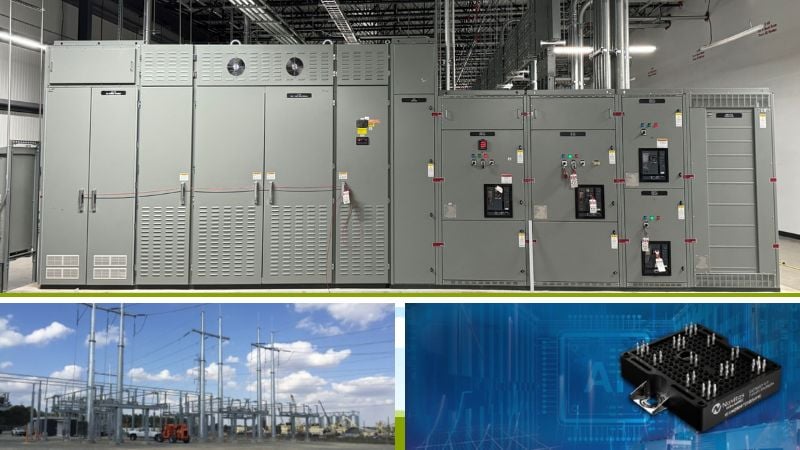
To that end, LS Electric has secured a $170 billion contract to deploy switchgear and other data distribution hardware across North America. Voltus is working with Google to create a virtual power plant in PJM’s region that could add nearly 1 GW of capacity from distributed energy sources. Navitas has introduced an ultra-high-voltage silicon carbide power module for grid systems. Finally, in Arkansas, Entergy and Google have a deal for $600 million in grid upgrades and additions without rate increases.
![]() Grid improvements.
In $170B Contract, LS Electric To Supply Switchgear for AI Data Centers
South Korea-based LS Electric has signed a nearly $170 billion contract with an undisclosed U.S. technology firm to deliver data center distribution hardware, specifically switchgear, across North America. The deal supports the increasing power needs for AI data centers.
LS Electric will supply 38 kV-class high-voltage switchgear to distribute incoming grid power through the facility and shut down damaged circuits during electrical faults. Potential deliveries include low-voltage switchgear, distribution transformers, and gas-insulated ring main units.
The $168.9 billion deal is part of a two-year commitment spanning 2027 through 2028. Shipment volumes for 2028 will depend on follow-up negotiations between both parties.
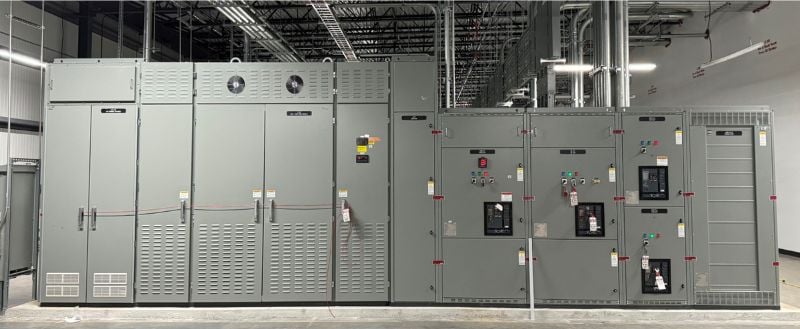
LS Electric switchgear and power distribution equipment. Image used courtesy of LS Electric
Regional demand will rely on the supplier's North American footprint. Operations center on manufacturing and service facilities in Cedar City, Utah, and Bastrop, Texas.
Google Plans 1 GW Virtual Power Plant in PJM’s Service Area
Google is working with energy technology company Voltus to build a 1 GW virtual power plant across 13 states and Washington, D.C., in the PJM grid region. The setup will target peak-hour power strain and lower electric utility bills for local energy users.
The project links distributed energy resources from area businesses and households into one coordinated network. Voltus will bundle flexible equipment like smart thermostats, battery systems, and industrial loads. Google plans to use the portfolio to supply flexible energy capacity across regional power markets.
Connected sites dial back electricity consumption when regional power demand reaches high thresholds. The added grid capacity stabilizes electricity flow. The completed network supports an electric transmission territory serving 67 million residents.
Virtual power plant explained. Video used courtesy of Voltus
The expanded contract scales up an initial 100 MW pilot signed earlier this year. This ten-fold expansion marks one of the largest customer-sited virtual plants funded by a major cloud operator.
Navitas Releases Ultra-High-Voltage SiC Power Modules
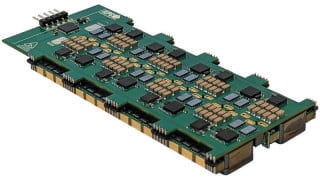
Navitas Semiconductor has launched an ultra-high-voltage silicon carbide power module lineup designed to boost efficiency and power density across grid-scale energy systems and solid-state transformers. The components enable direct translation of grid voltage into direct-current bus levels for AI data center racks, energy storage sites, and megawatt electric vehicle chargers.
The G4H08MT23GB4 full-bridge family offers a 2,300 V rating and an 8 mω on-state resistance in a SiCPAK package. Fourth-generation GeneSiC Trench-Assisted Planar technology drives the internal semiconductor architecture.

SiC power module. Image used courtesy of Navitas
An aluminum nitride active-metal-braze baseplate delivers thermal dispersion with electrical isolation exceeding 5 kV. Epoxy-resin potting limits strain and environmental ingress while offering a tenfold boost in thermal conductivity over silicone gel.
High-current press-fit pins supply double the ampacity per terminal compared to standard options. Navitas also offers an optional pre-applied thermal interface material to streamline heatsink mounting.
The devices meet AEC-Plus qualification standards with extended dynamic gate switching, dynamic reverse bias, and triple the normal duration for static high-voltage burn-in. Engineering samples and double-pulse evaluation systems are available now.
Entergy Expands Deal with Google for Infrastructure in West Memphis
Entergy Arkansas and Google expanded their utility pact to support a West Memphis data center campus. The arrangement brings at least $500 million in customer rate cuts over 20 years and upgrades grid reliability with no added charges for current rate payers.
Google will cover the full capital and operating costs for new power-generation and transmission assets under a direct supply contract. The bilateral terms add to initial commitments to fund $2.1 billion in regional utility system expenses.
Upgrades require about $600 million in direct grid additions, along with a power purchase deal. The project adds a 1,000 MWh battery storage system at Driver Solar in Osceola and a 400 MWh battery setup at Jones Mill near Hot Springs.
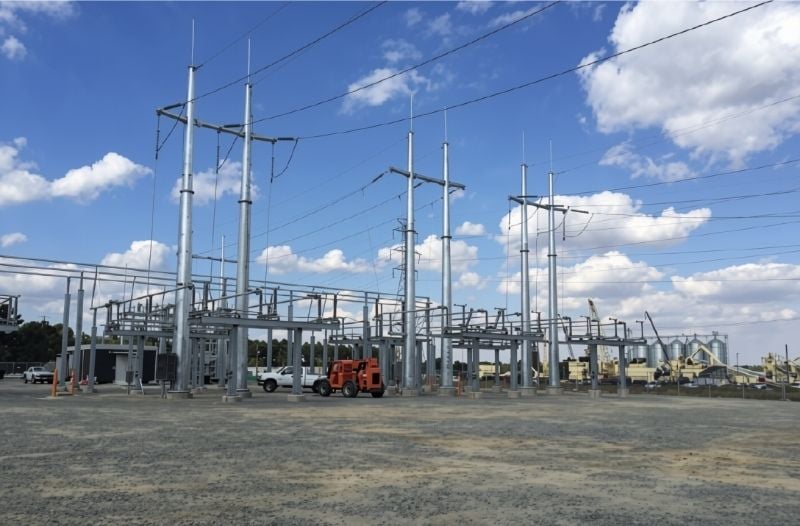
An Entergy substation in Arkansas. Image used courtesy of Entergy
Utility crews will erect two 230 kV transmission lines and expand the Galet substation near West Memphis. Entergy Arkansas also secured a 440 MW alternating-current solar power purchase agreement from the Big Island installation in Mississippi County.
These assets, along with the Arkansas Cypress site, will deliver over 1,000 MW of solar power and 2,800 MWh of dispatchable battery capacity statewide. The utility will submit the expansion plan to the Arkansas Public Service Commission, with commercial operation slated for 2028.