Facebook
 Google
 GitHub
 Linkedin
Making Room for DER: Planning Tool Aids Distribution Planning
Grid distribution systems are updating their planning processes to handle the increasing integration of distributed energy resources.
Distributed energy resource (DER) installations are skyrocketing across the U.S. as consumers and companies adopt electric vehicles, rooftop solar panels, stationary batteries, and other small-scale technologies that interface with power grids at the distribution level.
Given this rapid transformation, transmission and distribution planning must consider integrated scenarios assuming DERs’ widespread use in bulk power systems. Wood Mackenzie estimates 262 GW of DER and demand flexibility capacity will be added by 2027, nearing utility-scale resources (about 270 GW).
California’s Lawrence Berkeley National Laboratory has released an interactive tool to streamline integrated resource planning for power distribution systems. The web-based platform presents flow charts with grid operability considerations and resources covering load forecasting, circuit performance analysis, threat assessments, and other critical procedures. The tool also provides planning models for DER integration.
Distributed energy resources management example. Video used courtesy of Energy Research Institute NTU
DER Integration for Distribution Systems
Electrification and DER adoption vary widely by region, even within states and utility service areas, making grid integration difficult to predict and scale. The large number of DER providers and aggregators adds challenges. Many utilities have limited visibility into behind-the-meter DER behaviors.
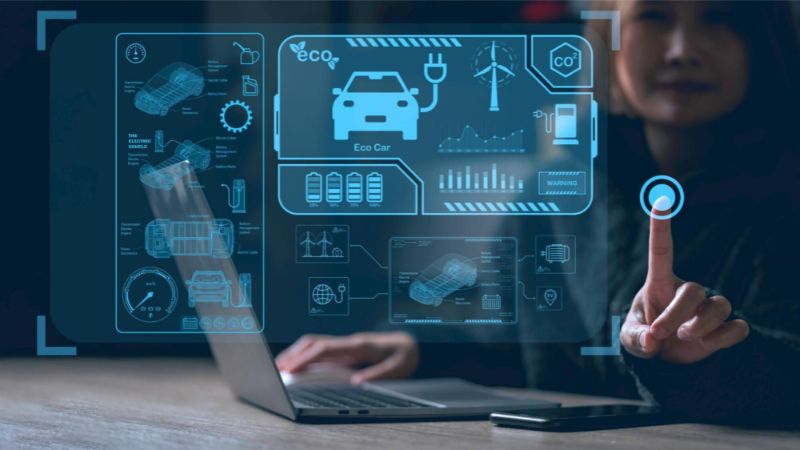
Distributed energy resources. Image used courtesy of Adobe Stock
Still, operators can leverage DERs to boost system performance, efficiency, and reliability. DERs allow utilities to expand capacity while avoiding the costly and time-consuming interconnection process required to install new resources.
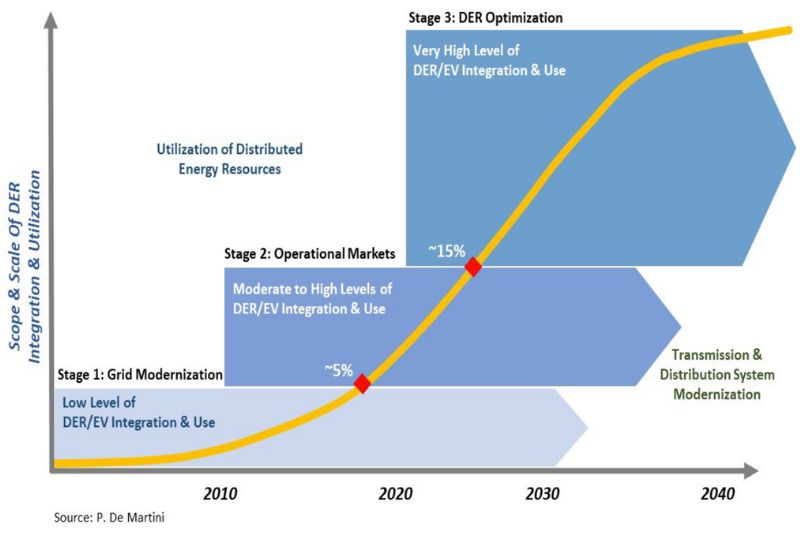
Evolution framework for integrating DERs into U.S. electric distribution systems. Image used courtesy of the DOE (Page 4, Figure 1)
The Department of Energy (DOE) recently modeled a three-stage framework detailing how the U.S. distribution system has adapted to two decades of DER adoption and public policy changes. In the early 2000s, early DERs highlighted the need for grids to replace aging distribution network infrastructure and improve operational efficiency with advanced technologies. In the following years, grid modernization activities saw utilities transition from analog to digital networks with smart devices, enhanced circuit-level monitoring, power system analytics, and automated field switches.
These foundational expansions continued through the 2010s as utilities began to leverage DERs at scale. Customer-sited storage, smart thermostats, vehicle-to-grid chargers, and community solar projects could supply distribution grid services to support responsive demand, ancillary services, and capacity reserves.
The third stage—well underway—assumes large-scale DER adoption with installed nameplate capacities exceeding 15% of distribution systems’ peak levels. Some states, including California and Hawaii, have surpassed these marks amid EV and distributed storage growth. Today, a large collection of DERs are available to form aggregations as virtual power plants, which export energy and manage demand through DERs like community microgrids, rooftop solar panels, EV chargers, energy storage systems, and smart building devices.
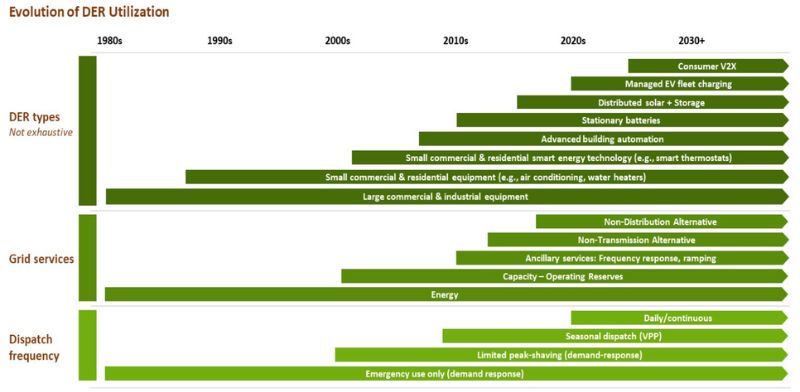
Evolution of flexible load management and other DERs. Image used courtesy of the DOE (Page 14, Figure 5)
The DOE noted that the third stage requires regional grid operators to ensure smooth operations in coordination with Federal Energy Regulatory Commission (FERC) Order 2222, issued in 2020, which allows DERs to participate in electricity markets. The order recognizes that aggregated DERs can be used as an energy supply tool and a flexible alternative to conventional infrastructure expansions. Most regional transmission organizations (RTOs) and independent system operators (ISOs) plan to implement Order 2222 between 2026 and 2030. California ISO and New York ISO are ahead of others, having already launched DER programs recently.
Meanwhile, grids face unmatched charging demand as transportation electrification expands rapidly across the U.S. With about 40 battery-based EV models available nationwide, annual electricity consumption by light-duty EVs has increased nearly five times since 2018. Vehicle-to-grid charging systems may ease flexibility in this transition, but a large-scale expansion in electric loads requires forward-thinking integrated DER strategies.
Integrated Distribution Planning Framework
Lawrence Berkeley Lab’s online tool can help local grids incorporate DERs into their expansion plans. Each category in the decision framework features answers to common questions, utility best practices, state projects and legislation, step-by-step strategies, and regional training resources and presentations.
For example, one subcategory covers distribution system analyses, where local grids can conduct engineering and technical studies to accommodate load growth from DER integration and electrification. This process considers hosting capacity, a factor determining the quantity of DERs that can be interconnected without straining the power quality or reliability under existing control and protection systems. Hosting capacity analysis reveals the technical ease and cost of interconnecting DERs like distributed solar PV systems, which require sufficient hosting capacity at the point of interconnection.
Other categories in the framework cover reliability and resilience analyses. Selecting “current distribution system assessment” reveals an approach to determining asset condition and operational performance based on loading data and substation and feeder performance.
This assessment would also include resilience and reliability analyses focusing on natural disaster mitigation and reducing outage duration and frequency. On the latter point, the tool links to examples of utilities’ threat-based risk assessments for storm and wildfire response.
Utilities can use these results to plan corrective actions. For example, engineers could perform a worst-performing circuits analysis to assemble a list of problematic feeders based on outage data. Several states like New York, Illinois, and Florida require an annual report and remediation plan addressing circuits with frequent power interruption.