Facebook
 Google
 GitHub
 Linkedin
VPT Launches FLX Series Configurable DC-DC Converters
The modular power platform integrates DC-DC conversion and EMI filtering in a single qualified assembly rated from -55°C to 110°C, with no derating, suitable for military and space applications.
VPT, a HEICO company specializing in high-reliability power conversion, has launched the FLX Series, a configurable DC-DC converter platform for military, avionics, and space applications. The series integrates VPT's DC-DC converter modules and EMI filters into a single scalable housing, covering output power from 1 W to 5,000 W across 28 V, 50 V, and 270 V input buses.
The product addresses a long-standing challenge in defense and aerospace power systems: qualifying multiple discrete converter modules for harsh-environment programs is time-consuming and expensive. VPT’s solution consolidates conversion and filtering into a pre-qualified, ruggedized assembly, which VPT states can reduce bill-of-materials complexity and qualification overhead.
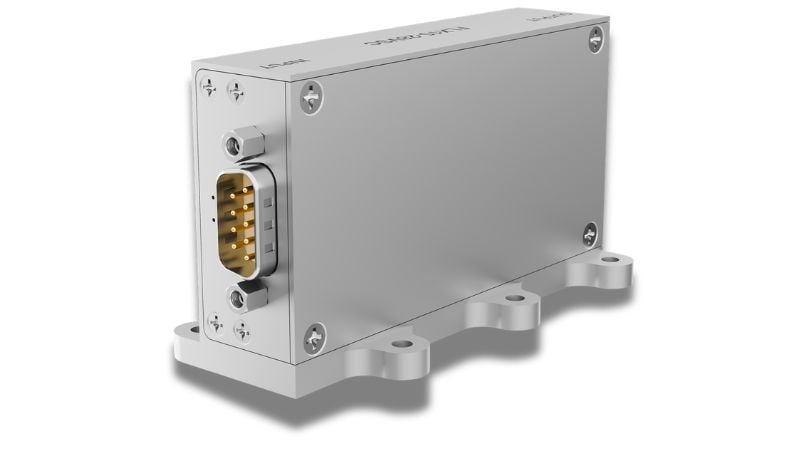
The FLX Series. Image used courtesy of VPT Power
Scalable Architecture
The FLX Series is built on a modular framework that lets engineers configure multiple output voltages and power levels within a single enclosure. Three mechanical arrangements are available: vertical, horizontal, and stacked. Each option accommodates different platform space constraints, from cramped avionics bays to bulkier ground-vehicle installations.
The converters deliver efficiency up to 90% and operate continuously across the full military temperature range of -55°C to 110°C with no power derating required. That temperature specification is particularly notable because many configurable power solutions in this class require derating at the extremes, limiting usable output power during high-altitude cold soaks or desert ground operations.
Standard protection features include current limiting, short-circuit protection, undervoltage lockout, and remote sensing capability. The design supports load sharing across modules and uses fixed-frequency operation with no optocouplers, reducing component count and eliminating a common reliability concern in isolated converter topologies.
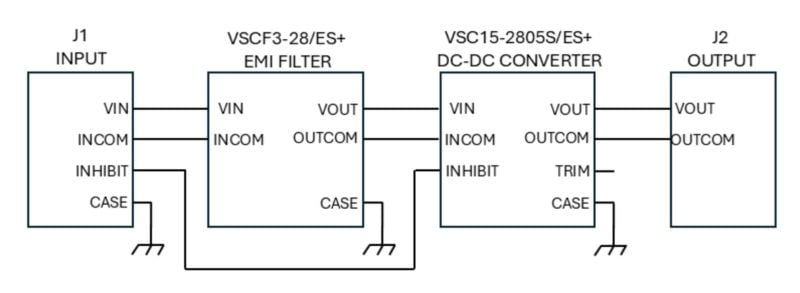
Block diagram example. Image used courtesy of VPT
Integrated EMI filtering supports MIL-STD-461 conducted and radiated emissions requirements and, depending on configuration, the assemblies are also compatible with MIL-STD-704 for aircraft power quality, MIL-STD-1275 for ground vehicle power, and DO-160 for airborne equipment environmental conditions. Manufacturing follows SAE AS9100 quality management standards, J-STD-001 with Space Addendum soldering requirements, and IPC-A-610 workmanship acceptance criteria.
Environmental and Radiation performance
The FLX Series’ mechanical design is rated for high shock and vibration loads consistent with military environmental testing standards. The operating range covers all standard military thermal profiles without requiring supplemental cooling or thermal management beyond the host platform's existing provisions.
For space applications, two radiation performance tiers are available. The radiation-tolerant option is rated to 30 krad(Si) total ionizing dose and withstands single-event effects from particles up to 42 MeV-cm2/mg linear energy transfer. The radiation-hardened variant extends those ratings to 100 krad(Si) and 85 MeV-cm2/mg, supporting longer-duration missions in medium Earth orbit, geostationary orbit, and deep-space trajectories.
The two-tier approach enables program managers to match radiation hardness to the mission environment rather than defaulting to the most expensive option. For example, a low Earth orbit satellite with a three-year design life and modest shielding may need only the radiation-tolerant specification. At the same time, a geostationary communications payload or interplanetary probe would justify the hardened version.
Typical FLX Series applications span the defense and aerospace spectrum, such as avionics power distribution units, shipboard electronics, unmanned aerial vehicle power systems, ground combat vehicle subsystems, and satellite power buses. Broad input-voltage support across 28 V, 50 V, and 270 V buses means a single product line can serve platforms from legacy 28 V military vehicles to 270 V high-voltage DC aircraft architectures. The configurable architecture also fits programs that need to reuse a qualified power platform across multiple variants of the same system, reducing recurring engineering costs.