Facebook
 Google
 GitHub
 Linkedin
Transducer Simplifies Current Sensing for High-Power Systems
Danisense voltage output current sensing transducers facilitate current measurements and assess power quality in renewable energy and e-mobility.
Denmark-based Danisense has released the DS, DM, DL, and DR series of voltage output current sense transducers designed to simplify workflows in data acquisition systems.
The current sense transducers feature integrated burden resistors to eliminate complicated and often error-prone calibration processes between the burden resistor at the transducer output and the measurement system.
The DS, DM, and DL series of current transducers support reliable and accurate measurements of AC and DC currents ranging from 55 A to 3000 A. The transducers are targeted for high-power e-mobility, renewable energy, and similar applications requiring operation in harsh environments and across wide temperature ranges.
For higher power current sensing applications (up to 11 kA), the DR series has an extra-large aperture (up to 150 mm) and is designed for a high level of immunity against external magnetic fields.
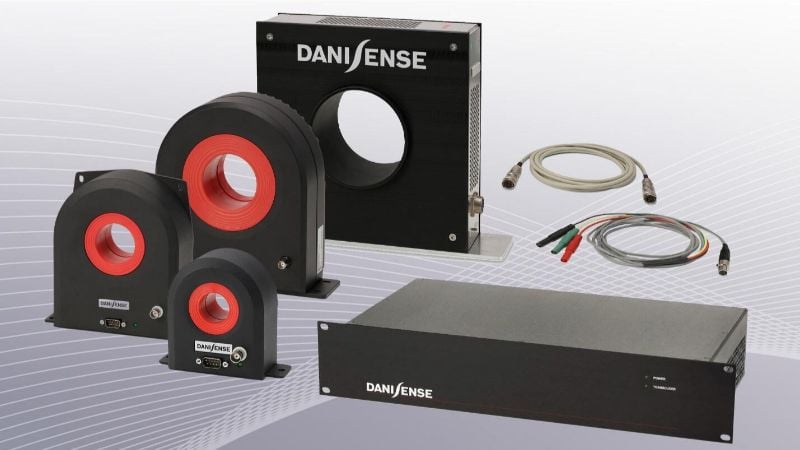
Current sense transducers. Image used courtesy of Danisense
Current Sensing With a Transducer
Measuring current flow directly through a wire or cable can be challenging. Current transducers sense current flows contactless by wrapping around the conductor and generating a magnetically induced current in the transducer’s windings. Current transducers can be designed to measure both AC and DC currents.
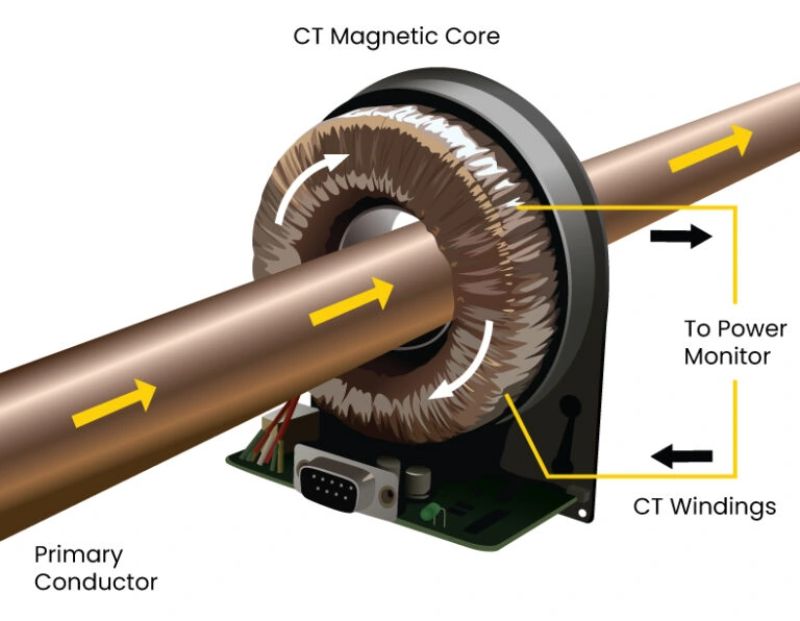
Operation of a current sense transducer. Image used courtesy of Danisense
Voltage Output Module and Integrated Burden Resistor
The DS, DM, and DL series of voltage output current transducers have an integrated voltage output module tuned to provide a highly linear output voltage via a BNC connector proportional to current flow with a full-scale output of either 2 V or 10 V.
For example, the DS200UB-10V outputs a 10 V signal at a full-scale current measurement of 200 A with a specified linearity of +/- 10 ppm.
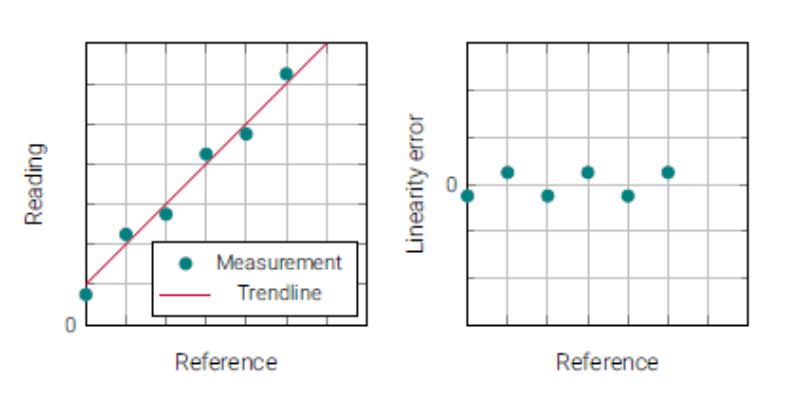
Output linearity error definition. Image used courtesy of Danisense
An integrated voltage output capability eliminates the need for an external burden resistor to convert the transducer’s current output to a measurable and proportional voltage level.
The external burden resistor can introduce errors into the measurement platform due to tolerances, non-linearity, and other factors. Integrating and pre-tuning the burden resistor function can greatly simplify and improve the accuracy of implementing the data acquisition system.
Power Quality for Renewables
With the broader adoption of renewable power sources such as solar, scrutiny over the power quality these energy sources deliver to the grid has increased.
For solar power generation, DC offsets can be injected into the grid due to nominal imperfections in the inverter. The inverter circuit converts DC from the photovoltaic cells to three-phase AC for delivery to the grid.
Unwanted direct currents in power lines can lead to corrosion damage in cables and damage to other equipment and saturate transformer and inductor circuits. It is important to monitor the level of any direct currents introduced into the grid.
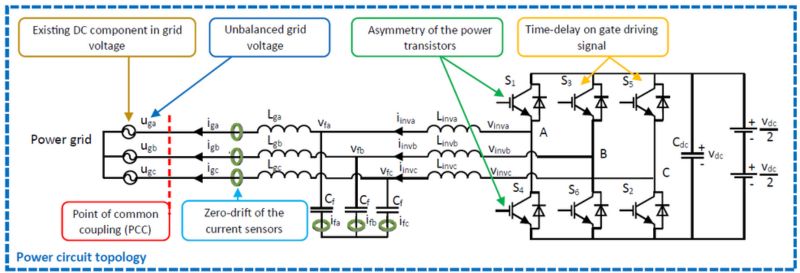
Unwanted DC sources from an inverter circuit. Image used courtesy of Danisense
According to Danisense, the high-precision fluxgate current transducers, used in conjunction with a power quality analyzer, are uniquely positioned to accurately measure these typically small but potentially harmful DC currents to mitigate their introduction into the grid.