Facebook
 Google
 GitHub
 Linkedin
Toshiba Intros UPS for Single-Phase Power Protection
The 1610XPi Series is a single-phase double-conversion UPS in 6 kVA and 10 kVA ratings, with integrated galvanic isolation, unity power factor, and selectable 120/208/240 V output.
Toshiba International Corporation's Power Electronics Division has launched the 1610XPi Series, a single-phase uninterruptible power system available in 6 kVA and 10 kVA models. The platform pairs true online double-conversion topology with an internal galvanic isolation transformer, and the company positions it for industrial, commercial, telecom, retail, and IT environments where utility power is unstable.
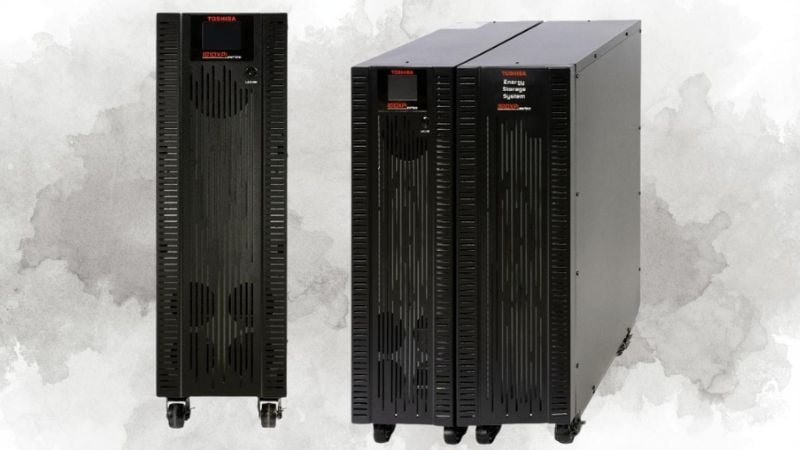
The 1610XPi ships in a 9.9 x 22.1 x 32.6-inch floor-standing steel cabinet. Shown beside Toshiba's Energy Storage System. Image used courtesy of Toshiba International Corporation
A Transformer in the Conversion Path
Online double-conversion systems rectify incoming AC to DC and regenerate a new AC waveform at the inverter, which places them in the voltage- and frequency-independent class under IEC 62040-3. The 1610XPi runs this conversion under DSP control and adds a factory-installed isolation transformer between input and output.
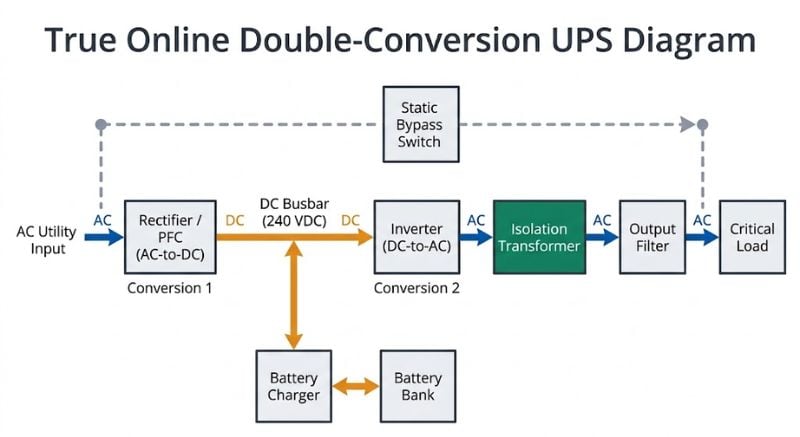
Double-conversion topology. Image created courtesy of Gemini
That transformer is the series' defining feature. Galvanic isolation breaks the conductive path between utility and load, giving installers grounding flexibility, limiting available fault current, and attenuating common-mode noise, rated here at under 0.5 V RMS.
Output voltage regulation holds within ±2% in battery and inverter modes, with total harmonic distortion at or below 2% into linear loads and 5% into non-linear loads. These figures keep the series within the envelope expected by switch-mode power supplies and medical instrumentation, which is where the isolated output is most likely to earn its cost.
Wide Input Window and Selectable Outputs
The UPS accepts single-phase 208, 220, 230, or 240 VAC on a two-wire-plus-ground input. Its acceptance window spans 176 to 300 VAC at full load and widens to 110 to 300 VAC at 60% load or less. A lightly loaded unit therefore stays on utility power through deeper sags, sparing battery cycles that a narrower input window would consume.
Auto-sensing covers 46 to 54 Hz and 56 to 65 Hz, extending to 40 to 70 Hz in generator mode. Input power factor is rated at 0.99 or better at full load, with input current THD below 4% into linear loads.
On the output side, users can select 104/110/115/120 VAC or 208/220/230/240 VAC across a three-wire-plus-ground connection. Rated load power factor is unity, so the 6 kVA and 10 kVA models deliver 6 kW and 10 kW, respectively, though capacity derates to 90% when output is set to 208 VAC.
Maximum output current at 240 V is 25 A on the smaller unit and 42 A on the larger. The system can run as a standalone power conditioner without batteries. A CVCF mode is also available that holds the output frequency fixed regardless of the source.
Battery, Efficiency, and Overload Capability
Internal energy storage uses flame-retardant valve-regulated lead-acid blocks in 12 V, 9 Ah increments on a 240 VDC bus, delivering seven minutes at full load on the 6 kVA model and three minutes on the 10 kVA. Recharging to 90% takes about nine hours. The charging current is adjustable to suit external battery cabinets.
Efficiency lands at 89% in AC mode and 87% on battery. Inverter overload capability is graded by duration. In AC mode, the unit runs continuously to 105%, sustains 105% to 125% for ten minutes, and 125% to 150% for one minute, and trips immediately above 150%.
On battery, the margins tighten to three minutes at 110% and 30 seconds at 130%, and trips instantly above that. Operating range is 0°C to 40°C, with 1% output derating per 100 m above 1,000 m altitude.
More information on the specifications is available on the product page.
Additional Features and Certifications
The series is RemotEye 5 monitoring-ready, with the RMTI-5 card preinstalled on initial offerings, which puts the UPS on the network for status monitoring, alarms, and automatic server shutdown. Power connections are hardwired as standard, with receptacle panels available as a field-installed option. An external EPO port is included for remote emergency shutdown.
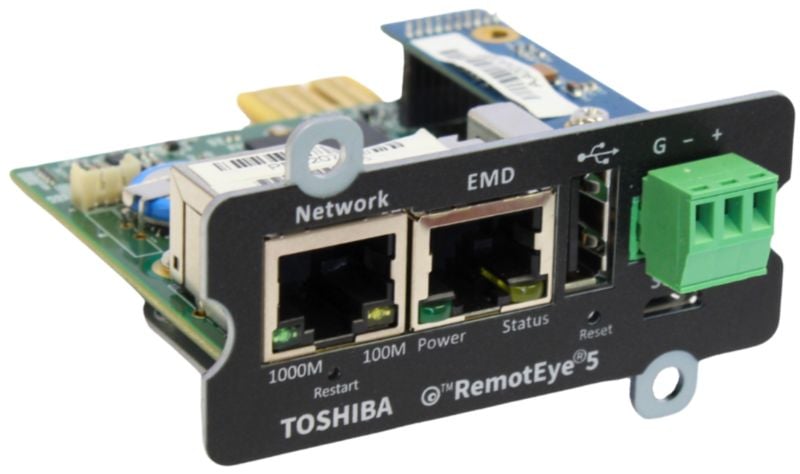
The RemotEye 5 IIoT network card is preinstalled in the 1610XPi. Image used courtesy of Toshiba International Corporation
Programmable outlet groups support flexible load management, letting operators shed non-essential equipment on battery to stretch runtime for critical loads. Certifications include UL 1778, cUL, FCC Part 15 Class A, IEC 62040-1/-2/-3, and ANSI/IEEE C62.41.
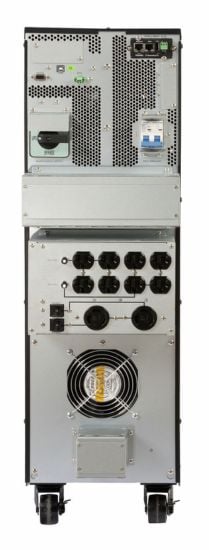
In the 1610XPi, connections are hardwired at the terminal block, with a socket panel connector for the optional receptacle panel. Image used courtesy of Toshiba International Corporation
Where the Load Is Moving
As computing spreads into telecom huts, plant floors, and retail backrooms, the two features that define this platform become the reasons it gets specified: isolation. Incoming power is dirty, and monitoring is necessary because nobody is on-site to read a front panel. Expect both to move from options to defaults across the 5-15 kVA range.