Facebook
 Google
 GitHub
 Linkedin
Isolated DC-DC Power Supplies: Module or Discrete Design?
When is a fully integrated module the better option, and when does a discrete design offer the greater advantage? This story discusses the major factors and trade-offs; it helps design engineers to make the best-fitting decision for their individual design.
This article is published by EEPower as part of an exclusive digital content partnership with Bodo’s Power Systems.
In the development of isolated DC/DC converters, that decision often arises at an early project stage. Some applications benefit from the speed and simplicity of a ready-made module, while others justify a more customized power stage assembled from individual components. Both approaches can be technically valid, but they differ significantly in terms of flexibility, engineering effort, manufacturability, and total system cost.
DC/DC Components of the Shelf
Finished DC/DC modules are often the preferred route where development schedules are tight and design risk must be contained. They simplify integration, reduce the effort required to qualify individual components, and provide a predictable solution in terms of performance, isolation, and compliance. In low-volume projects or early design phases, this can make modules the more practical choice.
Discrete DC/DC Implementation
A discrete implementation, by contrast, gives engineers more control over the converter architecture. Topology, thermal behavior, mechanical integration, and PCB placement can all be tailored more closely to the application. This added freedom can be particularly valuable where board space is constrained, where unusual form factors are required, or where electrical specifications do not align neatly with the footprint of a standard module.
The Key Decision-Making Factors
In practice, the choice is rarely determined by component cost alone. Engineering resources, availability of suitable magnetic components, validation effort, production methods, and in-house power design expertise all play a role. An isolated DC/DC converter is not simply a controller paired with a transformer; it is a tightly balanced subsystem in which switching behavior, isolation, regulation, EMI performance, and thermal constraints interact continuously.
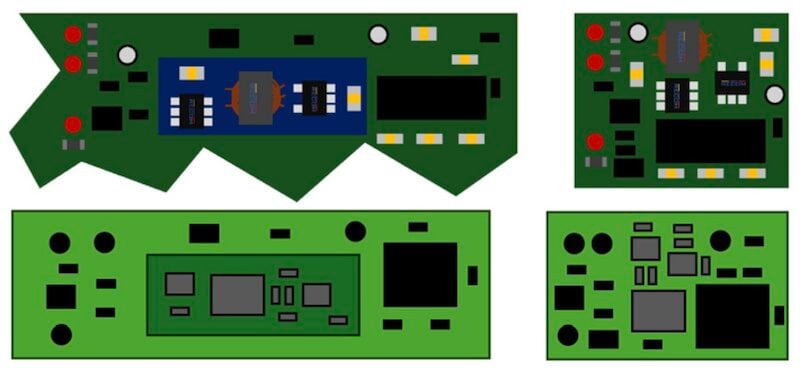
Figure 1. DC/DC supply modules (left) require a fixed space, while a discrete approach (right) can better accommodate space-constrained PCB layouts. Image used courtesy of Bodo’s Power Systems [PDF]
Transformer
The isolation transformer remains one of the key elements in that equation. In many designs, it is the component that most strongly influences feasibility, efficiency, mechanical size, and output-voltage configuration. If no suitable standard transformer is available, the effort associated with a discrete solution can rise quickly. On the other hand, an application-specific magnetic design may unlock optimizations that a standard module cannot easily deliver.
What About the Layout?
PCB layout is another important consideration. A power module occupies a clearly defined area on the board and can simplify placement. A discrete design, however, can often be distributed more flexibly within the available space. That can be advantageous in compact assemblies, irregular board geometries, or densely integrated systems where every square millimeter matters. In some cases, discrete solutions may also fit better into established manufacturing flows by avoiding secondary assembly steps associated with larger module packages.
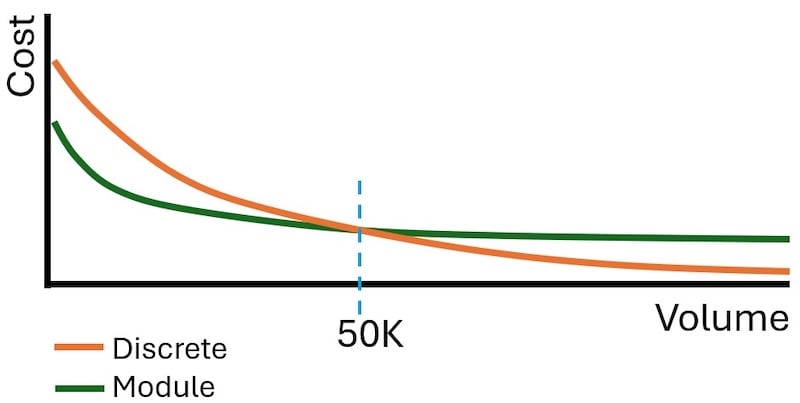
Figure 2. Discrete designs have a higher initial cost, but they become the more cost-effective approach (based on TCO) after approximately 50,000 annual units. Image used courtesy of Bodo’s Power Systems [PDF]
The cost picture typically follows a familiar pattern. Modules tend to offer an economic advantage at lower production volumes because they reduce development overhead and shorten implementation time. Discrete approaches may become more attractive as annual quantities rise and the design can be optimized more precisely around material cost and manufacturing efficiency. The exact crossover point depends on the application, however, and should be evaluated case by case rather than assumed in advance.
For development teams, the central question is therefore not simply ‘module or discrete?’, but which approach offers the best balance of risk, effort, flexibility, and total cost for the specific project. A structured assessment at the start of development—covering board space, target cost, time to market, certification requirements, and available design expertise—can prevent expensive redesigns later in the process.
The market is increasingly moving toward greater design freedom. In addition to complete power modules, suppliers are beginning to offer matched core components for discrete isolated DC/DC solutions, allowing engineers to combine a more customized implementation with a reduced level of design risk. For the industry, this widens the spectrum between standardization and full custom development. RECOM is among the suppliers addressing this shift by supporting both prequalified module solutions and the relevant core components for discrete converter design.
Time-to-Market
To reduce development effort and support shorter time-to-market targets, RECOM also provides matched IC and transformer combinations for discrete converter designs. These combinations are selected to provide the appropriate driver topology for the intended application and to ensure magnetic and electrical compatibility between the components. They also take into account power-transfer requirements, input and output voltages, isolation requirements, and height constraints, and they are pre-tested and verified as matching building blocks within the converter concept.
This approach is also relevant from a sourcing perspective. RECOM is the only single-source company providing both the IC and the transformer. For design teams, this means that two of the central functional elements of an isolated DC/DC converter can be obtained from one supplier, rather than being specified and sourced separately.
This article originally appeared in Bodo’s Power Systems [PDF] magazine.