Facebook
 Google
 GitHub
 Linkedin
Why Lithium-Ion Batteries Last Longer at 20–80% State of Charge
Explore the electrochemistry behind optimal charging habits and learn how avoiding extreme energy levels minimizes chemical stress and significantly slows down cell degradation.
The Origin of the 20–80% Rule
The “20–80% charging rule” is widely circulated among smartphone users, laptop owners, and even electric vehicle drivers. The idea is simple: keeping a lithium-ion battery within roughly 20% to 80% state of charge (SOC) is believed to extend its lifespan.
However, this rule is often repeated without a physical explanation. It is not a formal specification from lithium cell manufacturers, nor is it a hard engineering constraint. Instead, it is an empirical operating guideline that emerges from the electrochemical behavior of lithium-ion cells.
The real question is this: Why does avoiding the extreme SOC range reduce battery degradation?
To answer this, we need to examine how lithium-ion batteries age from the perspectives of physics and electrochemistry, focusing on electrode potentials, reaction kinetics, and degradation pathways.
Lithium-Ion Battery Basics
A lithium-ion cell consists of three primary components:
- Anode (typically graphite)
- Cathode (e.g., LiCoO₂, NMC, LFP variants)
- Electrolyte (lithium salt in organic solvent)
During discharge, lithium ions move from anode to cathode through the electrolyte, while electrons flow through the external circuit. Charging reverses this process. At a microscopic level, energy storage is achieved through intercalation, in which lithium ions embed themselves in electrode crystal structures rather than form metallic lithium under normal conditions.
State of Charge (SOC) and Voltage
SOC is not a linear representation of stored energy. Instead, it corresponds to the electrochemical potential difference between electrodes. This relationship is inherently nonlinear. The mid-SOC region exhibits a relatively flat voltage curve, whereas the high- and low-SOC regions show steep voltage changes. This nonlinearity is critical because degradation mechanisms depend strongly on electrode potential rather than on SOC itself.
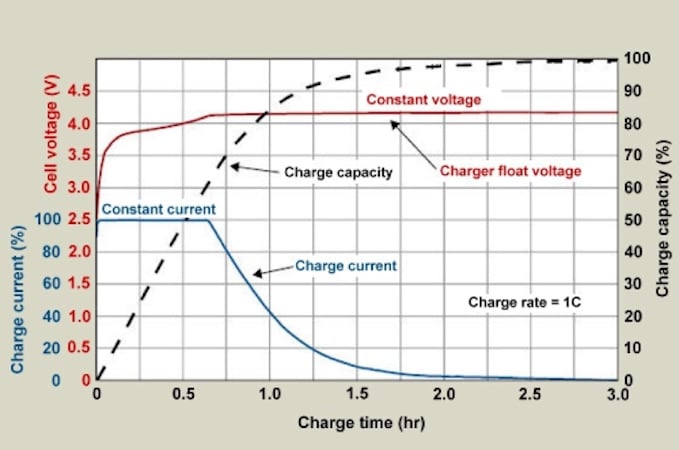
Figure 1. Cell voltage, current, and capacity over time during lithium-ion battery charging. Image used courtesy of Cadex.
What Actually Causes Lithium-Ion Battery Aging
Battery aging is generally divided into two categories—calendar aging and cycle aging. In calendar aging, degradation occurs over time, even if the battery is not cycled, whereas in cycle aging, degradation is caused by repeated charge-discharge cycles.
Both aging types originate from several coupled electrochemical mechanisms:
- SEI Layer Growth: A solid electrolyte interphase (SEI) forms on the anode during initial cycling. While necessary for stability, it continues to grow over time, consuming active lithium and increasing internal resistance.
- Lithium Plating: Under certain conditions (low temperature, high charge rate, or high SOC), lithium can deposit as metallic lithium rather than intercalating into graphite. This is irreversible and hazardous.
- Cathode Degradation: At high potentials, cathode materials undergo structural changes and oxygen release, accelerating electrolyte decomposition.
- Electrolyte Oxidation: Organic electrolytes degrade at high voltage, especially near the upper cutoff (~4.2 V per cell in many chemistries).
The key takeaway is that battery aging is driven primarily by electrode potential extremes rather than by cycle count alone.
Why High SOC (80–100%) Accelerates Degradation
The upper SOC region corresponds to high cathode voltage and near-full lithiation of the anode. This state significantly increases chemical instability.
Cathode Oxidation at High Voltage
As cell voltage approaches its upper cutoff, the cathode operates at high electrochemical potential. Reaction rates of electrolyte oxidation increase exponentially with voltage. This can be qualitatively described using Arrhenius-type kinetics. A higher voltage results in a higher reaction rate constant, while a higher temperature further amplifies degradation. Even small increases in cutoff voltage can significantly reduce cycle life.
SEI Instability at High Lithiation
At high SOC, the graphite anode is highly lithiated. This condition increases mechanical stress in graphite layers and promotes continuous SEI reconstruction, but also consumes cyclable lithium over time. SEI growth is self-reinforcing—as resistance increases, overpotential increases, accelerating further degradation.
Calendar Aging Acceleration Zone
High SOC combined with elevated temperature is the worst-case condition for lithium-ion storage. Empirically, a cell stored at 100% SOC ages significantly faster than one stored at 50% SOC. The difference between these cells becomes more pronounced at higher temperatures. This is because high SOC increases the thermodynamic driving force for side reactions.
Table 1. How the battery's internal chemistry shifts from the risk of copper dissolution at low SOC to oxidative wear at high SOC, with a stable middle ground in between.
| SOC Region | Electrochemical State | Dominant Stress Mechanisms | Primary Degradation Effects | Engineering Interpretation |
| 0–20% (Low SOC) | Highly delithiated anode | Copper dissolution risk, high polarization, structural stress | Capacity loss, voltage instability, higher internal resistance | Low energy state increases mechanical/electrochemical instability |
| 20–80% (Mid SOC) | Balanced electrode potential | Minimal side reactions, stable SEI behavior | Slow aging rate, stable cycle life | Optimal electrochemical operating window |
| 80–100% (High SOC) | Highly lithiated anode, high cathode voltage | Electrolyte oxidation, SEI thickening, cathode degradation | Accelerated calendar aging, lithium loss, impedance growth | High thermodynamic driving force for parasitic reactions |
Why Low SOC (0–20%) Is Also Harmful
While high SOC is widely recognized as stressful, low SOC operation also introduces degradation risks.
- Structural and Electrochemical Instability: At very low SOC, the anode becomes de-lithiated and structurally strained, and dissolution of the copper current collector can occur under deep-discharge conditions.
- Increased Internal Resistance Effects: Low SOC operation increases voltage drop under load due to reduced lithium concentration in electrodes and higher polarization losses. This leads to inefficient energy delivery and localized stress during current spikes.
- Over-Discharge Side Reactions: If voltage drops too low, irreversible chemical reactions may occur in the electrolyte, permanently damaging the cell.
Why the 20–80% SOC Window Is More Stable
The mid-SOC region is often considered the “electrochemically stable zone” of lithium-ion operation due to reduced extremes in electrode potentials. Within 20–80% SOC, the cathode voltage remains below the highly oxidative regime, and the anode avoids extreme lithiation or delithiation. This reduces the thermodynamic driving force for parasitic reactions.
Because degradation processes are voltage-dependent, operating at mid-SOC also results in slower reaction kinetics in degradation pathways. Specifically, this operating area reduces the SEI growth rate, electrolyte oxidation, and the probability of lithium plating.
Even if cycling continues, the rate constants of side reactions are significantly lower.
Mid-SOC operation also improves electrical performance and efficiency through reduced internal resistance effects, lower polarization losses, and reduced heat generation under load. Since heat accelerates chemical aging, this indirectly improves cycle life.
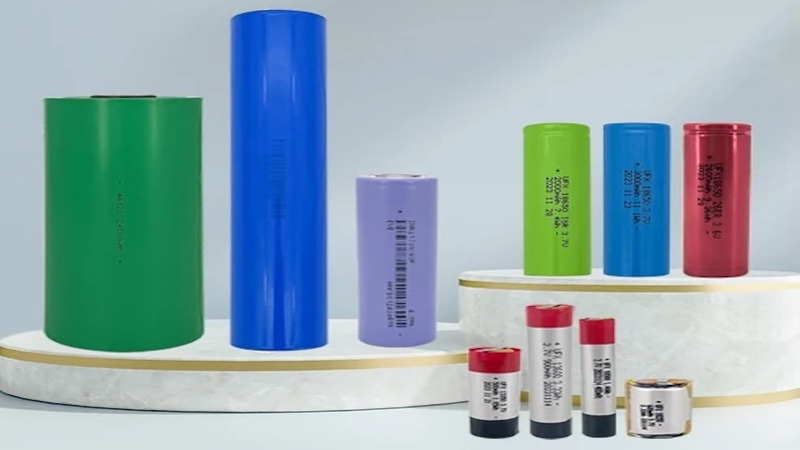
Figure 2. While batteries may look identical, internal degradation rates diverge significantly based on voltage exposure and temperature history. Image used courtesy of Ufine
Physical Interpretation: Energy Landscape Perspective
A useful way to interpret SOC-dependent degradation is to view the battery as an energy landscape system.
- High SOC → high chemical potential energy state
- Low SOC → unstable low-energy boundary conditions
- Mid SOC → relatively stable equilibrium region
In thermodynamic terms, extreme SOC regions increase the driving force for side reactions because the system is further from equilibrium.
A simplified engineering interpretation is that a battery’s degradation rate increases with electrochemical overpotential and reaction driving force, both of which are minimized in the mid-SOC range. This explains why the 20–80% window is not arbitrary—it reflects a region of reduced electrochemical stress.
Table 2. Comparing five mechanisms by how readily they trigger, how far they escalate with heat and charge state, and whether the damage can be undone.
| Degradation Mechanism | Primary Trigger Condition | SOC Sensitivity | Temperature Sensitivity | Reversibility | Engineering Impact |
| SEI Growth | Continuous electrode/ electrolyte reaction | High at high SOC | Very high | Partially irreversible | Gradual capacity fade, impedance rise |
| Lithium Plating | High charge rate, low temperature, high SOC charging | Very high (>80% SOC risk zone) | High (low T increases risk) | Largely irreversible | Safety risk, rapid capacity loss |
| Electrolyte Oxidation | High cathode potential (~>4.1–4.2V) | Strong at high SOC | High | Irreversible | Gas generation, cell swelling |
| Cathode Degradation | High voltage + long-term cycling | Moderate to High SOC | High | Irreversible | Structural breakdown, capacity fade |
| Copper Dissolution | Deep discharge (<~2.5V cell level) | High at very low SOC | Moderate | Irreversible | Internal short risk, catastrophic failure |
Why Devices Still Charge to 100%
Despite the benefits of limiting SOC range, most consumer devices still charge to 100%. This is a deliberate engineering trade-off.
- Energy Density vs Longevity: Users prioritize runtime over lifespan in daily use. Restricting SOC reduces usable capacity.
- SOC Calibration Requirements: Battery management systems (BMS) often require periodic full-charge cycles to calibrate SOC estimation.
- Adaptive Charging Strategies: Modern systems mitigate degradation using optimized charging (holding at ~80–90% until needed, temperature-aware charging control, and dynamic current limitation near high SOC.
All of these approaches aim to balance usability and degradation.
Engineering Implications for Battery System Design
From a design perspective, the SOC window has direct implications for system architecture. BMS should define conservative upper voltage limits when cycle life is prioritized, while thermal management becomes critical at high SOC due to accelerated reaction kinetics. Fast-charging strategies should also avoid prolonged exposure to near-maximum voltage. Cell balancing in multi-cell packs then also becomes more important near SOC extremes.
In high-reliability applications, such as industrial storage or aerospace systems, it is common to intentionally restrict the usable SOC window to extend service life.
Final Words
The widely cited “20–80% charging rule” is neither a myth nor a strict engineering requirement. It is a practical approximation derived from the underlying physics of lithium-ion degradation.
The key reasons it works are:
- Electrochemical reactions accelerate at voltage extremes.
- SEI growth and electrolyte oxidation are strongly SOC-dependent.
- High- and low-SOC regions introduce mechanical and chemical stress.
- Mid-SOC operation minimizes overpotential and reaction driving force.
In essence, the 20–80% SOC range represents a compromise region in which lithium-ion batteries operate under reduced electrochemical stress, leading to slower degradation and longer cycle life. Understanding this principle allows engineers to move beyond rules of thumb and design battery systems based on physical mechanisms rather than empirical habits.