Facebook
 Google
 GitHub
 Linkedin
Achieving Galvanic Isolation and Protection With Solid-State Isolators—Part 1
In Part 1 we introduce solid-state isolators (SSIs) with coreless transformer tech, covering architecture, energy transfer, built-in protection, standards, and applications.
This article is published by EEPower as part of an exclusive digital content partnership with Bodo’s Power Systems.
Article is co-authored by Sameh Snene, Product Applications Engineer at Infineon Technologies.
Achieving reliable galvanic isolation and integrated protection is increasingly critical in high-voltage industrial systems. Part One of this two-part series introduces solid-state isolators (SSIs) based on coreless transformer technology, highlighting how they combine compact form factors with fast switching, robust isolation, and built-in protection features.
In this article, we'll cover device architecture, energy transfer mechanisms, and integrated protection functions, including overcurrent, overtemperature, and dynamic Miller clamping. Lastly, it reviews relevant industry standards and application targets across industrial automation, power distribution, and smart building systems.
Galvanic isolation ensures both operational reliability and user safety in high-power systems. Based on coreless transformer (CT) technology, solid-state isolators (SSIs) offer a compact, efficient means of achieving galvanic isolation along with integrated protection and control functions. Unlike optical-based solid-state relays (SSRs), integrated SSI drivers provide galvanic isolation while enabling energy transfer capabilities.
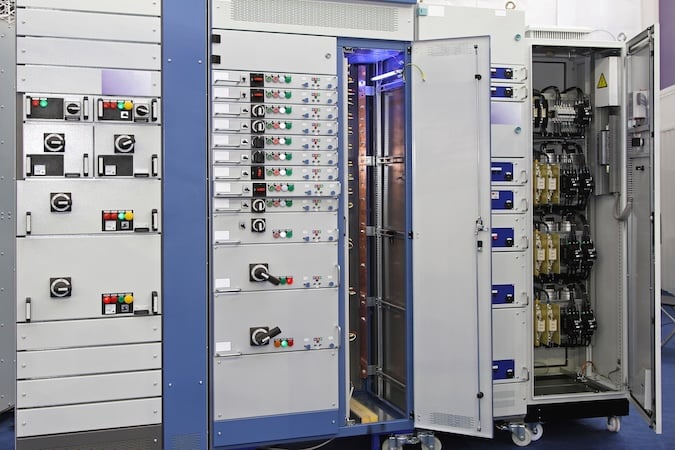
Image used courtesy of Adobe Stock
They also support fast switching, extended system life, and integrated protections such as dynamic Miller clamping (DMC), overcurrent and overtemperature protection (OTP), and under-voltage lockout. Additionally, CT-based isolators allow reliable ON/OFF control without requiring a secondary-side power supply, functioning like relay switches when paired with metal-oxide-semiconductor field-effect transistors (MOSFETs) or insulated-gate bipolar transistors (IGBTs).
Infineon’s SSI family enables cost-effective, low-power solid-state relays capable of handling loads above 1,000 V and 100 A. Target applications span battery management systems, power supplies, power distribution, industrial automation, robotics, and smart building systems such as HVAC controllers and smart thermostats.
Energy Transfer Through Coreless Transformer Isolation
The primary design feature of Infineon’s integrated SSI family is a coreless transformer which enables power transfer across a galvanic isolation barrier of up to 10mW. This eliminates the need for an isolated power supply for the switch, reducing bill of materials (BOM) volume, component count, and cost. It also supports fast turn ON/OFF performance (≤ 1 µs), ensuring the switch operates within its safe operating area (SOA).
All variants meet Underwriters Laboratories’ UL1577 for 5700 Vrms isolation and the planned International Electrotechnical Commission’s IEC 60747-17 for 8000 Vpeak isolation. With an output voltage up to 18V, an Infineon SSI provides an ideal solution for driving a broad range of MOSFETs and IGBTs.
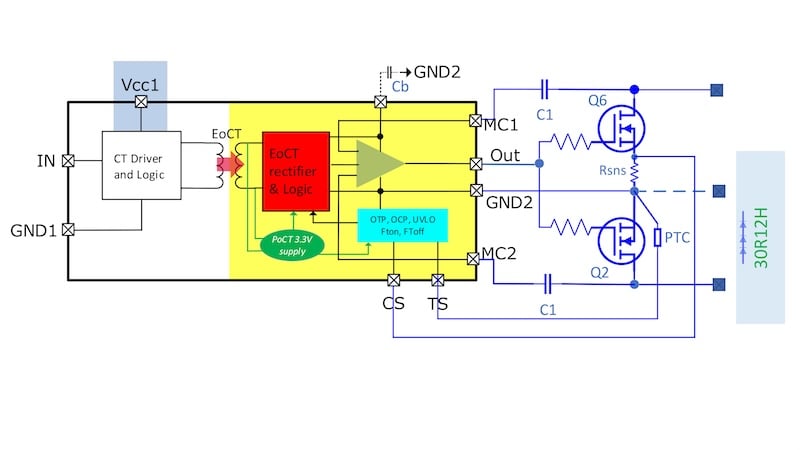
Figure 1. Highly integrated solid-state isolators, such as the iSSI30R11H/12H, easily drive MOSFETs or IGBTs and do not require an isolated bias supply. Image used courtesy of Bodo’s Power Systems [PDF]
Integrated Protection
Depending on application requirements and selected product variant, the iSSIx0RxxH portfolio offers features such as a dynamic Miller clamp and under-voltage lockout (latch-off) protection. It also supports overcurrent protection (OCP) and overtemperature protection (OTP), implemented either through an external positive temperature coefficient (PTC) thermistor/resistor or a MOSFET integrated direct temperature sensor (iSSI30R12H).
In the event of an overcurrent or overtemperature fault, the SSI triggers a latch-off response. The protection activates in under 1 μs, allowing the SSR to effectively protect the connected load without the need of fuses in series, saving space and money in customer's application.
Overcurrent Protection
A common challenge with solid-state relays is handling fast overcurrent or short-circuit events ranging from 20 A/μs to 100 A/μs. Isolation issues can lead to short circuits with very high current levels, determined by the power source’s impedance and cable resistance.
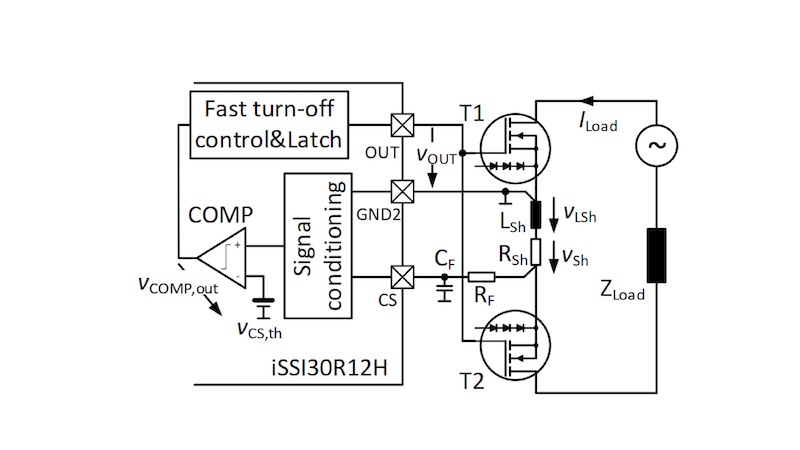
Figure 2. Circuitry to implement overcurrent protection using an iSSI30R12H isolator driver. Image used courtesy of Bodo’s Power Systems [PDF]
Figure 2 shows a circuit for implementing the overcurrent protection capability of the iSSIx0R1xH. The shunt resistor (RSh) and its inherent stray inductance (LSh) generate a voltage drop that is monitored by the current sense comparator. Noise on the grid needs to be filtered out from the shunt signal, so an external filter (CF and RF) complements the integrated filter. When the comparator triggers, it activates the fast turn-off and latches the fault leaving the system in a safe state.
Overtemperature Protection
Another challenge in solid-state relay operation is managing slow overload events that heat the switches and current sensor (shunt). Elevated load current and insufficient thermal management can push the overall temperature beyond the power transistor’s maximum operating limits.
Figure 3 illustrates overtemperature protection using the iSSI30R12H. The Infineon SSI shuts down two IPT60T022S7 MOSFETs with integrated temperature sensors configured in a common-source mode. As load current heats the sensing MOSFET, the sensor voltage drops below the comparator threshold, triggering a shutdown. The SSI output turns off within 500 ns, preventing the transistors from exceeding their safe operating area.
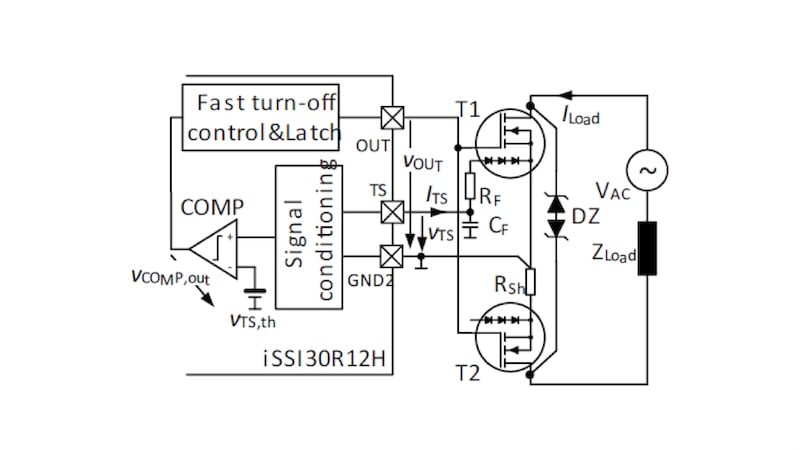
Figure 3. The iSSI30R12H’s overtemperature protection triggers within 500 ns. Image used courtesy of Bodo’s Power Systems [PDF]
|
Sales Number |
VIN range |
VVCC1 range |
lout pk |
Features |
Package |
|
iSSI20R02H |
TTL/CMOS |
2.85V- 3.5V |
175uA |
OTP or OCP, DMC |
PG-DSO-8-66 |
|
iSSI20R03H |
TTL/CMOS |
2.85V- 3.5V |
175uA |
OTP and OCP |
PG-DSO-8-66 |
|
iSSI20R11H |
TTL/CMOS |
2.85V- 3.5V |
400mA |
Fast Ton, OTP or OCP |
PG-DSO-8-66 |
|
iSSI30R11H |
TTL/CMOS |
2.85V- 3.5V |
400mA |
Fast Ton, OTP and OCP, DMC |
PG-DSO-16-33 |
|
iSSI30R12H |
TTL/CMOS |
2.85V 3.5V |
400mA |
Fast Ton, OTP (CoolMOSᵀM Tsense) and OCP, 2x DMC |
PG-DSO-16-33 |
Table 1. Component summary for a 600V – 6A SSR
Dynamic Miller Clamping Protection
Some products in Infineon’s SSI family also feature an integrated dynamic Miller Clamp to protect against spurious switching due to surge voltages and fast electric transients as well as the dv/dt of the line voltage. The dv/dt applied by the connected AC voltage creates capacitive displacement currents through the parasitic capacitances of a power transistor. This can lead to parasitic turn-on of the power switch by increasing the voltage at its gate node during its “off” state. The dynamic Miller clamping feature ensures that the power switch remains safely in the „off” state.
Meeting UL, IEC and Other Requirements
All products in Infineon’s solidstate isolator family meet essential UL and IEC specifications. Depending on the feature requirements (see Table 1), SSI products are available in either a full-featured DSO 16-pin (PGDSO-16-33) or an optimized 8-pin (PG-DSO-8-66) package. Both packages are 300-mil-wide, wide-body designs that offer high creepage and clearance distances to meet UL 1577 requirements and support reinforced isolation in line with planned IEC 60747-17 compliance.
They are also qualified for industrial applications, meeting relevant JEDEC 47/20/22 test standards.
Matched with the appropriate power switches, the isolator drivers enable designs with a much lower ON resistance compared to optically driven/isolated solid-state solutions. This translates to longer lifespans and lower cost of ownership in system designs. As with all solid-state isolators, the devices also offer superior performance compared to electromagnetic relays, including 40% lower turn-on power loss and increased reliability due to the elimination of moving or degrading parts.
In summary, the integrated capabilities of an iSSIx0RxxH include:
- No isolated bias supply required
- Galvanic Isolation up to 5.7 kVrms
- Minimizes the need for heatsinks
- Widest range of controllable switches
- Large application platforms
- Eliminates spurious switch turn on
- Meets UL 1577 and IEC 60747-17 requirements
Part Two of this story, which will be published in the next issue, will describe Infineon’s solid-state isolator (SSI) technology in realworld solid-state relay (SSR) designs.
This article originally appeared in Bodo’s Power Systems [PDF] magazine and is co-authored by Davide Giacomini, Director of Marketing, Power IC Group, and Sameh Snene, Product Applications Engineer, both Infineon Technologies.