Facebook
 Google
 GitHub
 Linkedin
Ruggedness Matters: MOSFETs Built on Mature Planar Technology
Many industrial and mission-critical systems continue to depend on MOSFETs with proven robustness and predictable behavior under stress. Learn how Littelfuse Polar MOSFETs address this need with a portfolio based on mature planar technology.
Article co-authored by Littelfuse's Liutauras Storasta, Raymon Zhou, and José Padilla.
This article is published by EEPower as part of an exclusive digital content partnership with Bodo’s Power Systems.
Balancing Efficiency and Reliability in Power Electronics
Power electronics systems, including industrial power supplies, process control equipment, and test platforms, require reliable operation under a wide range of electrical conditions. Transient events, including load interruptions, inductive load switching, and input disturbances, can generate voltage overshoots and current spikes.
Repetitive thermal cycling adds mechanical and electrical stress, making device robustness as important as efficiency. At the component level, designers typically consider voltage capability, current rating, switching speed, and on-state resistance to achieve acceptable efficiency and thermal performance. However, practical operation rarely follows ideal assumptions.

Image used courtesy of Pexels
Key reliability-driven requirements include:
- Strong tolerance to overvoltage events
- Wide safe operating area (SOA)
- Low thermal resistance
- Capability to withstand pulsed energy
- Stable operation during abnormal events
While modern semiconductor technologies such as superjunction silicon and wide-bandgap materials excel in efficiency, they may require tighter design control or additional protection in stress-intensive environments. In contrast, planar-based devices such as Polar MOSFETs provide a balance of switching performance and ruggedness, making them well-suited for applications where robustness under diverse operating conditions is a key design constraint.
The Polar MOSFET Platform
The Polar MOSFET offering includes two primary device families: Polar and Polar3, each tailored to support a broad spectrum of voltage and current requirements. Both series offer standard MOSFET and HiPerFET™ devices with optimized body diodes for fast switching performance. Devices are available in industry-standard packages, isolated, and high-voltage package options designed for harsh environments. The planar-gate architecture provides balanced conduction, switching, and ruggedness performance.
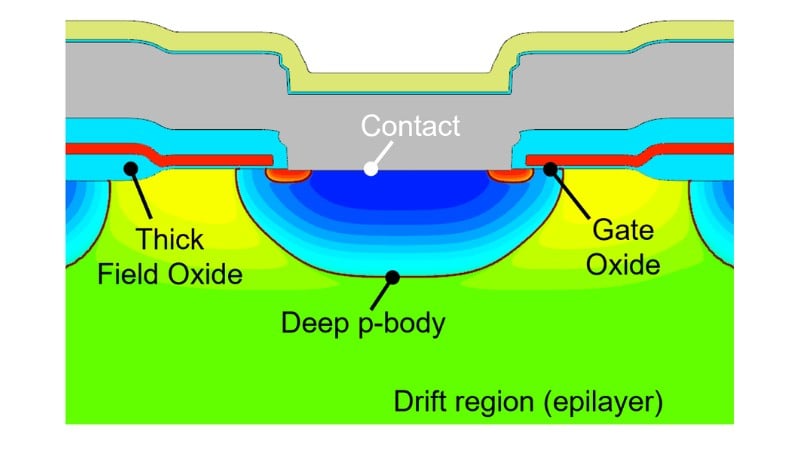
Figure 1. Polar MOSFET cell technology. Image used courtesy of Bodo’s Power Systems [PDF]
Polar Family
- Blocking Voltage range: 100 V to 1200 V
- Current capability: 0.2 A to 300 A
- On-state resistance down to 5.5 mΩ
Polar3 family
- Blocking Voltage capability extending up to 3000 V
- Current ratings up to 210 A
- On-state resistance from 14.5 mΩ upward
The core of the Polar MOSFET technology is a vertical DMOS cell architecture as illustrated in Figure 1. The active area is composed of optimized rugged MOS cells incorporating a deep p-body, which enhances robustness under avalanche stress conditions. A reduced gate-to-drain capacitance is achieved by introducing a thick field oxide layer between the cells. The device employs a robust, thick planar gate oxide, ensuring high long-term reliability.
High blocking capability is achieved through a sufficiently thick epitaxial layer grown on a highly conductive substrate. The epitaxial layer parameters, together with the transition region between the epitaxial layer and the substrate, are carefully optimized to balance conduction losses RDS(on), breakdown voltage, and avalanche ruggedness. The ring termination is designed with a high margin, ensuring long-term reliability under application-induced and environmental stresses.
A key advantage of planar MOSFET architectures is their predictable switching behavior and tolerance to real-world circuit conditions. This often allows designers to reduce implementation complexity compared with more sensitive device technologies. Polar MOSFETs simplify system integration by offering several advantages.
- High single-pulse avalanche capability
- Wide SOA at elevated voltages
- Standard gate-drive requirements (no negative gate bias)
- Reliable parallel operation
- Reduced dv/dt stress, contributing to cleaner switching
- HiPerFET diode variants for improved reverse-recovery behavior
- Simple thermal design
Polar Advantage
Managing Overvoltage Events Through Avalanche Capability
Regardless of topology, transient overvoltage events are unavoidable in practical systems. Even well-designed circuits exhibit voltage spikes during switching transitions, especially when inductive elements are present.
Avalanche-rated MOSFETs address this challenge by allowing the device to safely dissipate excess energy when the drain voltage temporarily exceeds its breakdown threshold. During this controlled avalanche condition, the device absorbs transient energy without catastrophic failure, provided it remains within specified limits.
In such events, an avalanche-rated MOSFET provides controlled dissipation of excess energy, preventing immediate device failure. This capability improves fault tolerance, reduces the risk of device failure, and increases resilience to real-world disturbances, enhancing system uptime.
In continuously operating industrial or mission-critical systems, such robustness directly improves reliability and reduces downtime. Avalanche capability is therefore a critical factor in hard-switching converters, industrial control systems, and pulse-power applications. Datasheet comparison shows that Polar MOSFETs offer higher avalanche energy levels than many alternatives across various voltage classes, providing additional margin in applications where transients are frequent.
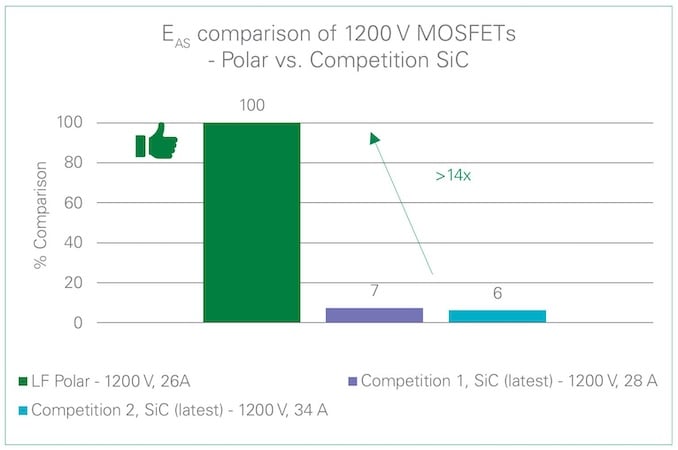
Figure 2. Comparison of measured single pulse avalanche energy for 1200 V MOSFETs from different technologies. Image used courtesy of Bodo’s Power Systems [PDF]
Figure 2 illustrates the superior avalanche capability of Littelfuse Polar MOSFETs compared to other existing technologies. This comparison is based on single-pulse avalanche energy measurements, evaluated across 1200 V MOSFETs from different technologies with similar nominal current ratings.
Safe Operating Area as a Reliability Indicator
The safe operating area defines the allowable combinations of voltage, current, and time duration a MOSFET can tolerate without degradation. It provides a clear representation of the device’s ability to survive high-power conditions - especially during temporary operation in the linear region.
Transient linear-mode operation may occur during:
- System start-up
- Load transitions
- Short-duration overloads
- Control-loop response events
Applications particularly dependent on wide SOA performance include:
- Linear amplifiers
- Push-pull converter stages
- Auxiliary supply modules
- Booster circuits
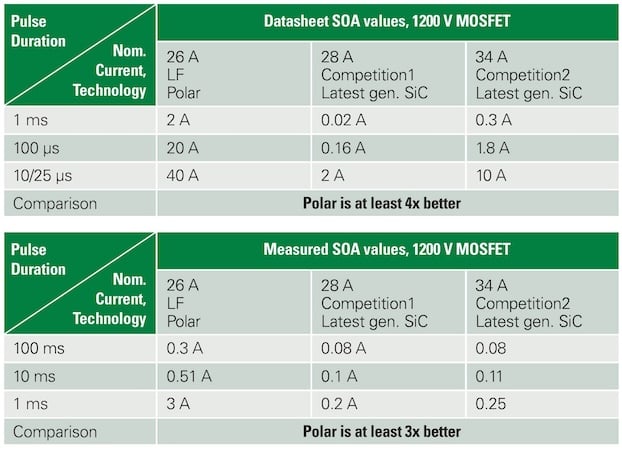
Figure 3. Comparison of datasheet and measured SOA parameters of 1200 V MOSFETs for pulsed operation. Image used courtesy of Bodo’s Power Systems [PDF]
Devices with extended SOA capability provide increased design margin and reduce the probability of failure under dynamic operating conditions. Comparative evaluations across common voltage classes indicate that Polar MOSFET devices maintain strong pulsed SOA capability, providing additional reliability headroom in demanding applications.
Figure 3 compares the datasheet and measured SOA maximum current values during pulsed operation at the maximum voltage rating for 1200 V MOSFETs in similar packages. The comparison highlights that Littelfuse Polar MOSFETs offer greater safety margins than competing technologies.
Where Ruggedness Delivers the Most Value
Many industrial systems operate in environments where electrical disturbances, high power density, and long operational lifetimes are unavoidable. In some scenarios, device ruggedness often outweighs efficiency gains. Application areas that benefit from enhanced robustness include:
- Industrial power supplies
- Motor control and drive systems
- Process power equipment
- Test and measurement platforms
- Auxiliary and standby power systems
- High-voltage pulse systems
In these applications, the ability to tolerate occasional fault events without immediate failure can extend system life and reduce maintenance costs. Table 1 captures key applications where Polar MOSFETs provide a clear advantage.
Conclusion
Polar MOSFET technology continues to provide a dependable foundation for power conversion systems operating under demanding conditions. Combining strong avalanche capability, wide SOA performance, and predictable thermal behavior, these devices offer a reliable alternative to newer technologies focused solely on efficiency metrics. For designers supporting both legacy platforms and modern industrial systems, Polar MOSFETs represent a practical solution - delivering proven reliability while supporting evolving application requirements.
Table 1. Typical applications where reliable operation is a critical requirement.
| Applications | Key Concern | Polar Advantage |
| Industrial and laboratory power supplies | Overvoltage, pulsed linear mode operation | Avalanche ruggedness, robust SOA |
| Test and measurement equipment | Sustain transient linear mode operation | Robust SOA |
| Medical and mission-critical power systems | Lifecycle, EMI, maturity, legacy designs | Availability, mature technology with proven decades in the field, clean, noise-free switching |
| Process and pulsed power, such as plasma, laser, and welding | Packaging, pulsed power, availability | Special packaging, superior pulsed power capability |
| Industrial servo drives and robotics | Overvoltage, pulsed linear mode, pulsed power handling | Avalanche ruggedness, robust SOA, superior pulsed power capability |
| Auxiliary power supplies in transmission and distribution, PV inverters, and motor drives | Overvoltage, transient linear mode operation, ease of design | Avalanche ruggedness, robust SOA, simplified design |
| Power amplifiers, e.g., in audio and signal amplifiers | Transient linear mode operation, EMI | Robust SOA, clean noise-free switching |
References
Check out Littelfuse's offerings of Polar MOSFETs and gate drivers.
This article originally appeared in Bodo’s Power Systems [PDF] magazine and is co-authored by Sachin Shridhar Paradkar, Liutauras Storasta, Raymon Zhou, José Padilla; Littelfuse