Facebook
 Google
 GitHub
 Linkedin
Tektronix Unveils Analysis Software for Modern Power Distribution
The PDN Analysis Software combines power and signal integrity measurements in a single workflow, aimed at high-current power rails in AI servers and compute hardware.
AI servers and high-performance compute racks now draw transient currents exceeding 1,000 A, leaving the power rails that supply them with little design margin. A brief voltage droop or a poorly damped transient is no longer just a power delivery issue; it can also introduce jitter or bit errors on a high-speed serial link.
Engineers have traditionally relied on separate tools to evaluate these effects, such as network analyzers or dedicated power integrity techniques to characterize the PDN, while relying on oscilloscopes to investigate signal quality. However, these have limited ability to correlate the results within a single workflow.
To bridge that gap, Tektronix introduced PDN Analysis Software for its 4 Series B, 5 Series B, and 6 Series B Mixed Signal Oscilloscopes, combining power integrity and signal integrity validation into a single workflow.
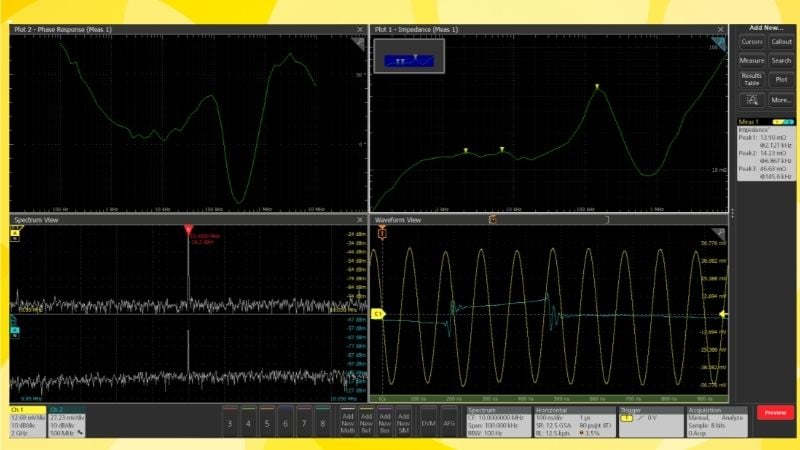
Impedance measurement results from Tektronix's PDN Analysis Software. Image used courtesy of Tektronix
Where the Traditional Approach Falls Short
Engineers have traditionally validated PDN stability using frequency-domain measurements on a standalone vector network analyzer (VNA), breaking a voltage regulator's control loop to run a Bode plot. This approach works well for small-signal conditions, but it doesn't capture how a rail actually behaves under a real, high-current transient load.
It also requires probing a voltage regulator's feedback node, which many current designs simply don't expose, and breaking the loop to make the measurement can itself alter how the regulator behaves. Step-load measurements better reflect the dynamic conditions modern PDNs operate under and don't require access to voltage regulator feedback at all.
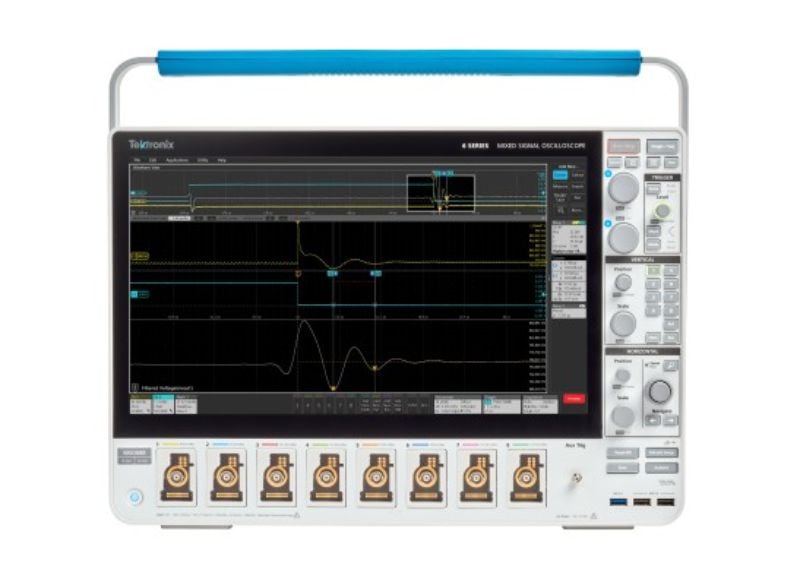
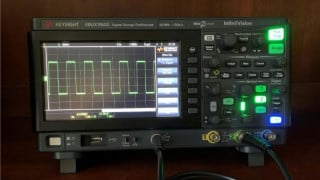
A Tektronix 6 Series Mixed Signal Oscilloscope capturing a step-load transient response. Image used courtesy of Tektronix
PDN Analysis Software, Built on SEPIA
PDN Analysis Software is an oscilloscope-based solution for power integrity validation and debug. It’s built on the Stability Evaluation for Power Integrity Analysis (SEPIA), a time-domain methodology developed by Picotest, and is the first implementation of SEPIA embedded natively in an oscilloscope.
SEPIA derives stability metrics and an equivalent RLC circuit model from a single measured step-load response, rather than from a swept frequency signal as in a Bode plot. A rail exhibiting second-order dominant behavior produces a ringing waveform following the load step, and the decay rate and peak count of that waveform are used to determine the circuit's quality factor, Q.
From a single step-load event roughly half a millisecond long, it extracts phase margin, damping, and an equivalent circuit model, without modifying the board or breaking the control loop. Control Loop Response, the conventional swept-frequency Bode measurement, remains available natively alongside it, for cases where a feedback node is accessible and a full frequency sweep is still the preferred check.
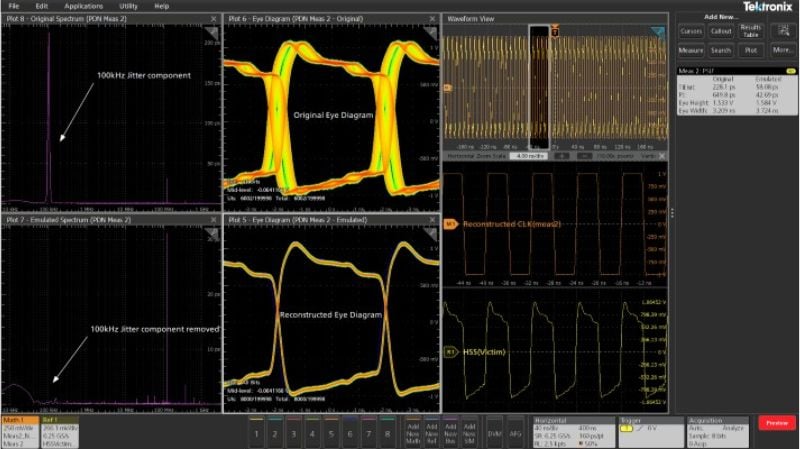
PDN Analysis Software isolating a 100 kHz jitter component on the power rail. Image used courtesy of Tektronix
Beyond stability analysis, the software includes several additional power integrity measurements. It also runs 2-port shunt-through impedance sweeps from 10 Hz to 50 MHz using the oscilloscope's built-in function generator.
On the signal integrity side, it correlates jitter measured on high-speed serial waveforms with noise measured on the power rail, letting engineers evaluate how that rail noise contributes to signal degradation. The software also automates Power Supply Rejection Ratio measurements, with a typical dynamic range around 85 dB, and runs multichannel spectrum analysis to isolate rail noise sources.
Tektronix positions the software as part of a broader power integrity setup, meant to run alongside its own low-noise oscilloscopes and dedicated power rail probes rather than as a standalone add-on.
PDN Analysis Software is available now worldwide as an instrument option or an application bundle upgrade for existing 4 Series B, 5 Series B, and 6 Series B oscilloscopes, with more information on Tektronix's product page.
Looking Ahead
Integrating SEPIA into an oscilloscope reflects a broader shift in PDN validation methodology rather than a single product update. As rack-scale AI power delivery moves toward multi-kilowatt loads and sub-millisecond transients, standalone VNA-based characterization is likely to be displaced further by in-situ, time-domain methods that do not require breaking open a regulator's control loop.
Other oscilloscope vendors are likely to pursue similar partnerships with power integrity specialists, and future development will likely focus on improving current probe and current-sensing accuracy, since the reliability of a unified power and signal integrity workflow depends directly on the fidelity of the underlying current and voltage measurements.