Facebook
 Google
 GitHub
 Linkedin
R&S Intros 3-Phase Power Analysis for MXO Series Oscilloscopes
Rohde & Schwarz’s power analyzer for its MXO series oscilloscopes allows engineers to measure key power parameters while directly correlating them with voltage and current waveforms.
Three-phase power systems are widely used in inverter-fed industrial motor drives, power conversion stages, renewable-energy inverters, and other high-power electronic applications. Accurate characterization of these systems is critical for assessing conversion efficiency, power quality, and dynamic electrical behavior, especially as modern SiC- and GaN-based power electronics operate at higher switching frequencies with faster dv/dt and di/dt transients.
To support this type of analysis, Rohde & Schwarz has introduced the software, MXO-K333, enabling integrated three-phase power analysis directly on MXO series oscilloscopes.
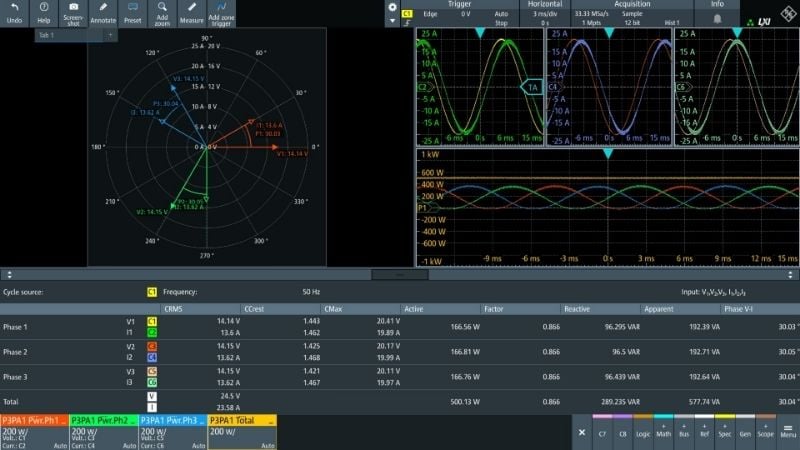
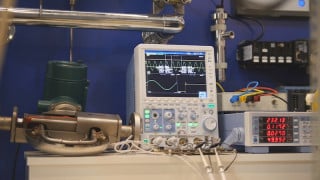
The analysis shows phase-shifted voltage and current waveforms, phasor diagrams, and power measurements.
From Separate Instruments to Integrated Analysis
Traditionally, engineers use a dedicated power analyzer to measure parameters such as active power, reactive power, power factor, efficiency, and harmonics, while relying on an oscilloscope to examine switching behavior, transients, and waveform distortion. Using separate instruments can make it more difficult to correlate power-performance results with specific events in the voltage and current waveforms.
The MXO-K333 addresses this by integrating three-phase power analysis into the oscilloscope measurement environment. Engineers can therefore move between waveforms and calculated power measurements without changing instruments or measurement setups.
This approach can be particularly useful when debugging power converters and inverters, where a transient or switching event can directly affect measured power performance.
Core Three-Phase Measurements
The MXO-K333 supports two-wire, three-wire, and four-wire (2V2A, 3V3A, and 3VN3A) measurement configurations. The software can perform cycle-by-cycle measurements, enabling engineers to observe how power parameters change over individual electrical cycles rather than relying only on longer-term averages. The configuration can also be set for different three-phase load arrangements, including star (wye) and delta connections.
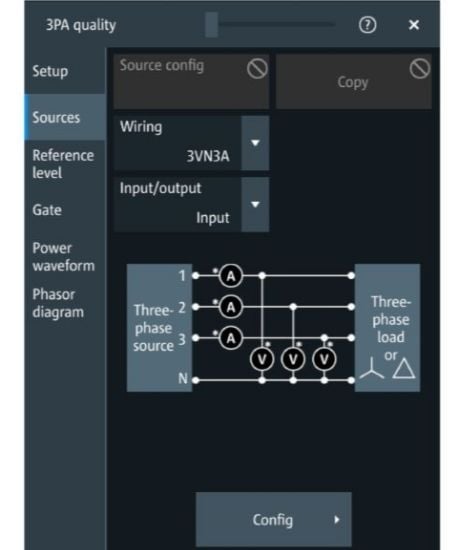
3VN3A setup applicable for star/wye configuration.
Its measurement capabilities include RMS voltage and current, active power, reactive power, total power, power factor, and three-phase efficiency. These measurements, along with the corresponding voltage and current waveforms, provide additional context when investigating variations in converter efficiency or power consumption.
For example, engineers evaluating a three-phase inverter can examine the waveform associated with a change in efficiency or power factor and determine whether switching behavior, waveform distortion, or another electrical event contributes to the measured result.
Harmonics and Power Quality
Beyond basic power measurements, the software provides phasor and harmonic analysis, allowing engineers to investigate the phase relationships and frequency components present in three-phase systems. It also supports total harmonic distortion (THD) measurements in line with IEC 61000-3-2 and MIL-STD-1399.
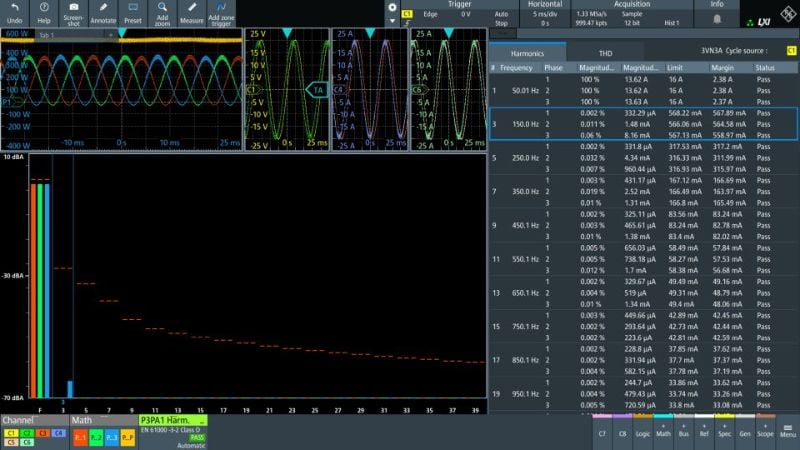
Three-phase harmonics and THD analysis in line with IEC 61000-3-2: Testing beyond pass/fail of harmonic analysis of up to 40th harmonics.
The three-phase analysis can also be used with the MXO platform’s existing advanced triggering, FFT, automated measurements, track functions, and protocol decoding capabilities.
The software is available for four- and eight-channel versions of the MXO 3, MXO 4, MXO 5, and MXO 5C oscilloscopes. More information is available on the product page.
Looking Ahead
This kind of integration hints at where power electronics testing is going: fewer instruments, faster correlation, and less guesswork between "what the power numbers say" and "what's actually happening on the rail."
As three-phase drives and inverters keep pushing toward higher switching speeds and tighter efficiency margins, having power analysis and waveform debugging live in the same box may become less of a convenience and more of a necessity.
All Images used courtesy of Rohde & Schwarz