Facebook
 Google
 GitHub
 Linkedin
Microreactors To Power 5 Military Bases in $2.2 Billion Project
The U.S. Army’s Janus program links five nuclear developers with five military bases, aiming for the first Army-regulated reactor to be operational by September 2028.
The U.S. Army has tapped five companies to build microreactors at five military bases under its Janus program. These compact nuclear systems are designed to provide steady, on-site power with less dependence on outside grids.
The Army says Janus could ultimately encompass more than 20 reactors across Department of Defense installations, backed by up to $2.2 billion in federal funding alongside private-sector capital.
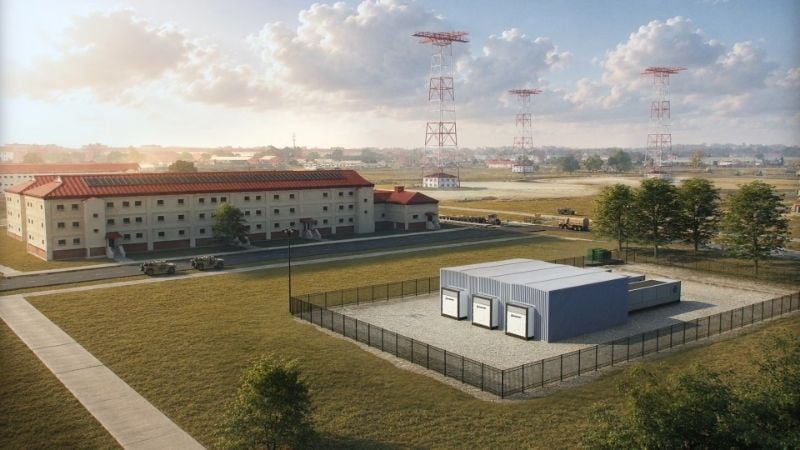
Rendering of Kaleidos microreactors at Fort Benning in Georgia. Image used courtesy of Radiant Industries
Meet the Five Microreactors
These advanced reactors are expected to deliver sustained power to military bases for years at a time. Microreactors generally operate in the low-megawatt range. By comparison, a conventional commercial nuclear reactor typically produces around 1 gigawatt. By generating electricity on site, the Army aims to reduce its reliance on external grids that may be vulnerable to disruption.
Army officials say the Janus projects incorporate passive safety systems that can safely shut down the reactors during an emergency if external power is lost and operators cannot immediately respond.
The Army has also said that spent fuel will not stay at the bases permanently. After a required cooling period on site, used fuel would be transferred to federal facilities for longer-term handling or potential recycling.
The five designs vary in output, cooling approach, and operating characteristics.
Antares Nuclear will supply the reactor to Fort Bragg in North Carolina. The company is developing a factory-built microreactor running on TRISO fuel particles. Its Mark-0 test reactor reached zero-power criticality at Idaho National Laboratory in June under the Department of Energy’s Reactor Pilot Program. The company is targeting power generation in 2027 and its first military sites in 2028.
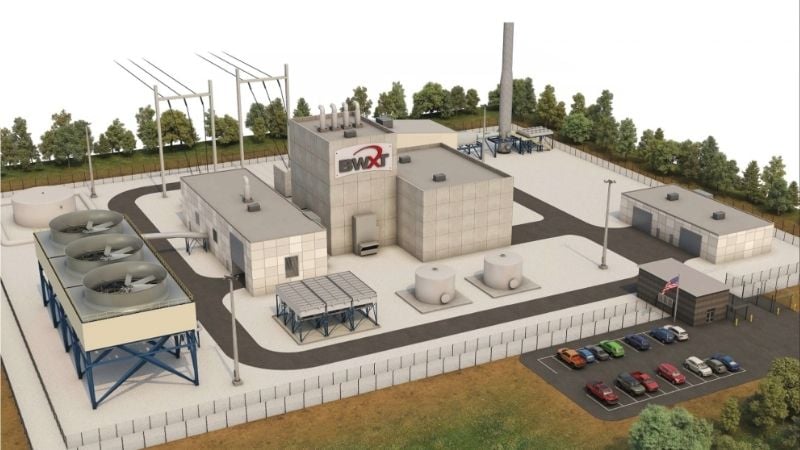
A BWXT BANR reactor at Fort Campbell in Kentucky. Image used courtesy of BWX Technologies
At Fort Campbell in Kentucky, BWXT Technologies is bringing its 20-MW BANR microreactor, a high-temperature gas-cooled system fueled with TRISO. Refueling is planned roughly every four years. The company aims to break ground in late 2028, with reactor operations beginning in the early 2030s.
General Atomics takes a different approach at Fort Hood in Texas with GA-TES, a liquid-metal-cooled design that uses natural circulation to move heat through the system. The baseline version produces about 5 MW of electricity, while larger configurations could reach about 20 MW.
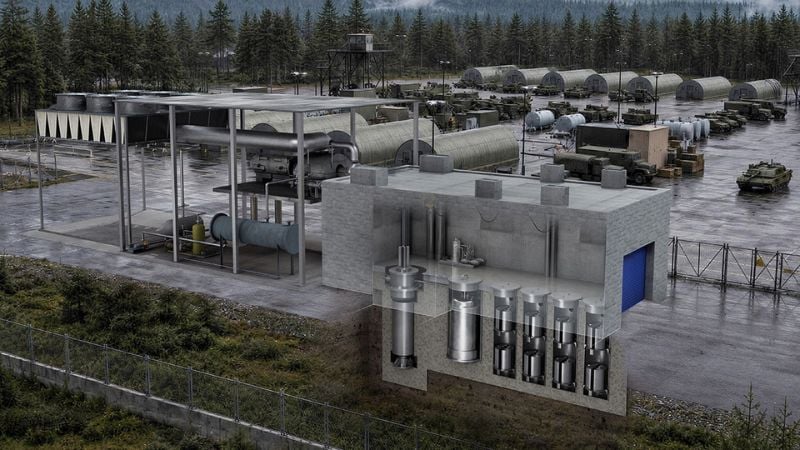
Rendering of a General Atomics GA-TES microreactor at a military installation. Image used courtesy of General Atomics
Radiant Industries will bring its containerized Kaleidos prototype to Fort Benning in Georgia. The 1-MW high-temperature gas-cooled reactor is built to operate for about five years between refueling, with a planned service life of 20 years. Radiant has said it intends to deploy 15 Kaleidos units through Janus by 2030.
Westinghouse Government Services, paired with Fort Drum in New York, is developing the eVinci microreactor, a heat-pipe-cooled system designed to run at full output for at least eight years before it needs fresh fuel.
The Army wants the selected systems to prove they can supply dependable electricity through years of real-world service. The selection process assessed each developer's technical readiness, financial capacity, and ability to execute the project. Site evaluations also considered each base's power requirements and physical characteristics, including geological and water-related conditions that could affect reactor safety.
What Comes Next for Janus
The Army and the Defense Innovation Unit are making up to $2.2 billion available from 2027 through 2031. Vendors are also expected to commit substantial private capital. Government funding is tied to performance, with payments released as developers meet agreed technical benchmarks. The companies will retain responsibility for owning and operating the prototype plants.
Learn about Westinghouse’s eVinci microreactor. Video used courtesy of Westinghouse
Janus builds on earlier federal reactor demonstrations but eyes a different test: whether microreactors can operate for years and mature into products with customers beyond the military. The Army also expects the technology to expand to additional defense installations.
Janus is working toward a May 25 deadline for an Army-regulated reactor at a domestic military installation by September 2028.