Facebook
 Google
 GitHub
 Linkedin
Rohm Releases PLECS Electronics Verification Simulator
Rohm has launched a free, browser-based simulator built on the PLECS environment, enabling power electronics engineers to run loss and thermal analysis on Rohm devices in seconds to minutes.
Running a full circuit simulation every time you want to compare two power device candidates adds unnecessary setup overhead at the device-selection stage. Most simulation tools are built for verification—confirming a design that's already taking shape—not for the earlier stage where the question is simply which device belongs in the circuit.
Rohm's PLECS Simulator is built specifically for that stage. It detects loss and thermal verification during device selection, before detailed circuit-level analysis begins. It runs in the browser, requires no local software, and returns power loss and junction temperature results within seconds to minutes across 20 available topologies.

Rohm PLECs is a browser-based simulator. Image used courtesy of Rohm
What PLECS Does Differently
PLECS, developed by Plexim, Inc., approaches power electronics simulation differently from cycle-accurate SPICE. Rather than resolving every switching transition through full circuit equations, it models power semiconductors as ideal switches and applies precharacterized loss and thermal data separately.
The trade-off is intentional. It accepts lower waveform fidelity in exchange for substantially faster simulation, which is appropriate when the goal is comparing device candidates across operating points, not validating a finalized design.
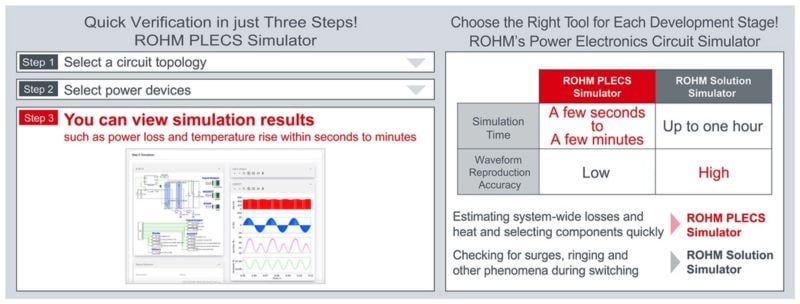
The PLECS Simulator’s three-step workflow and a direct comparison with Rohm’s Solution Simulator. Image used courtesy of Rohm Semiconductor
In Rohm's implementation, a designer picks one of 20 topologies, selects a Rohm power device, sets the operating parameters, and runs the simulation. Power loss, efficiency, and junction temperature appear numerically in the schematic view alongside waveforms. Results can be exported as CSV.
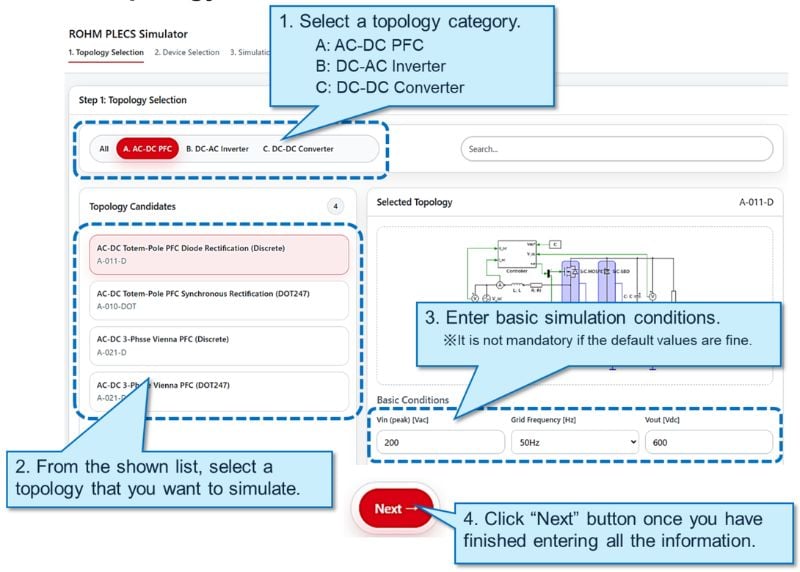
Rohm PLECS Simulator interface showing Step 1, circuit topology selection. Image used courtesy of Rohm Semiconductor
Both steady-state and start-up simulation modes are available, depending on what the analysis requires. The start-up mode simulates all transient processes from the start time (i.e., 0 sec) to the earlier-configured end time, while setting circuit parameters; the steady-state mode only shows steady-state results.
The Hold Result function allows back-to-back device comparisons on the same waveform plot: run one device, hold the output, swap in another, run again. No scripting or manual data handling is needed.
Where It Fits in the Design Workflow
The PLECS Simulator is one part of a two-stage simulation workflow. The second stage is the Rohm Solution Simulator, which Rohm launched in 2020 and has expanded continuously since.
The Rohm Solution Simulator is a web-based circuit simulation tool built on the SystemVision Cloud platform from Mentor, a Siemens business. It is designed for complete circuit verification, covering component selection, individual device verification, and system-level validation — across 44 solution circuits.
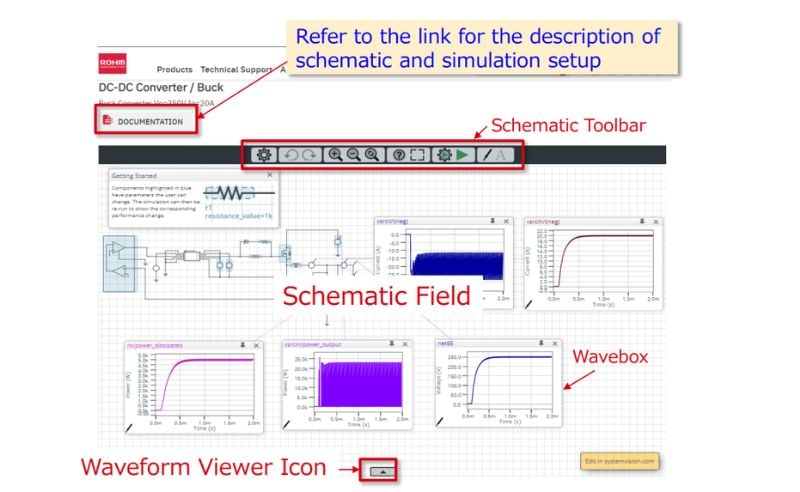
Rohm Solution Simulator Interface. Image used courtesy of Rohm Semiconductor
It includes high-precision SPICE models for simultaneous verification of Rohm power devices, including SiC MOSFETs and IGBTs, along with driver and power supply ICs under conditions close to actual application environments.
Solution Simulator supports complex topologies, such as 3-level NPC inverters, active clamp flyback converters, and multi-rail automotive power trees. It is designed for pre-prototype validation, including gate drive behavior, switching waveforms, transient response, and system-level interaction between power devices and control ICs.
The distinction between the two tools is deliberate and maps to different phases of development. The PLECS-based platform is optimized for the early design phase, where the priority is speed and rough optimization: Which device minimizes losses for this topology? Will thermal performance be within acceptable limits? These questions don't require microsecond-accurate waveforms; they require fast answers.
The intended sequence is PLECS Simulator for device screening, Solution Simulator for waveform verification. Used together, they can cover the span from initial device selection through pre-prototype validation.
The Quick Start Guide covers full parameter configuration and simulation setup in detail.
Looking Ahead
With SiC and GaN devices becoming mainstream in demanding applications, and with system complexity increasing as power densities rise, the demand for fast, accessible device modeling will only grow. Rohm's move to offer both rapid and high-fidelity simulation paths, free of charge via the web, positions the company to become a deeper partner in the design process, not just a component supplier.