Facebook
 Google
 GitHub
 Linkedin
Multiphysics Simulation and Simulation Apps in Power Electronics
Learn how multiphysics-based digital twins are increasingly used to capture interactions in electrification applications, enabling more accurate predictions and better-informed design choices.
This article is published by EEPower as part of an exclusive digital content partnership with Bodo’s Power Systems.
There is a global push for faster charging and smaller EV footprints, which in turn calls for power electronics to do more in less space. For engineers, these demands mean the old “siloed” way of working is dead. For instance, you cannot just optimize the electrical side of a system and then hand it off to the thermal team anymore. If the heat rises, the conductivity shifts; if the switching frequency climbs, you are suddenly dealing with vibration and acoustics issues you never saw in a static model.
These physics are not just “interacting”; they are actively fighting each other. Using simplified calculations or waiting for a late-stage physical prototype to find these issues slows down the process and is, frankly, a recipe for expensive field failures.
For example, in a modern inverter, physical phenomena do not occur in isolation but rather cascade. When semiconductors dump heat into busbars, cooling is not the only issue. Temperature changes electrical conductivity, which shifts switching behavior and alters magnetic properties. Meanwhile, thermal gradients introduce mechanical stress that slowly deforms solder joints and bond wires. These hidden interactions are often what kill a design in the field.
Two examples of hidden interactions to look out for include:
- The fatigue trap: A design may look electrically sound and thermally stable on paper, but if you ignore cyclic mechanical stress, thermomechanical fatigue will take out bond wires or solder layers long before the expected lifetime.
- The transient gap: Steady-state models capture best-case conditions, but real systems rarely operate there. A cooling strategy that looks acceptable in a static analysis can fail once transient switching losses and fluctuating airflow come into play.
At this point, “close enough” is no longer good enough. A unified multiphysics framework offers higher accuracy and enables teams to catch expensive surprises in software before a single prototype reaches the test bench.
Benefits of Simulation Apps and Digital Twins
Multiphysics models can be complex to handle for those who do not work with simulations on a daily basis. One solution to making the integration of simulation easier is through the use of simulation apps, which are task-specific tools built on high-fidelity models. They have specialized user interfaces that expose only the parameters relevant to a given decision, such as geometry dimensions, material properties, or operating conditions (such as ambient temperature). The underlying physics remain consistent and controlled, and the user does not need to be an expert in the underlying simulation machinery or even have to open the full simulation environment.
Physics models can also be packaged into digital twins that use minimal sets of inputs and outputs. In practice, a digital twin may be implemented as a simulation app or through custom programs written using APIs, often integrated with other software services. A digital twin represents a virtual counterpart of a physical system, one that reflects geometry, materials, boundary conditions, and operating scenarios, and can be revisited throughout development. Digital twin technology is still evolving, especially in power electronics. Today, digital twin concepts are most often discussed as a way to:
- Predict temperature distributions and identify hotspots under realistic load cycles
- Evaluate electrothermal and thermomechanical stress during power cycling
- Assess how material choices, packaging concepts, and cooling strategies interact
- Support design tradeoffs involving efficiency, power density, and lifetime
- Improve continuity between design assumptions and real operating behavior
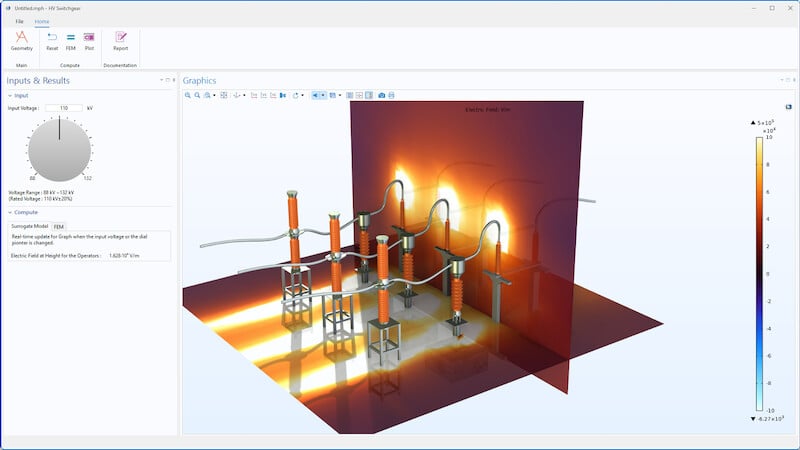
Figure 1. An example surrogate model for an HV switchgear. This app can be used to analyze how the electric potential distribution affects the input voltage. Image used courtesy of Bodo’s Power Systems [PDF]
When rapid feedback matters more than full detail, reduced-order or surrogate models (Figure 1) can be used. Trained on simulation data, these models are based on machine learning techniques and can reproduce system behavior in a fraction of the time, making them well-suited for interactive studies and early-stage exploration. More recently, GPU acceleration has been used to speed up both the training of surrogate models and the solution of full-scale simulation models.
In practice, the implementation of simulation apps and digital twins varies widely, but however they are used, they offer a feasible way to bring simulation into day-to-day engineering work. For instance, a common antipattern in R&D is the back and forth between production teams and modeling specialists for every design iteration. Each change requires another round of setup, simulation, and interpretation, turning advanced analysis into a workflow bottleneck. Simulation apps break that cycle and put physics-based insight into more hands: Design engineers can compare concepts early, and manufacturing teams can examine the influence of process parameters. System specialists can explore operating conditions using the same underlying assumptions. Even sales departments can make use of simulation apps. As one example, sales engineers used simulation apps to demonstrate the impact of design changes in real time in meetings with customers.
Multiphysics Modeling with COMSOL Multiphysics®
The COMSOL Multiphysics® software provides a unified environment for both multiphysics modeling and simulation app development through its Application Builder. Rather than stitching together separate tools, engineers can combine multiple physics interfaces directly within a single model. For power electronics, teams can combine:
- Electromagnetic modeling of currents, fields, and inductive and capacitive effects
- Thermal analysis covering Joule heating, electromagnetic losses, and radiation
- Fluid–solid–thermal dynamics for natural and forced convection cooling, as well as conjugate heat transfer
- Structural mechanics for thermal expansion, stress, and fatigue
- Semiconductor device modeling for MOSFETs, IGBTs, diodes, and wide-band-gap materials
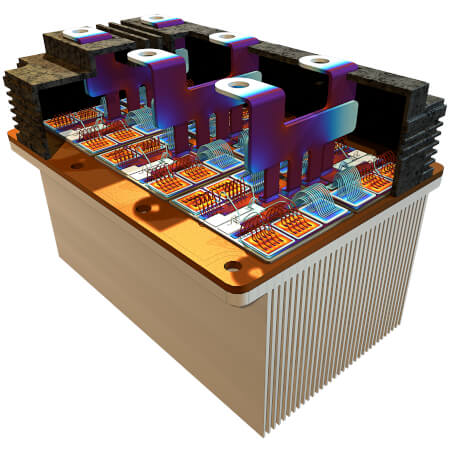
Figure 2. A COMSOL model of the electric current density distribution in an IGBT module. Image used courtesy of Bodo’s Power Systems [PDF]
In power electronics, changes in one domain immediately influence the others, either locally or at some distance, such as for magnetic couplings. This reaction makes coupling for predicting how high-power, high-density designs behave outside the simulation environment.
The following case studies illustrate how companies are using multiphysics modeling and simulation apps to handle these interactions in practice. The examples are drawn from real industrial projects, but the company identities are omitted.
Case Study: Electrothermal Optimization of EV Power Electronics
In EVs, inverters and DC link capacitors strongly influence efficiency, driving range, and reliability. A global automotive supplier used multiphysics simulation to redesign these components for next-generation electric drivetrains.
By coupling electromagnetic and thermal analyses, engineers identified local hotspots in DC link capacitors early in development (Figure 3). This insight made it possible to adjust geometry, materials, and cooling concepts before building hardware prototypes.
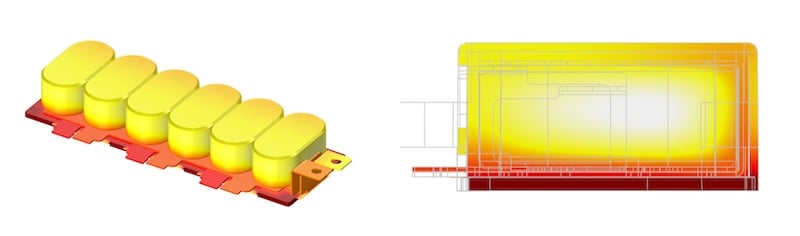
Figure 3. Left: the thermal effects inside of a DC link capacitor design. Right: a cutaway view of the capacitor model showing a hotspot. Image credit Bosch. Image used courtesy of Bodo’s Power Systems [PDF]
The result was a new generation of optimized inverters with higher power density and extended vehicle range, offering one example of how multiphysics-based simulation supports system-level performance improvements.
Case Study: Simulation Apps Streamline EV Motor Development
Electric motor design involves a constant balancing act between electromagnetic and mechanical requirements. Using a multiphysics model alone to test and balance requirements such as torque and durability can quickly become time-consuming.
To speed up development, an automotive engineering team built a simulation app that could automate load testing of rotor laminations, making it easier to predict the effects of stress and benchmark designs. Users were able to quickly adjust parameters and even get a generated report that included strength ratings. The app reduced repetitive model setup and ultimately saved the team time and money.
Case Study: Custom Capacitor Design with Simulation Apps
Designing capacitors to meet application-specific requirements means balancing electric field stress, thermal behavior, and packaging constraints. Traditional workflows often require multiple rounds of simulation and refinement.
An engineering team at an electronic equipment manufacturer addressed this challenge by building simulation apps based on high-fidelity multiphysics models. The apps offered customized user interfaces where users could adjust parameters such as:
- Film geometry for a power film capacitor in order to determine the capacitance and resistance
- Film and winding characteristics for the metal film in a cylindrical capacitor in order to calculate power density
- Terminal properties of a single-tab film capacitor in order to calculate the effective series inductance (ESL)
With these apps, design teams and teams at manufacturing sites can test and compare ideas faster.
Case Study: Simulation Apps for Semiconductor Packaging Design
High-performance power electronics based on wide-band-gap semiconductors place strict demands on efficiency, thermal stability, and manufacturability. At a developer of silicon-carbide technologies, multiphysics simulation supported design decisions that involved electrical, thermal, and structural considerations. The engineers created multiple simulation apps that made it possible to simplify design analyses.
One app focused on the wires that connect semiconductor devices. With this app, the engineers could evaluate the fusing current and impedance of the wires in order to determine how many wires they needed. Another app made it possible to determine the temperature of high-performance power modules during operation.
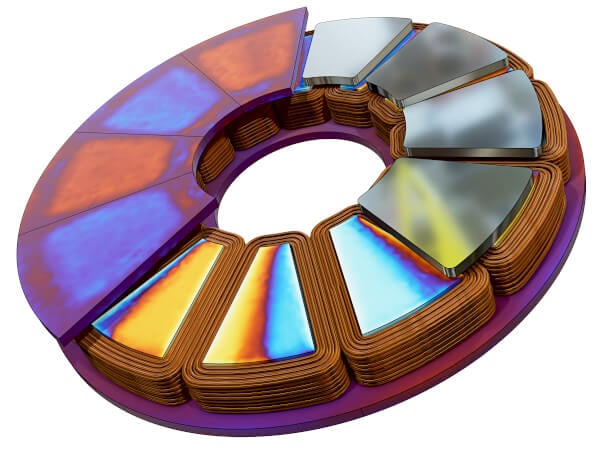
Figure 4. An example of a complex electric motor model that could be packaged into a simulation app. Image used courtesy of Bodo’s Power Systems [PDF]
These apps, and more, were used by the company’s engineering team as well as supervisors and the marketing team. The different teams were able to assess real-world performance and better understand the products.
Preparing for the Next Generation of Power Electronics
Power electronics sit at the center of electrification. Their performance and reliability depend on the interaction of electrical, thermal, mechanical, and fluid phenomena, interactions that single-physics approaches cannot fully capture.
Wide-band-gap semiconductors, higher switching frequencies, and tighter integration will only intensify multiphysics interactions in power electronics. At the same time, pressure to shorten development cycles and control cost continues to grow. Multiphysics-based simulation and simulation apps offer a scalable response. They support collaboration and preserve detailed physical insight while making advanced analysis accessible beyond a small group of specialists.
By embedding multiphysics directly into everyday engineering workflows, teams can move away from reactive troubleshooting and toward more predictive, model-driven development. Teams that integrate this development approach will be better positioned to deliver reliable, high-performance power electronics for the next generation of energy and mobility systems.
COMSOL Multiphysics is a registered trademark of COMSOL AB.
This article originally appeared in Bodo’s Power Systems [PDF] magazine.