Facebook
 Google
 GitHub
 Linkedin
pSemi Unveils Power Solutions for Humanoid Robotics and More
At APEC 2026, pSemi launched a 72 W DC-DC converter module to deliver ultra-thin, high-efficiency power delivery in robotics, AI data centers, and other applications.
At APEC 2026, pSemi released its PE25304 DC-DC converter module, which reduces PCB size while delivering high-power throughput. By combining a complete power solution into a low-profile package, pSemi aims to help teams simplify their power distribution network layouts without sacrificing thermal performance or efficiency.

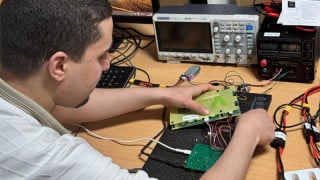
The pSemi (a division of Murata) team was at APEC 2026, demonstrating multiple new products, including the PE25304. Image used courtesy of pSemi
The PE25304 Module
A major feature of the PE25304 is its ability to deliver up to 72 W of power in a compact 11.5 x 9.5 x 2.0 mm package. Based on a fixed divide-by-4 charge pump-based converter, the system operates over an input voltage range of 20 to 60 V.
According to the company, this input flexibility lets the module support standard 48 V bus systems commonly found in data centers, networking equipment, and base stations. In addition to its input flexibility, the PE25304 module has a peak efficiency of 96.5% at a 2.4 A load and 95% at a full 6 A load, with a 48 V input.
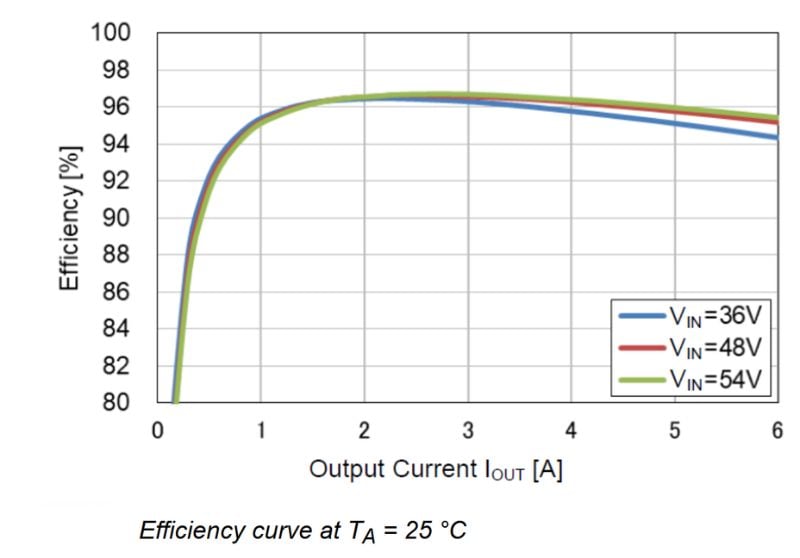
Efficiency curve of the PE25304 module. Image used courtesy of pSemi
To simplify the product development process, pSemi includes a power solution in the module that operates without external loop compensation. This means hardware engineers only need three additional external components to complete the design.
The company further optimized the module’s pinout to enable a simple power layout, helping engineers reduce routing parasitic resistance and further improve overall system efficiency. For higher-power applications, development teams can scale the design by stacking up to 4 PE25304 modules in parallel.
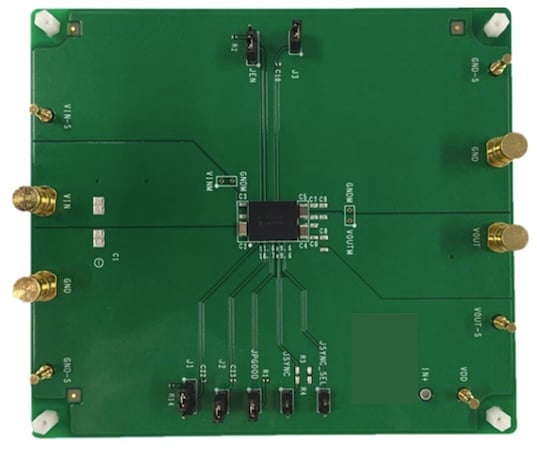
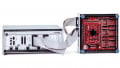
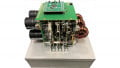
This application board example was used to demonstrate the performance of the PE25304. Image used courtesy of pSemi
pSemi has built several fault protection features directly into the device, including over-current protection with a 10 A threshold and short-circuit protection that automatically latches the device off at 15 A. To prevent overheating damage, the internal thermal shutdown circuitry turns off the charge pump if temperatures exceed 150°C.
Understanding Charge Pump Architectures in DC-DC Conversion
Charge pump circuits store energy primarily in capacitors, transferring charge from an input to an output through a network of controlled switches. Compared to traditional inductive buck converters, which rely on magnetic fields within an inductor to step down the voltage, charge pumps use a multi-phase switching sequence to change capacitor connections.
In a divide-by-four configuration, the controller alternates the switches to charge several internal capacitors in series during one phase, then discharge them in parallel or at a specific ratio during the subsequent phase. This method inherently defines the voltage conversion ratio based on the circuit topology rather than a pulse-width modulation duty cycle.
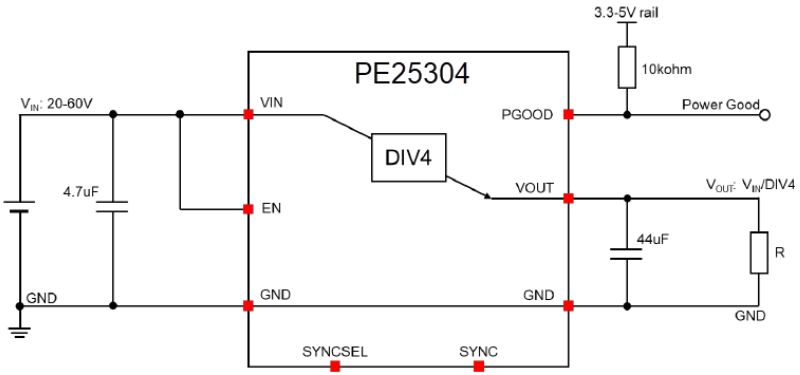
Schematic of the PE25304 module’s charge pump circuit. Image used courtesy of pSemi
Charge pump circuits help engineers avoid using inductors for a more compact power supply, as inductors are typically the largest and tallest components. By relying solely on capacitors for voltage boost or buck, charge pump circuits deliver a path toward more compact solutions. In addition, inductors generate significant electromagnetic interference when subjected to rapid current changes, which adds complexity and requires additional filtering components.
Future Impacts on High-Density Power Systems
The PE25304 is currently available to use in new product designs as part of pSemi's power management portfolio.