Facebook
 Google
 GitHub
 Linkedin
Navitas Unveils 12 kW GaN and SiC PSU Targeting AI Data Centers
The PSU leverages ORv3 and OCP specifications to meet the needs of hyperscale data centers.
Navitas has released a 12 kW PSU for hyperscale AI data centers that leverages gallium nitride (GaN) and silicon carbide (SiC) technologies to deliver 97.8% peak efficiency. Designed in compliance with Open Rack v3 and Open Compute Project specifications, the PSU offers a reliable option for designers seeking to upgrade their data center power delivery.
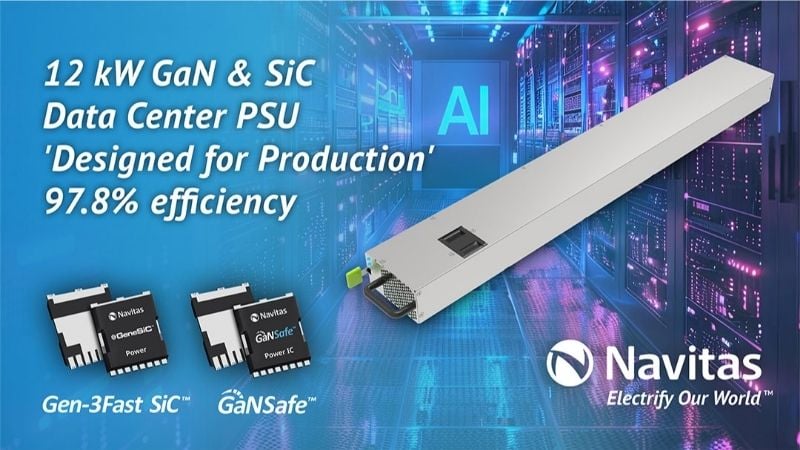
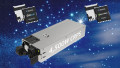
Data center PSU. Image used courtesy of Navitas
Navitas AI PSU
Navitas’ PSU measures 790 x 73.5 x 40 mm, operates from a 180-305 V AC input, and has an architecture combining 3-phase interleaved totem-pole power factor correction (TP-PFC) with a full-bridge LLC converter. The TP-PFC stage uses Navitas’ third-generation Fast SiC MOSFETs featuring trench-assisted planar technology to maximize switching efficiency and thermal performance. The LLC stage uses four GaNSafe ICs that consolidate drive, sensing, protection, and control functions in a single compact package. Together, these GaN devices offer 350 ns short-circuit response, 2 kV ESD resilience, and programmable slew rate with only four external pins and no VCC pin requirement.
The PSU incorporates Navitas’ IntelliWeave digital control to switch between critical and continuous conduction modes (CrCM/CCM) depending on load conditions, which reduces power losses by 30% relative to CCM-only designs. It outputs up to 50 V and maintains full 12 kW delivery above 207 V input, while degrading gracefully to 10 kW below that threshold.
From a safety perspective, the device includes protections against overcurrent, overvoltage, undervoltage, and overheating. This is further supported by active current sharing that supports parallelization for scalability. An internal fan handles thermal management.
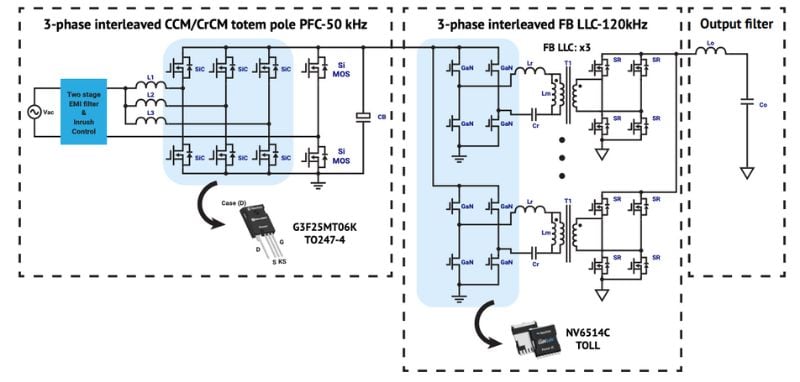
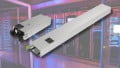
12 kW PSU diagram. Image used courtesy of Navitas
With a hold-up time exceeding 20 ms at full load and inrush current under three times steady-state for less than 20 ms, the PSU meets the transient load demands of modern AI data centers, according to Navitas.
Thermal and Efficiency Challenges of High-Density AI Compute Racks
As hyperscale data centers shift toward AI-centric compute workloads, power architectures must contend with escalating thermal and efficiency constraints. Modern GPU clusters demand exponentially higher current densities, with rack-level power exceeding 100 kW and often pushing beyond 120 kW. This growth stresses traditional silicon-based PSUs, which cannot efficiently switch at high frequencies without incurring substantial conduction and switching losses. The resulting heat buildup degrades performance, reduces system lifespan, and increases cooling costs.
GaN and SiC devices provide an exciting material solution that can help them overcome these limitations. Their wide bandgaps allow higher switching frequencies, reduced losses, and better thermal performance compared to silicon. When paired with high-efficiency topologies such as 3-phase interleaved TP-PFC and full-bridge LLC, and orchestrated with hybrid conduction strategies, designers can optimize performance across varying loads without increasing complexity. Such an approach directly addresses the light-load inefficiencies that often plague data center power systems operating under dynamic AI-driven workloads.
Redefining Baselines for AI Infrastructure
As compute requirements scale, the baseline expectations for efficiency, thermal performance, and integration will change. Design strategies that once relied on incremental efficiency gains now must contend with steep thermal gradients, rapid load swings, and increasingly dense rack geometries. GaN and SiC technologies, when implemented through cohesive architectures, begin to recast what’s viable in real-world deployments.