Facebook
 Google
 GitHub
 Linkedin
Littelfuse Launches High-Voltage TVS Diodes for Power Protection
The high-voltage TVS diode family delivers a stand-off voltage of up to 400 V in a single AEC-Q101 SMC package.
Littelfuse has launched three automotive-grade TVS diode series, TPSMC, TPSMD, and TP5.0SMDJ, that can protect GaN/SiC MOSFETs and IGBTs up to 400 V in a single device. The diodes also reduce BOM complexity in battery disconnect units, HVAC systems, and PTC heaters.
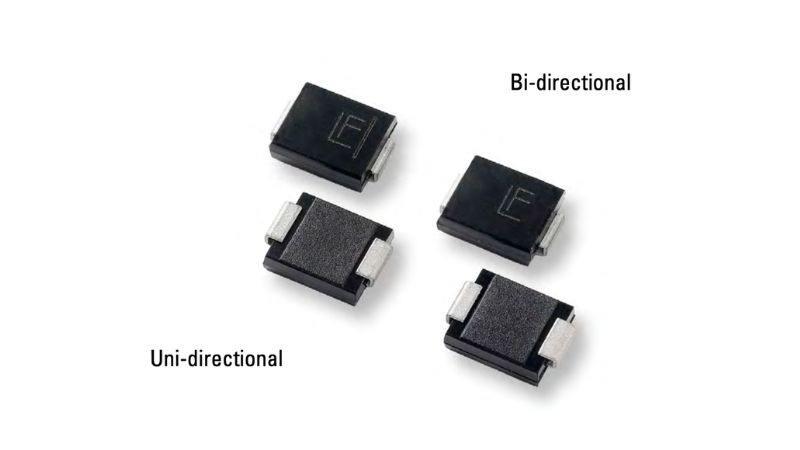
Littelfuse TVS diodes in unidirectional and bidirectional configurations. Image used courtesy of Littelfuse
The Problem With Protecting Wide-Bandgap Devices
GaN and SiC MOSFETs, along with IGBTs, dominate modern automotive power modules because they are efficient in high switching frequencies and elevated temperatures. But these devices are acutely sensitive to voltage overstress. Load dumps, inductive switching events, and other high-energy transients can spike voltages far beyond the device ratings in microseconds.
Traditional TVS solutions work well below 400 V, forcing designers to place multiple devices in series to achieve sufficient standoff voltage, where each stack shares a portion of the clamping burden. But every additional device introduces another solder joint, another failure mode, additional board area, and greater BOM complexity.
Littelfuse is targeting that directly with its new TVS diode series, built primarily for the high-voltage automotive subsystems inside electrified vehicles.
What the TVS Family Offers
Littelfuse's TVS diodes are available in a DO-214AB surface-mount package and are characterized using a 10/1000 µs waveform at a 0.01% repetition-rate duty cycle. All three series share a common architecture built around high standoff voltage and broad surge handling capability, and are differentiated by their peak pulse power ratings to accommodate the energy demands of different automotive subsystems.
The TPSMC supports a standoff voltage range of 300 V to 540 V with a peak pulse power rating of 1,500 W, making it well-suited to layouts where board space is at a premium and surge energy requirements fall within a moderate range. 
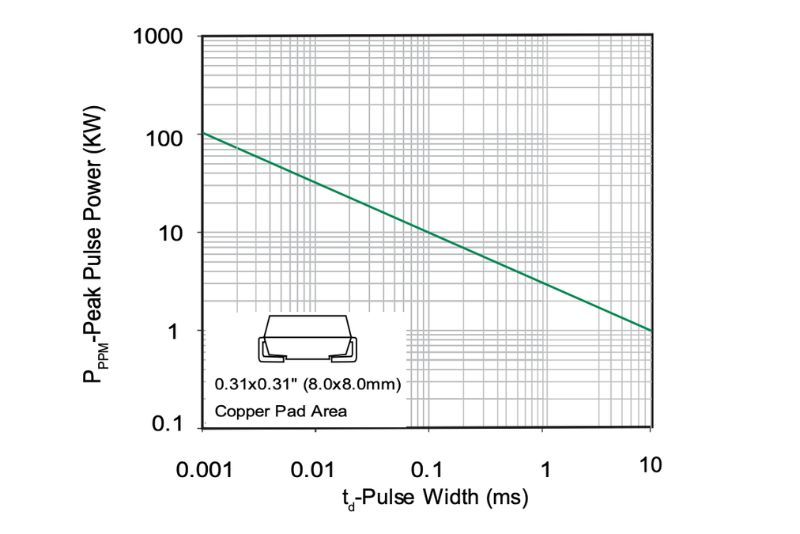
Peak pulse power rating. Image used courtesy of Littelfuse
The TPSMD spans 180 V to 400 V with a peak pulse power rating of 3,000 W, targeting applications on high-energy HV rails where surge conditions are more severe. The TP5.0SMDJ carries the highest surge capability in the family at 5,000 W peak pulse power, providing the maximum transient energy handling across the portfolio.
These devices support peak surge current up to 300 A. Response time across the family is rated at less than 1 picosecond from 0 V to the minimum breakdown voltage, ensuring fast clamping before sensitive semiconductor junctions are stressed.
Automotive Qualification Without Compromise
On the qualification side, they carry AEC-Q101 certification, are PPAP-capable, and available in both unidirectional and bidirectional configurations. ESD immunity is rated to IEC 61000-4-2 for electrostatic discharge up to 30 kV (air and contact), and EFT immunity is validated to IEC 61000-4-4 standards. The typical failure mode under overstress is a short circuit, a predictable and generally preferred behavior in protection device applications.
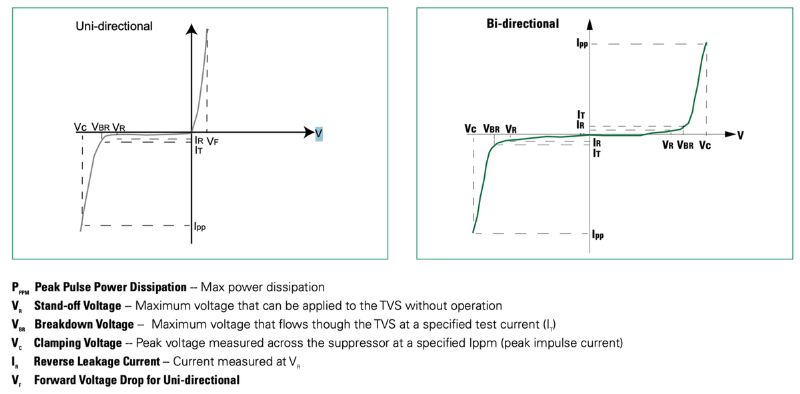
I-V characteristics curve for both unidirectional and bidirectional configurations. Image used courtesy of Littelfuse
Beyond direct protection, a tighter clamping voltage carries a downstream benefit for the power semiconductors. When a single well-characterized device tightly controls the clamping voltage, the worst-case overvoltage that the protected device must survive is reduced. Engineers can therefore specify GaN or SiC MOSFETs rated closer to the actual operating voltage rather than building in excess voltage margin to accommodate transient headroom. That means lower on-resistance, reduced conduction losses, and better overall system efficiency.
These high-voltage TVS diodes target high-voltage automotive subsystems such as battery disconnect units (BDUs), high-voltage HVAC compressors, and PTC cabin and battery heaters.
Additional information is available on TPSMC, TPSMD, and TP5.0SMDJ product pages.
What’s Ahead
Littelfuse is first to market with an automotive-qualified solution at this voltage class, but with 800 V platforms already in production and some next-generation programs exploring even higher voltages, the standoff voltage requirements for automotive TVS diodes will only climb from here.
How the rest of the protection supply chain responds, and whether the industry sees a broader push toward standardized high-voltage TVS specifications for next-generation EV platforms, will define the competitive landscape for this device category over the next several years.