Facebook
 Google
 GitHub
 Linkedin
No Fear of Short Circuits
The energy transition is giving birth to numerous new DC applications that require protection against overloads and short circuits. Learn how Mersen’s new fuse design addresses these challenges.
This article is published by EEPower as part of an exclusive digital content partnership with Bodo’s Power Systems.
Article co-authored by Jean-François de Palma, Vice President SPM R&D at Mersen.
In the coming years, thousands of new charging stations, electrical energy storage systems, and DC distribution systems will be put into service. These systems are, so to speak, the backbone of the energy transition. However, the expansion of charging and storage capacities involves numerous challenges. One of these is effective protection of the infrastructure against damage from short circuits. This is essential to guarantee the constant availability of systems and equipment.

Figure 1. Charging points for electric cars can be easily damaged by short circuits or overloads. Image used courtesy of Adobe Stock
Currently infrastructures are protected by standard fuses. They are usually installed in an external circuit and therefore require a certain amount of installation space, as well as their own electrical connections. On top of electrical characteristics new emerging DC applications are requiring compact and lighter fuse, ease of connection as well as minimized heat generated in the cabinet where the fuses are installed.
Mersen, The Recognized Specialist for Fault Current Protection
Mersen has released and is currently developing new ranges of DC fuses up to 1500 V and 2000 V DC. The latest developments are addressing new electrical as well as mechanical requirements expected by these emerging DC applications. The very last development is focusing on compact DC fuse concept, product name PowerPack fuse, for applications up to up to 1000 V DC, followed by 1500 V DC rated fuse as a second step.
In a standard fuse, the heat from the fuse-link is dissipated for the most part via its connections, bars and cables, as well as fuse body. However, these thermal conduction paths are away from the zone with ohmic resistance. To gain in fuse current rating still maintaining low I2t a new cooling approach was investigated.
New Cooling Concept
Mersen therefore developed a completely new type of thermal management for the new fuses. The company relies on its cooling knowledge, which is used for power semiconductor modules. The fuse elements are positioned as close as possible to a heat sink through a DCB and base plate layer, allowing an efficient heat transfer. Since heat generated by the PowerPack fuse elements is efficiently managed versus a standard fuse, more current can be carried by this new design, still keeping a much lower I2t. The gain is estimated at 30% in current rating, 50% in peak let-through current, 10 times less in I2t vs a standard fuse. The PowerPack current ratings of the compact cooled fuses ranged from 330 A to 1000 A with a 65 °C cooling plate. The innovative fuse cooling concept is important, especially with a view toward the increasing power density of electronic components.

Figure 2. The new cooled compact fuses from Mersen protect, among other things, charging stations for electric cars from overloads and short circuits. Image used courtesy of Adobe Stock
Compact Design Enabling Fast Clearing
The innovative PowerPack thermal management design is not the only advantage of Mersen's new fuses. As a result, better thermal management of fuse elements helps reduce their size, leading to faster melting in the event of a short circuit. Consequently, a fault current is interrupted much faster. Another striking feature is its compact size, which is three times smaller than standard fuses. Fast triggering of the new compact fuses from Mersen means that the current flow is interrupted, thus protecting downstream components. This principle offers excellent protection against short circuits down to overload current.
The PowerPack fuse original design permits to eliminate the heat generated into a cabinet. Like semiconductor module designs, SiC or Si, PowerPack fuse module design allows the heat generated by the fuse elements to be extracted thru the fuse module base plate to a heat sink, thus eliminating the heat generated in a cabinet. In addition to saving space, this design offers other advantages like better cycling.
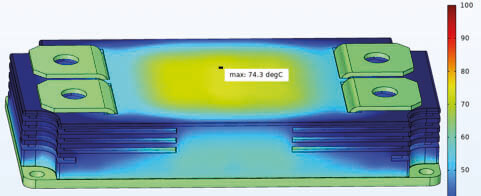
Figure 3. Simulation of the thermal management of the cooled compact fuse at 1000 A on a cooling plate with a temperature of 65 °C. Image used courtesy of Mersen and Bodo’s Power Systems [PDF]
Standardized Dimensions for Easy Installation
For fast integration of the fuses in power distribution and storage systems, Mersen designed the fuses with dimensions like conventional semiconductor modules. Installation is also facilitated thanks to the fuse module design. Connection to a laminated bus bar becomes easier, resulting as well in a lower stray inductance. Fuse module design is three times lighter than standard fuse catalog. This makes it easy for manufacturers to integrate the compact fuses in their applications.
Innovative Simulation Process Was Used
The development process for the new fuse concept took a little more than one year. The experts at Mersen used innovative numeric tools for the development that were modeled using multiphysical simulation processes. It was shown that a compact fuse design with a cooling function not only results in a lower l2t value, but also a lower peak flow than standard fuses.
The thermal simulation also showed that the new concept increases the conductivity rating of the fuse by at least 30 percent compared to an uncooled fuse if it is mounted on a cooling plate having a temperature of 65 °C. In addition, short circuit tests confirm the excellent performance of the cooled compact fuse in accordance with DC fuse standards. For a voltage rating of 1000 A, for example, a minimum breaking capacity of 3600 A was measured – which corresponds to 3.6 times the rated current. The maximum breaking capacity of the compact fuse was tested up to 30 kA, not representing the max IR of this fuse.
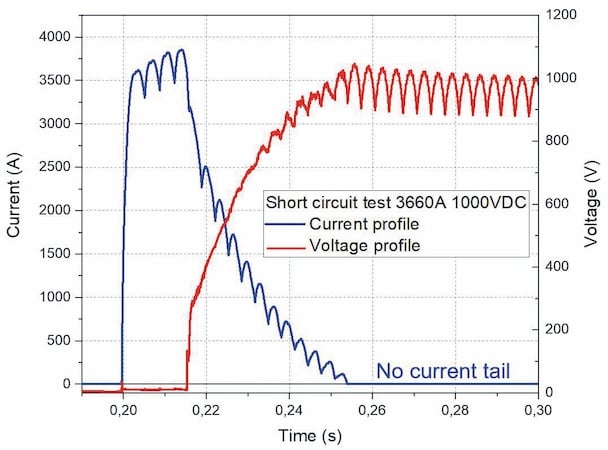
Figure 4. The graph shows the current and voltage range of the cooled compact fuse during a short-circuit test at 3660 A and 1000 A respectively. Image used courtesy of Mersen and Bodo’s Power Systems [PDF]
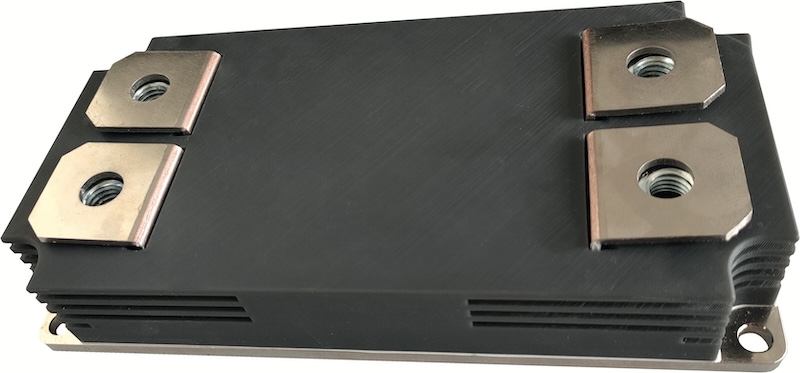
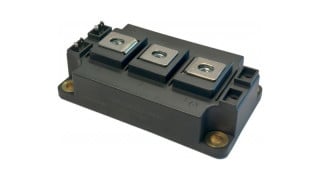
Figure 5. Mersen has developed a completely new compact fuse that can be welded directly to a cold plate. Image used courtesy of Mersen and Bodo’s Power Systems [PDF]
Mersen Continues Developments
The new cooled compact fuses from Mersen represent a high-performance electrical protection concept for DC on-board applications like charging boxes dedicated to MegaWatt Charging, as well as for stationary applications like Charging stations or EES containers applications with L/R ≤ 3 mS. Featuring low I2t, ease of connection, no heat generated in the cabinet, smaller size, lower weight … this fuse design offers a clear advantage versus standard fuses. Mersen's R&D team is continuing to improve the design of the compact fuses. The next version will also be suitable for DC applications up to 1500 V.
This article originally appeared in Bodo’s Power Systems [PDF] magazine and is co-authored by Jerome Michoux, Mersen.