Facebook
 Google
 GitHub
 Linkedin
ITECH Launches DC Electronic Loads for Servers, Charging Tests
The IT8100A/E high-power family targets fast transient response and parallel scaling for AI accelerator, fuel cell, and DC fast charger development.
The IT8100A/E high-power family targets fast transient response and parallel scaling for AI accelerator, fuel cell, and DC fast charger development.
ITECH has introduced the IT8100A/E Series, a family of high-speed, high-power DC electronic loads designed to validate power supplies for AI servers, GPU accelerators, fuel cell stacks, and high-voltage DC charging equipment.
The Taiwanese test instrument vendor describes the line as a successor to its existing IT8800 and IT8900 high-power loads, stating that it features groundbreaking power density, scalable parallel operation, and high-dynamic response performance.
The launch reflects how two parallel demands are reshaping the test instrumentation market. AI server power supplies routinely must absorb load steps measured in hundreds of amps as GPU clusters cycle through training and inference workloads. New energy DC fast chargers, meanwhile, push tens of kilowatts at constantly varying battery voltages and need their power stages exercised across the full envelope before deployment.
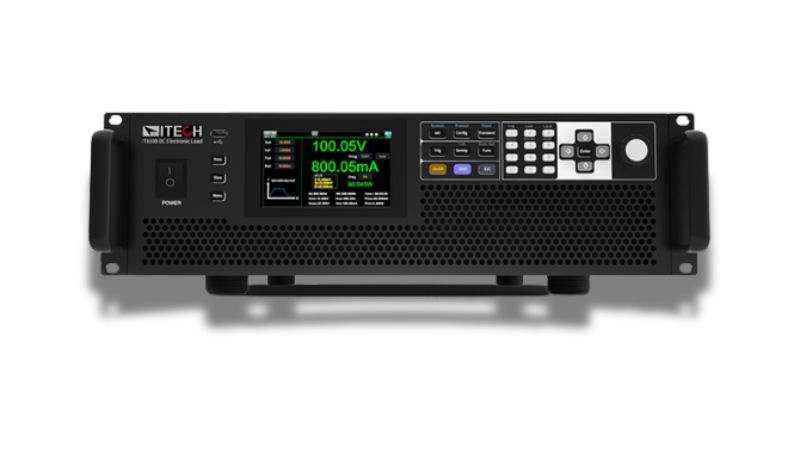
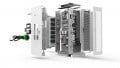
The IT8100A/E. Image used courtesy of ITECH
Four Primary Applications
ITECH’s new series has four primary application areas: AI server power supplies, energy DC charging devices, GPU power supplies, and fuel cells. All four share a common test profile in that they demand sustained kilowatt-class power dissipation, fast transient capability to mimic real load swings, and the ability to combine multiple load chassis to scale up to hundreds of kilowatts of sink capacity for full-system testing.
Detailed channel-by-channel power and voltage figures for the IT8100A/E weren’t disclosed. However, based on ITECH's existing product lines—where the IT8800 covers 150 W to 6 kW and the IT8900 reaches 45 kW—this series appears to sit between those two ranges. It is built around a modern set of operating modes (CC, CV, CR, CP) and includes the dynamic and battery test functions standard across ITECH’s programmable load portfolio.
Learn more about IT8100 DC testers. Video used courtesy of IITECH
The vendor specifically highlights parallel scalability. For high-power test setups, especially around AI server PSUs that can themselves run into the multi-kilowatt range per unit, the load bank needs to grow to match the device under test. ITECH's wording around scalable parallel operation is notable here, allowing customers to combine units into a coordinated bank that behaves as a single instrument from the user interface.
Dynamic Response
Static load testing, in which a power supply must deliver a fixed current and the engineer measures voltage regulation and thermals, is comparatively easy compared to dynamic response. How quickly can the supply's control loop react when the load suddenly steps from light to heavy, or back? AI workloads make this worse because the load patterns aren’t just step functions but irregular, repeating bursts in milliseconds.
DC fast chargers share similar dynamic concerns, but they’re inverted. The charger has to ramp output as the battery management system requests, and any sluggishness in the charger's regulation shows up as either undelivered energy or, worse, voltage transients on the battery side. A load that can faithfully replicate those battery-side current demands is the only way to qualify the charger before it sees a real vehicle.
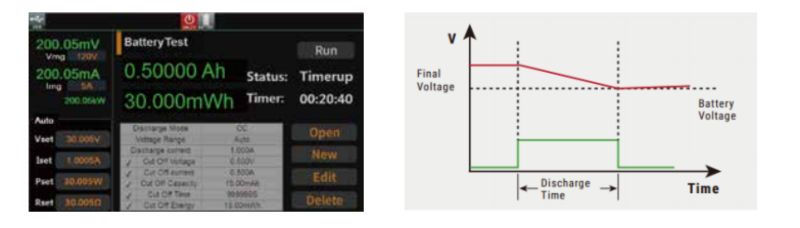
Battery discharge mode. Image used courtesy of IITECH
So, while ITECH isn’t breaking new ground with a fast electronic load as a category, the IT8100A/E does represent a refresh of the company's high-power tier with the kind of slew rates and resolution that current-generation engineers are now demanding as standard.
A Competitive Field
The high-power programmable load market is concentrated, and the IT8100A/E enters a field that includes Chroma's 63600 and 63800 families, Keysight's RP7900 regenerative loads, and the legacy Agilent N3300 and N3306 lines that still see service in many labs.
Regenerative loads, which return absorbed energy to the grid rather than dissipating it as heat, are an increasingly important differentiator at the upper end. ITECH's existing IT8000 series competes there, and the absence of explicit regenerative mention in the IT8100A/E announcement suggests the new family is designed as a high-density purely dissipative platform rather than a regenerative system.