Facebook
 Google
 GitHub
 Linkedin
EV Racecars Accelerate, Setting Speed and Endurance Records
Formula E racing has introduced its Gen4 racecar, while Ford has shattered speed records in electric drag racing.
While Formula 1 has dominated racing since the 1940s, its all-electric counterpart, Formula E, held its first race in 2014. Created to inspire racing fans, raise awareness about climate issues and clean transportation, and accelerate electric vehicle innovation, Formula E is now demonstrating just how far (and how fast) EVs can go.
Formula E’s Gen4 cars are reaching top speeds of 208 mph, while Ford Racing and the National Hot Rod Association (NHRA) are pushing the limits even further, surpassing 222 mph in electric drag racing.
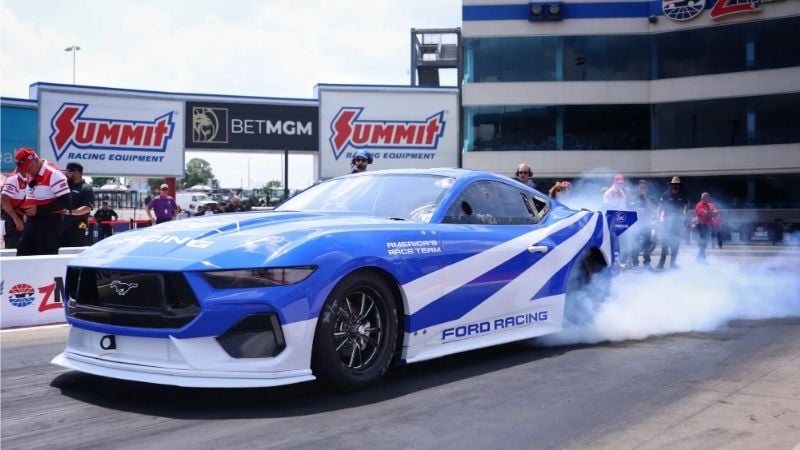
The Ford Racing Mustang Cobra Jet 2200 reached a top speed of 222 mph. Image used courtesy of Ford
Pit Boosts Offer Super Fast Charging
Formula E has introduced a mandatory “Pit Boost,” requiring cars to stop for a 34-second, 600 kW boost that adds 10% more usable energy. Before the Pit Boost, drivers had to carefully conserve battery power throughout the race or recover energy through regenerative braking to make it to the finish line.
Adding the pit stop introduced a new layer of strategy. Teams can only use the Pit Boost when a car’s state of charge is between 40 and 60%, meaning drivers cannot pit at just any point in the race. Teams are also limited to servicing one car at a time, making the timing of each stop potentially decisive for both individual and team outcomes.
To increase the strategic element, Citroën boss Cyril Blais has proposed allowing Formula E teams to choose how much energy cars receive during a recharge. Teams could opt for a shorter stop with less energy or a longer stop with a greater recharge, creating new opportunities for competitive advantage and race strategy.
Formula E Gen4 Reaches Over 208 mph
The Gen4 vehicle dominates Formula E’s racetrack. The car will race during the 2026-27 season, which starts later this year.
Learn more about Gen4 Formula E racing. Video used courtesy of FIA and Formula E
The Gen4 is expected to reach speeds exceeding 208 mph, accelerate from 0 to 62 mph in approximately 1.8 seconds, and from 0 to 124 mph in just 4.4 seconds, 1.5 seconds faster than the Gen3 Evo. It also delivers up to 600 kW of power, representing a 71% increase in base output over its predecessor, and is the first Formula E car to feature permanent all-wheel drive.
The performance leap marks a significant milestone for Formula E and EV technology, including improvements in speed, power, and on-track performance. The Gen4 incorporates 20% recycled materials, reflecting Formula E’s commitment to sustainability.
Ford Racing Proves Electric Can Go Even Faster
In the world of drag racing, Ford Racing and the NHRA unveiled the Mustang Cobra Jet 2200 in April. The completely redesigned vehicle is powered by a 900 V electrical architecture and a combined 32 kWh battery pack. According to Ford, the system can recharge in approximately 20 minutes, fitting comfortably within the NHRA’s standard 45-minute turnaround window between runs.
The vehicle uses a patented centrifugal clutch, a component rarely found in EVs. In drag racing, however, precise torque delivery at launch is critical. The clutch briefly slips before locking into direct drive, maximizing traction and efficiency.
Ford’s electric Mustang drag racing program has advanced rapidly. The original Cobra Jet 1400 ran an 8.128-second quarter mile in 2021, while the Cobra Jet 2200 has smashed the seven-second barrier with a 6.87-second pass at 222.36 mph. Ford credits the progress to extensive simulation and development work.
The Cobra Jet 2200 also introduced a pyrotechnic circuit breaker that can instantly disconnect the high-voltage system in an emergency, adding another layer of protection for drivers and crews while meeting NHRA safety standards.