Facebook
 Google
 GitHub
 Linkedin
Third-Gen DC Chargers Offer Faster Charging for Fleets, Trucks
ChargeTronix’s 240 kW fleet chargers can handle up to 16 electric vehicles at once.
Many businesses are turning to electric trucks and fleets to save costs and reduce their carbon footprints. Yet, the transition to electric fleets often requires building an extensive charging infrastructure. A charging station that could quickly charge more than one vehicle could be an efficient solution.
California-based ChargeTronix has introduced its third generation of 240 kW EV charging systems. Included is its 1,280 kW Nexus Distributed Charging System that can charge as many as 16 EVs at a time from a single power cabinet. The system is suitable for fleets, large truck stops, dispatch centers, and charging hubs.
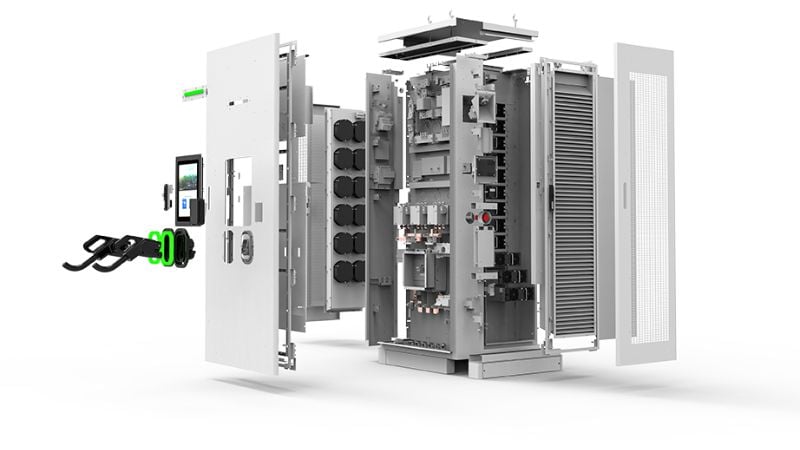
Inside ChargeTronix’s EV charger. Image courtesy of ChargeTronix
Fast DC Charging
DC fast chargers are rapidly becoming a cornerstone of the global electric vehicle charging infrastructure, and their future is marked by continued growth, technological innovation, and expanding deployment. The global market for DC fast chargers, including 240 kW models, is projected to grow significantly, driven by rising EV sales and an international trend of governmental support for electrification. The need for rapid charging solutions to reduce range anxiety and minimize downtime is pushing 240 kW chargers into mainstream deployment as the number of public charging stations has more than doubled in recent years.
Transitioning commercial fleets, such as delivery vans, trucks, and buses, to electric power is fueling demand for higher power solutions such as 240 kW and 350 kW chargers. In terms of hardware efficiency, 240 kW and 350 kW chargers are nearly identical—both are highly efficient, with minimal conversion losses. In real-world use, the difference in charging efficiency is usually dictated by vehicle limitations and charging curves, not the charger itself. For most EVs, a 240-kW charger delivers nearly the same average charging performance as a 350-kW charger, unless the vehicle is specifically designed to sustain ultra-high charging rates. The main trade-offs with 350 kW chargers are higher infrastructure costs and complexity.
The widespread adoption of high-power chargers like 240 kW units will require careful management of grid stability and local infrastructure upgrades. While equipment costs for 240 kW chargers are higher than lower-power units, their ability to serve more vehicles in less time can improve return on investment, especially in high-traffic locations. As EV battery technology evolves, 240 kW and higher-powered chargers will need to remain compatible with a wide range of vehicles, from passenger cars to commercial trucks.
ChargeTronix
The third-generation 240 KW chargers introduced by ChargeTronix are designed for both passenger EVs and electric trucks. They feature a 50 percent larger ADA-compliant video control screen, intelligent power distribution between multiple charging connectors, and advanced safety features such as flood and smoke detection. The 240 kW chargers can allow most Class 6 to 8 vehicles to reach 80 percent charge in as little as 30 minutes and can charge heavy-duty vehicles in one hour. In the past three years, the company has produced more than 3,000 DC fast chargers.
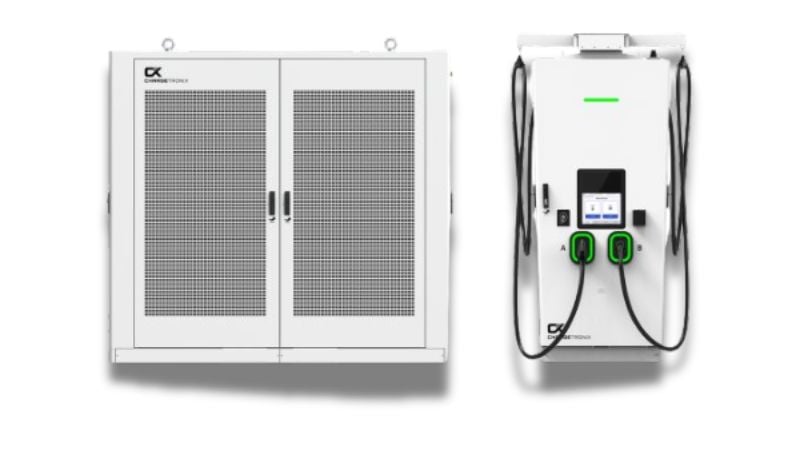
The third-generation 240 KW chargers. Image used courtesy of ChargeTronix
ChargeTronix also expanded its Gen-3 Apex SXE line of silicon carbide-based EV chargers and now includes 60kW, 120kW, 160kW, and 240kW all-in-one chargers with dual charging and advanced safety sensors, including flood and smoke detection. A 15-inch high-definition (HD) touchscreen and versatile payment options provide user-friendly operation.
The future for high-power (240 kW) EV chargers is robust and promising. As EV adoption accelerates and charging infrastructure matures, such chargers will play a pivotal role in enabling fast, reliable, and scalable charging for both passenger and commercial vehicles. Integrated with renewable energy, these chargers are a key part of the transition to electric mobility.