Facebook
 Google
 GitHub
 Linkedin
Modular Architecture: The Key to Reliable EV Charging Infrastructure
Learn how modular design principles contribute to EV charger reliability, scalability, and maintenance for engineers planning charging networks.
One out of every five. According to J.D. Power's 2024 Electric Vehicle Experience Public Charging Study, that's how often a charging session fails when a consumer is trying to refuel his or her EV. The result? EV owners are frustrated and dissatisfied.
The first quarter of 2025 saw a slight uptick to public EV charger performance, improving to an 84% success rate, but still falling well below the 97% goal that engineers target when designing charging infrastructure. In fact, some governmental funding programs mandate minimum uptime thresholds, making reliability a prerequisite for infrastructure investment rather than merely a competitive advantage.
Traditional monolithic charger designs create single points of failure that can sideline entire stations for weeks during repairs. The solution lies in modular architecture—a design philosophy that transforms the approach to EV charging reliability, scalability, and long-term infrastructure planning.
Modular Design: Engineering for Reliability
Modular charger architecture addresses the reliability challenge by breaking complex charging systems into distinct, replaceable components. Rather than treating the charger as a single integrated unit, modular designs separate key functions into independent modules that can operate independently and be serviced without affecting other system components.

Figure 1. An example of an EV charger that uses modular components, a 180 kW charger from BTC Power.
Power Module Independence: In a modular DC fast charging system, power conversion is distributed across multiple independent power modules rather than concentrated in a single large converter. Each module typically handles 25-50 kW of power conversion, with multiple modules working in parallel to achieve the desired total power output. If one module fails, the remaining modules continue operating at reduced capacity, maintaining charging capability while repairs are scheduled.
This approach contrasts sharply with traditional integrated designs, where a single power converter failure renders the entire charger inoperable. For example, a 150 kW modular charger using six 25-kW modules can continue operating at a 125 kW capacity even with one failed module, maintaining 83% of its full capacity rather than experiencing complete failure.
Hot-Swappable Components: Advanced modular designs incorporate hot-swappable components, enabling field replacement without shutting down the entire charging station. Critical components, such as power modules, control boards, and communication interfaces, are designed for rapid replacement using standard tools and minimal technical expertise.
This capability dramatically reduces the mean time to repair (MTTR) from days to hours or even minutes. Field technicians can carry common replacement modules and swap failed components on-site, often restoring full functionality during a single service call. Advanced modular designs also integrate cooling systems that eliminate external chillers, reducing both installation complexity and potential failure points.
Scalability Advantages
Beyond the benefits of reliability, modular architecture offers unprecedented scalability for infrastructure deployment. This flexibility addresses one of the most significant challenges facing charging network operators: the uncertainty surrounding future demand and the evolution of vehicle technology.
As EV adoption accelerates, convenience retailers are exploring flexible and scalable solutions to meet the growing demand for charging infrastructure. One retailer, Jacksons Food Stores, recently launched a pilot program featuring BTC Power’s Gen 4 All-in-One (AiO) DC Fast Chargers.
Modular design played a pivotal role in the company’s decision, enabling Jacksons to future-proof their investment—adding charging capacity at individual sites as EV adoption increases, without needing to overhaul their infrastructure. For retailers navigating the evolving EV landscape, scalability and adaptability are becoming essential features in charging deployments.
Phased Deployment Strategy: Modular systems enable phased deployment strategies that reduce initial capital investment while preserving expansion options. Engineers can specify infrastructure capable of supporting high-power charging but initially install only the number of power modules required to meet current demand projections.
For example, a site designed for eventual 350 kW charging might initially deploy with 150 kW capacity using six 25 kW modules. Advanced models offer a future capacity of up to one megawatt, contained within a system that occupies a similar footprint to other EV chargers, providing concentrated power without requiring additional real estate.
As demand grows or funding becomes available, additional modules can be installed to reach full capacity without requiring the replacement of existing infrastructure. This approach can reduce initial deployment costs while hedging against funding lapses or slower-than-expected adoption.
Technology Future-Proofing: The modular approach provides inherent future-proofing as EV technology continues to evolve. Vehicle charging capabilities are increasing rapidly, with new models supporting 800V architectures and charging rates exceeding 250 kW. Modular chargers can accommodate these advances through module upgrades rather than complete system replacement.
When next-generation power modules become available with improved efficiency, higher power density, or enhanced capabilities, they can be integrated into existing modular systems. This upgrade path extends the life of infrastructure services and protects capital investments against technological obsolescence.
Economic Benefits
The economic advantages of modular architecture extend beyond the obvious benefits of reduced downtime and phased deployment. Total cost of ownership (TCO) analysis consistently favors modular designs when lifecycle costs are considered, including ease of maintenance and servicing time.
While EV charger owners may have maxed out on charging power capacity now, newer EVs with larger, more powerful batteries are always in development. Having a modular system means easy power upgrades in the future without having to buy an entirely new system.
Maintenance Cost Reduction: Modular designs significantly reduce maintenance costs through several mechanisms. Component standardization enables bulk purchasing of spare parts, reducing the need for technician training. The ability to quickly swap failed components reduces labor costs and minimizes the need for specialized repair expertise in the field. The Gen 4 AiO EV charger from BTC Power, for example, features swappable modules that can be replaced in under 30 minutes by a single technician, without requiring wiring changes.
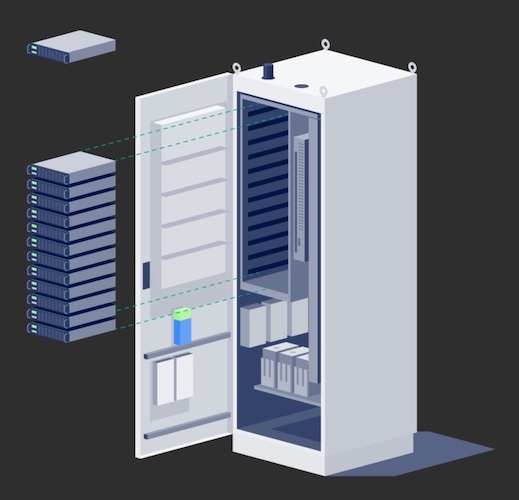
Figure 2. Technicians can increase the charging capacity of an EV charger in the field by adding additional power modules.
Modular charger design architecture enables faulty power components and related circuit boards to be identified and swapped out quickly. OCPP-compliant modular designs enable centralized monitoring and diagnostics across entire charging fleets, regardless of manufacturer, further streamlining maintenance operations.
Predictive maintenance becomes more effective with modular designs because the health of individual modules can be monitored independently. This enables condition-based maintenance strategies that replace modules before failure occurs, further reducing unplanned downtime.
Modular designs also streamline firmware management across charging networks. When manufacturers release updates, standardized modules enable fleet-wide deployments without the complexity of managing multiple firmware variants across different charger configurations.
Industry Impact and Future Trends
The adoption of modular architecture represents a fundamental shift in how the industry approaches charging infrastructure design. Early adopters have demonstrated uptime rates exceeding 98%, above the 96% minimum requirements and competitive with traditional fuel dispensing equipment.
Standardization Initiatives: Industry organizations are developing standardization initiatives for modular charger interfaces and communication protocols. These efforts aim to enable interoperability between modules from different manufacturers, creating more competitive supply chains and reducing vendor lock-in concerns.
The Charging Interface Initiative (CharIN) and other organizations are collaborating to establish standardized interfaces for power modules, communication protocols, and safety systems. These standards will accelerate adoption by reducing integration risks and enabling the mix-and-match sourcing of components.
Modular designs enable manufacturing scalability, allowing for a more effective response to market demand fluctuations. Manufacturers can adjust production volumes for individual modules rather than complete charger systems, enabling more efficient capacity utilization and shorter lead times.
Multiple Benefits of Modularity
Modular architecture represents a change in thinking toward more reliable, scalable, and economical EV charging infrastructure. By breaking complex charging systems into discrete, manageable components, engineers can achieve the stringent uptime requirements mandated by funding programs while providing the flexibility needed to adapt to evolving technology and market conditions.
The benefits extend far beyond simple reliability improvements. Modular designs enable phased deployment strategies that reduce financial risk, provide clear technology upgrade paths, and support new business models around component reuse and refurbishment. As the EV charging industry matures, modular architecture will likely become the dominant design paradigm for commercial and fleet applications.
For engineers specifying charging infrastructure today, modular architecture offers a proven path to meeting reliability requirements while future-proofing investments against technological change. The combination of improved uptime, reduced lifecycle costs, and deployment flexibility makes modular chargers a compelling choice for any serious charging infrastructure deployment.
BTC Power has demonstrated the effectiveness of this approach, achieving industry-leading 98% uptime across over 22,000 deployed charging systems, far exceeding typical industry performance, and directly addressing the consumer satisfaction crisis documented by J.D. Power research.
All images used courtesy of BTC Power.