Facebook
 Google
 GitHub
 Linkedin
Compact Battery Cycler-Emulator Offers Flexibility, Efficiency
NI’s scalable cycler and emulator tests batteries in laboratory or production environments.
NI’s latest addition to its product lineup is the NHR 4800 high-density battery cycler and emulator. NI aims to enhance battery testing efficiency for industries such as automotive, aerospace, and energy.
The NHR 4800 high-density battery cycler and emulator addresses the high demand for a more efficient and cost-effective battery testing method. This component is designed for easy scalability, with the module possessing three key characteristics that contribute to efficient scalability: high modularity, scalability, and a flexible software-defined battery approach. These characteristics enable engineering teams to adapt quickly to evolving technology and expand their testing capabilities.
Drita Roggenbuck, senior vice president and GM of Transportation at NI, explained that NI provides users with an open, flexible, and cost-effective platform. Roggenbuck also highlighted the NHR 4800 as delivering “a safe and compact system" to meet the performance needs for battery testing across multiple industries.
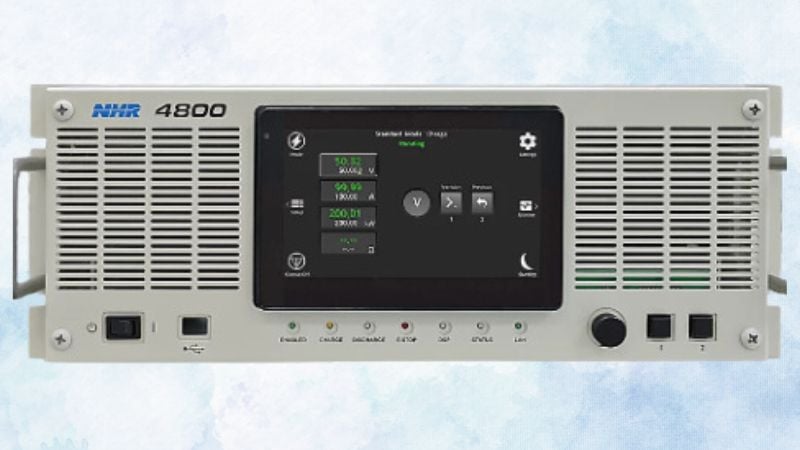
The NHR 4800 mid-voltage DC battery module cycler and emulator. Image used courtesy of NI
NHR 4800 Functions and Capabilities
The NHR 4800 is a highly adaptable and robust device. NI has integrated many features and capabilities, making the component a suitable tool for laboratory and production environments.
The NHR 4800 is multifunctional, performing multiple roles typically requiring several different instruments. It can act as a battery cycler (charging and discharging batteries), a DC power source, a DC load (absorbing power), a battery emulator (simulating battery behavior), and an amplifier for power-level hardware-in-the-loop (HIL) testing. The system can deliver up to 80 V and 400 A and provide scalable power from 16.5 to 165 kW, depending on how many components are wired in parallel. Since it can handle different power levels, it can test various energy systems, including low to mid-range battery modules, fuel cells, energy storage systems, and solar photovoltaic systems.
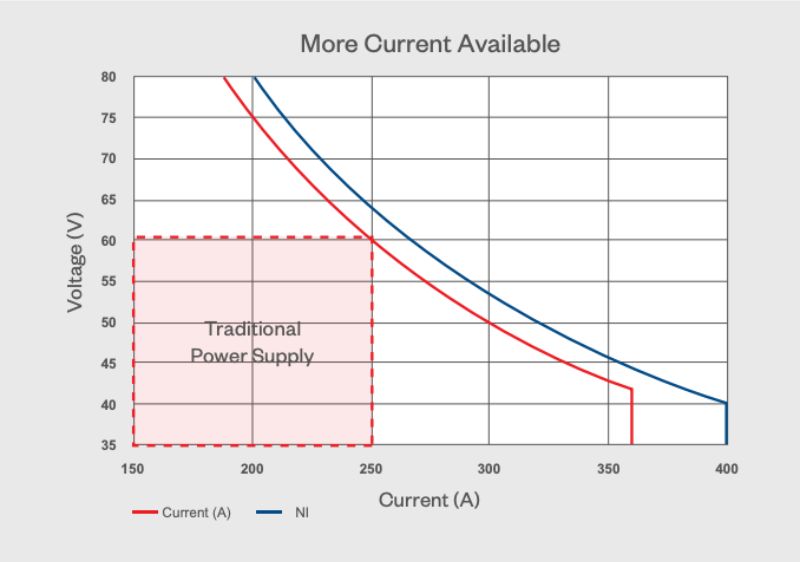
The NHR 4800’s current and power capabilities. Image used courtesy of NI
Despite its high power capabilities, the component fits into a single 4U chassis, a standard rack-mounted equipment size. This compact design saves space in the lab or production environment, allowing more efficient use of available space.
NHR 4800 Safety Features
Safety is essential when working with high-powered equipment such as the NHR 4800. Many factors come into play, including personnel safety, equipment longevity, and regulation compliance.
NI has included various safety features in the component, including built-in isolation contactor relays, a pre-charge circuit, and a reverse polarity checker. The built-in isolation contactor relays act as switches to disconnect electrical circuits to prevent accidental contact or short circuits. The precharge circuit gradually charges capacitors to prevent sudden current rushes. Lastly, the reverse polarity checker ensures the connections are made correctly, preventing damage if the positive and negative terminals are accidentally switched. Together, these features enhance safety and reliability during testing by avoiding accidents and protecting the equipment from potential damage.