Facebook
 Google
 GitHub
 Linkedin
Input Power Flexibility Design Challenges in EV Charging Stations
Learn how you can reduce EV charger installation costs and complexity with field-configurable bus bars. The charging station adapts to the voltage and configuration of the local infrastructure.
The national charging infrastructure network grows as the U.S. electric vehicle market rapidly expands. However, while developers strive to install more EV charging stations nationwide, they continue encountering significant challenges related to the U.S. electric grid’s regional variability. Developers frequently encounter mismatches between the power configurations available in existing infrastructure and standard EV charger power requirements, resulting in extended installation times, increased project costs, and reduced charger efficiency.
Demonstration of field-configuration of EV quick chargers to match the electrical infrastructure. Video used courtesy of Pii
Challenges of a Non-Uniform Electric Grid
As the U.S. expanded from east to west in the late 19th and early 20th centuries, electricity began to play an ever-growing role in Americans’ lives. The national network of electricity transmission and distribution slowly developed. Regional and temporal variations in technology during expansion resulted in a complex grid with drastically varying power requirements and capacities (Figure 1).

Figure 1. Map of the U.S. electric power transmission network. Image used courtesy of the U.S. Energy Information Administration
Today, developing infrastructure—and products compatible with that infrastructure—often presents the challenge of integrating standardized products with a regionally variable grid. For example, most EV charging stations are designed for a specific type of power input, often 480 V Delta. However, the existing infrastructure might only support other configurations, such as 240 V single-phase or 208 V 3-phase Wye.
The challenges developers face when installing EV charging stations result from these power level discrepancies, and the EV industry has struggled to produce solutions to these problems that don’t, in turn, come with their own shortfalls and issues.
Variable Power Outputs and Standards
The difference between Delta and Wye electrical configurations is foundational. These terms refer to how transformers connect to form three-phase systems. As illustrated in Figure 2, the Delta (Δ) configuration forms a closed loop resembling a triangle, while the Wye (Y) configuration includes a neutral, creating a network that looks like the letter “Y.” These configurations not only differ visually but functionally, particularly in how they manage voltages and currents.
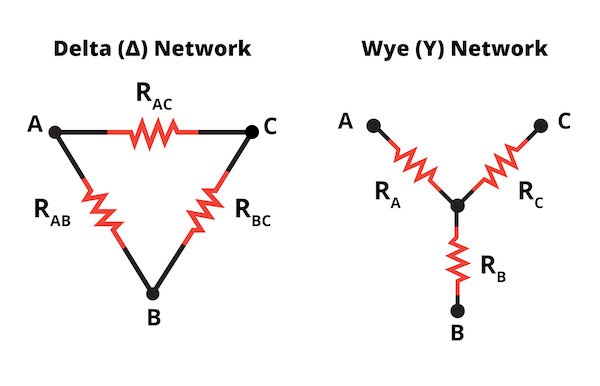
Figure 2. Delta and Wye electrical network configurations. Image used courtesy of EEPower
Access to 208 V, 480 V Delta, or 480 V Wye varies significantly within different US regions, based on the incoming utility configuration and, significantly, whether installers have access to a transformer if the installation site and preferred charging station don't match. Access to 480 V is more prevalent from the utility across the western US, for example, while 208 V access is more common in the eastern United States due to the way the US grid developed and utilities expanded historically. These logistical hurdles represent a significant portion of the installation planning lifecycle for many industry OEMs.
Traditional Industry Workarounds for Power Matching Problems
Within this context, an unsurprising problem presents itself—developers often encounter mismatches between an installation site’s existing infrastructure and the power level configuration of their charging stations. They are then forced to reconcile these differences to ensure their product will work once it’s put in the ground. This often impacts the project’s installation timeline, charging efficiency, and overall project cost.
While developers have a few workaround options, each contains its own downfalls. Let’s review two of these options.
Infrastructure Upgrades
Upgrading infrastructure to match the charger’s requirements often involves installing new substations or transformers. These infrastructure upgrades are sometimes considered visually unappealing or mismatched with the branding of the proposed charging station. This process can also be complex and prohibitively expensive, often running into five (or even six) figures. This contributes to significantly longer project timelines and increased disruption to the area.
Charging Station Reconfiguration
Reconfiguring the charging station involves lowering the charger’s output to match what the existing infrastructure can safely supply without overloading the system. This may also require derating the system. While less expensive and time-consuming than infrastructure upgrades, derating results in a highly undesirable outcome: users get less power output from the system than advertised. For example, a derated 30 kW charging station might only output 24 kW, leading to longer charging times and a product that fundamentally delivers less than is advertised.
Neither of these workarounds of the EV grid’s fundamental complexity and inflexibility are suitable solutions for an industry looking to grow and compete with the convenience and perceived reliability of standard combustion engines and gasoline infrastructure.
An Innovative Approach: Multi-Input Flexibility
Power Innovations International (Pii) addresses these industry challenges through its bus bar technology that supports multiple input configurations. Pii-manufactured charging stations leverage proprietary technology to enable standalone chargers that adapt to various power inputs, reducing installation costs and complexity.
Many conventional EV chargers are designed to accept a single input (often 480 V). Pii’s trio of configurable bus bars facilitate flexibility by allowing easy reconfiguration of power connections to match the available infrastructure. These configurable bus bars allow connection to 240 V single phase, 208 or 240 V Delta, or 480 V Wye infrastructure supplies.
Each charging station is delivered with a set of bus bars labeled for standard U.S. input voltages. This allows the field installer to select the appropriate bus bar configuration to match the input voltage. For example, in Pii’s EVQC030 30 kW DC Quick Charger, shown in Figure 3, the bus bar is configured by accessing a panel underneath the charging cable holder.
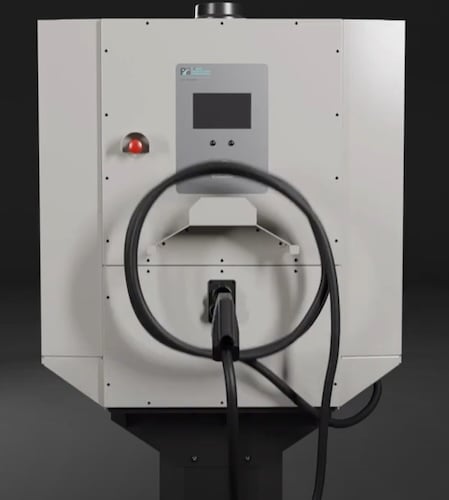
Figure 3. EVQC030 30 kW DC quick charger cable holder. Image used courtesy of Pii
This panel includes a trio of bus bar configurations. The bus bar is shown near the center bottom of Figure 4.
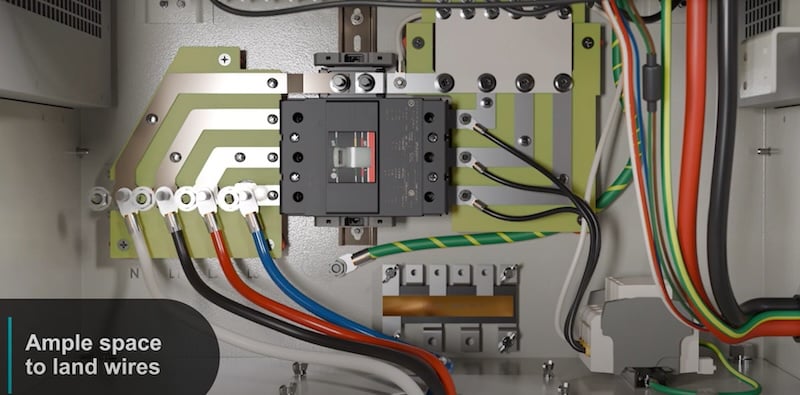
Figure 4. Configurable bus bar inside the Pii quick charger. Image used courtesy of Pii
The field installer simply selects the correct bus bar to match the existing infrastructure electrical system. Figure 5 demonstrates the installation of the bus bar before connecting the charging system to the grid.
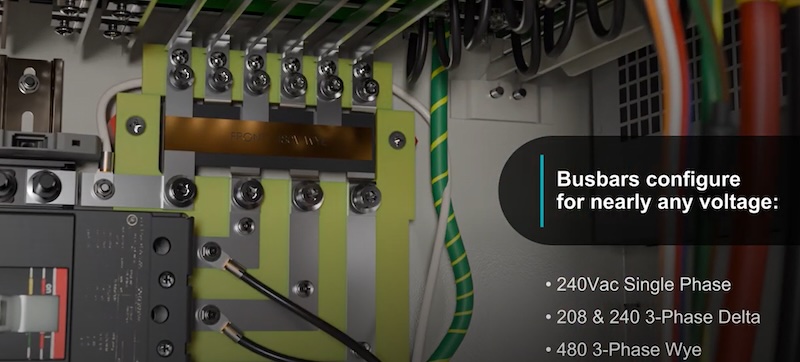
Figure 5. Example bus bar installation inside a Pii quick charger. Image used courtesy of Pii
This patent-pending field configuration setup results in faster installation and lower costs since there is no need for extensive modifications to the existing electrical system. In other words, the charging station adapts to the power supplied, not vice versa. No other EV charging manufacturer today can match this claim: field-configurable, variable input acceptance without derating.
Using existing infrastructure without costly upgrades or extensive construction significantly reduces installation time. This reduces installation costs and can accelerate the national EV charging station network’s expansion—an essential factor in supporting the growing number of EVs on the road. This installation efficiency is critical in an industry where equipment lead times can eclipse two years.
Moving Forward with Power Input Flexibility
As electric vehicles continue to comprise more of the automotive market, expanding the national charging network in step with vehicle adoption will become the industry’s defining challenge. Power configuration mismatch in EV charging stations is a significant barrier to EV market expansion due to the resulting time delays, project costs, and consumer impact. Innovations like the multi-input flexibility of Pii’s chargers are enhancing charging stations’ economic and operational efficiency and shaping the future of EV infrastructure development. As the industry continues to evolve, the ability to integrate seamlessly with existing power systems will be crucial for the widespread adoption of electric vehicles, and Power Innovations International is leading the way.
Power Innovations International is a vertically integrated EV charger manufacturer with more than 25 years of experience in engineering and power electronics. Pii offers a novel solution to one of the great bottlenecks in the EV industry’s growth. Pii’s modular, multi-input voltage chargers do not require infrastructural modifications or derating of the charging system.