Facebook
 Google
 GitHub
 Linkedin
Allegro Targets Noise and Heat With SiC Gate Drivers, Sensors
The silicon carbide gate drivers and an ultra-low-loss isolated current sensor can improve efficiency and power density in high-voltage systems.
As silicon carbide continues to move into high-voltage power designs, engineers must compensate for fast switching behavior and the heat generated by high-current paths. These aren’t new problems, but they become harder to ignore as systems grow more compact and power levels increase across electric vehicles, data centers, and industrial equipment, creating more heat within the system.
Allegro MicroSystems has released two power components: one for driving silicon carbide (SiC) devices and the other for sensing high current levels. The AHV85003/AHV85043 gate driver chipset and the ACS37200 isolated current sensor are designed to help engineers deal with switching noise, heat, and layout constraints that show up in high-voltage power systems.
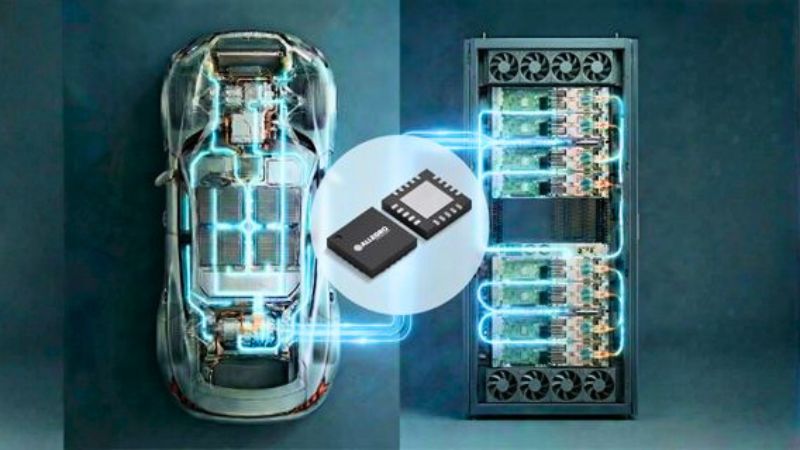
Allegro’s Power-Thru SiC gate drivers transfer control and gate power across a single isolation barrier. Image used courtesy of Allegro Microsystems
Self-Powered SiC Gate Drivers Reduce Noise and Complexity
The AHV85003/AHV85043 chipset adds to Allegro’s Power-Thru isolated gate driver family, which also includes the AHV85311 integrated solution. Power-Thru technology enables the transfer of both the control signal and gate-drive power across a single isolation barrier using a compact transformer, potentially eliminating the need for separate isolated bias supplies or bootstrap circuits.
Using a single isolation path also lowers common-mode capacitance, helping limit switching noise and reducing the effort required to meet EMI targets. With less noise introduced at the gate driver stage, it is possible to avoid additional filtering or more complex board layouts.
The AHV85311 uses the transformer for a more self-contained solution, while the AHV85003/AHV85043 chipset allows the transformer to be selected externally to match specific isolation or layout requirements. However, both options support adjustable gate drive voltages and negative turn-off, making it easier to work with different SiC devices.
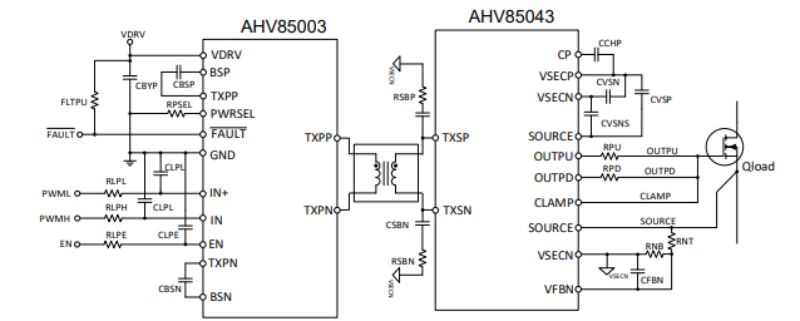
A typical application for the AHV85003 and AHV85043 chipsets. Image used courtesy of Allegro Microsystems
Ultra-Low-Loss Current Sensor Targets Heat and Space Constraints
Allegro has also introduced the ACS37200 isolated current sensor, focused on high-current systems where traditional shunt resistors can become a problem due to heat. In applications such as EV chargers, server power supplies, and solar inverters, even small resistance values can translate into several watts of wasted heat.
The ACS37200 will use an integrated Hall-effect sensing approach with an ultra-low primary conductor resistance of 50 micro-ohms. At high currents, this sharply reduces power loss compared to milliohm-level shunts, easing thermal design and improving overall system efficiency. Less heat also means less reliance on heatsinks.
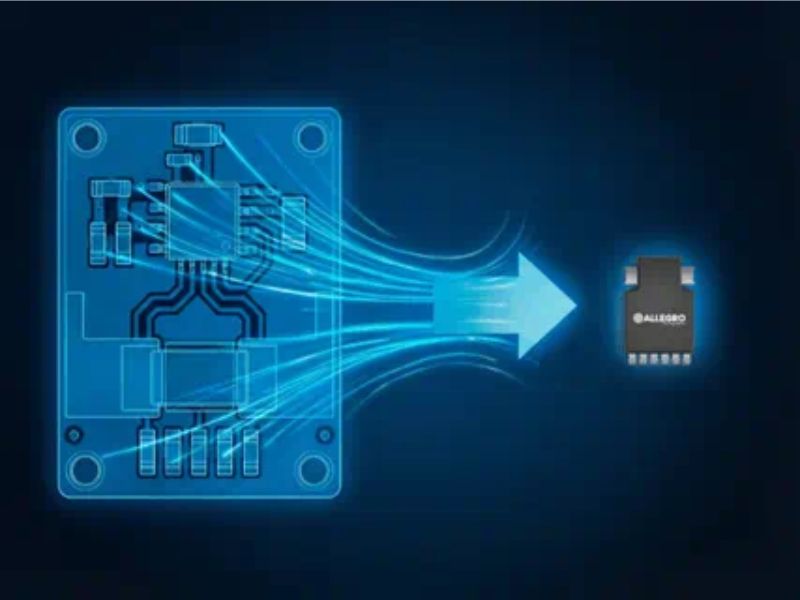
The ACS37200 integrates isolated current sensing into a single, low-loss device, reducing heat and board space. Image used courtesy of Allegro Microsystems
The ACS37200 sensor offers a compact design that combines current sensing and isolation in a single unit. It focuses on simplifying installation while reducing the overall footprint compared to traditional shunt-based solutions that require additional components to ensure safe isolation for high-voltage systems.
High-voltage power designs will always face challenges in managing noise, handling heat, and navigating complex system requirements. Allegro’s self-powered SiC gate drivers and ultra-low-loss current sensors could enable cleaner switching and reduced power loss, allowing more compact designs. As a result, designers may be able to achieve higher efficiency and power density, which are becoming essential in today's market.