Facebook
 Google
 GitHub
 Linkedin
3 Inductors Push Thermal and Voltage Performance Boundaries
Vishay, Würth Elektronik, and Sumida have introduced inductors for next-gen automotive, industrial, and AI applications, improving operating temperature, isolation voltage, and current density.
Two industry trends are pushing inductors beyond the limits of standard catalog parts. In electric vehicles, 800 V architectures and underhood power electronics are exposing inductors to ambient temperatures above 150°C, exceeding the +125°C rating of most SMT parts. In data center and AI compute infrastructure, 800 VDC bus architectures are becoming standardized through OCP, requiring isolation voltages and saturation currents that compact ferrite-core inductors cannot meet without increasing package size.
Releases from Vishay, Würth Elektronik, and Sumida directly address those constraints: up to 180°C operating temperatures, 1.5 kV isolation, and 150 A saturation current in standard SMT footprints.
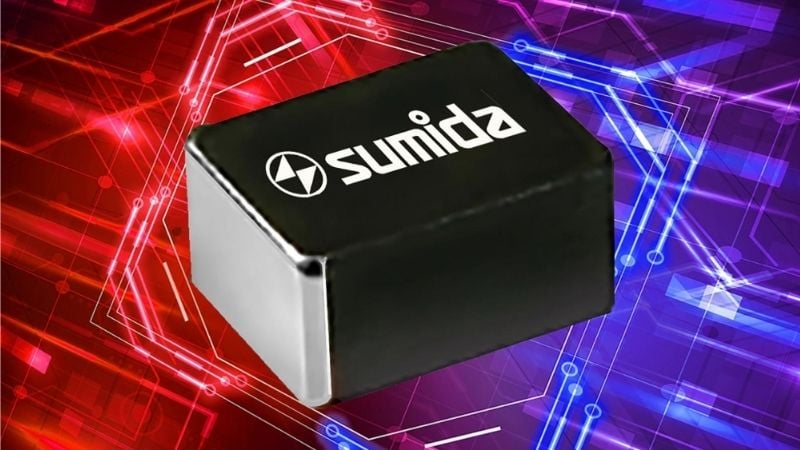
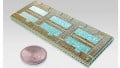
Sumida MCDMCF201612/DS shielded metal composite SMT inductor. Image used courtesy of Sumida Corporation
Vishay IHDV: 1.5 kV Isolation in a Compact Power Inductor
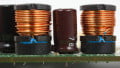
Vishay introduced four devices in its IHDV line of high-voltage power inductors: the automotive-grade IHDV-0808AC-3A and IHDV-1008BB-3A, and the commercial IHDV-0808AC-30 and IHDV-1008BB-30. Available in 0808 (20 mm × 14 mm × 14 mm) and 1008 (25 mm × 20 mm × 23 mm) packages, the inductors feature a 1.5 kV isolation rating enabled by a PET coilform insulator—far above the roughly 350 V typical of conventional inductors.
The powdered iron alloy core enables soft saturation behavior, meaning inductance remains relatively stable under increasing load, which is valuable for ripple current regulation and lets the device absorb inrush events up to 5x its rated heat current. For EMI filtering, the 0808 models deliver 1 kΩ impedance at 80 MHz peak, while the 1008 models reach 2.8 kΩ at 25 MHz — roughly three times the impedance of the same-sized iron-composite inductors.
All four devices are rated to operate at up to 180°C and provide additional support pins for shock and vibration resistance. Surface-mount (0808) and through-hole (1008) termination options address different mechanical requirements in rugged environments.
Target applications include onboard chargers, PFC stages, and high-voltage DC battery filter chokes.

Vishay IHDV inductors in 0808 (SMT) and 1008 (through-hole) case sizes. Image used courtesy of Vishay Intertechnology
Würth Elektronik WE-SFIA: Flat Wire Inductors for Automotive Electronics
Würth Elektronik's WE-SFIA series brings flat-wire winding technology to automotive DC-DC converters in a surface-mount form factor. Available in 2010, 2013, and 2016 package sizes, the inductors target single- and multiphase converters, as well as buck and boost converters, with saturation currents up to 150 A.
The flat-wire construction offers several advantages over round-wire alternatives. The larger conductor cross-section lowers DC resistance, which increases current-carrying capacity, and the tighter, more uniform winding geometry improves heat dissipation. AC losses, particularly the skin effect, are also significantly reduced at high switching frequencies.
Würth Elektronik also highlights an optimized core material that improves magnetic saturation performance compared to other commercial products. The WE-SFIA operates across a -40 °C to +180°C temperature range and covers inductance values from 0.33 µH to 4.7 µH, with custom values available on request.
Beyond powertrain DC/DC conversion, the series is suited for battery management, motor drive, audio, and infotainment filter choke applications.
_and_1008_(through-hole)_case_sizes.jpg)
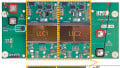
Würth Elektronik WE-SFIA in 2010, 2013, and 2016 SMT packages. Image used courtesy of Würth Elektronik
Sumida MCDMCF: Breaking the +125°C Ceiling in a 1.2 mm Profile
Sumida introduced the MCDMCF series of shielded metal composite power inductors in two variants: MCDMCF201612/DS and MCDMCF252012/DS. The standout feature is a +165°C operating temperature rating (including self-heating), providing 40°C more thermal margin than the +125°C limit common to many SMD power inductors.
Despite the elevated temperature rating, both devices maintain an ultra-low 1.2 mm profile. The MCDMCF201612/DS measures 2.2 × 1.8 × 1.2 mm with inductance values from 0.22 µH to 1.50 µH, while the larger MCDMCF252012/DS measures 2.7 × 2.2 × 1.2 mm and extends the range to 2.2 µH.
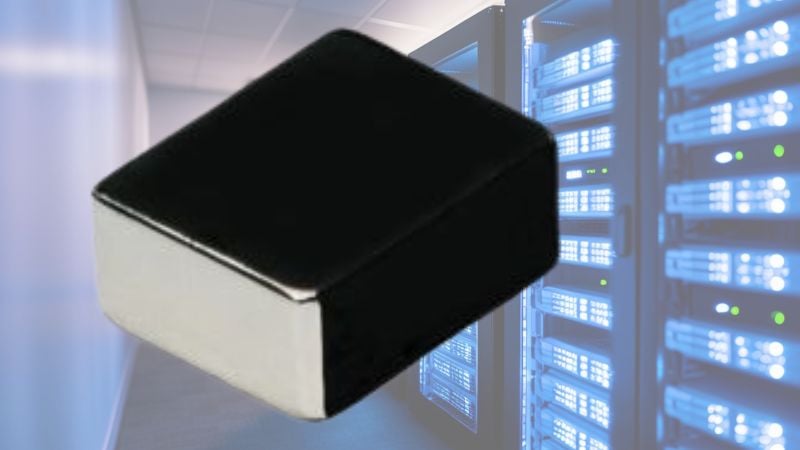
Vishay MCDMCF252012/DS. Image used courtesy of Vishay
The magnetically shielded metal composite core enables higher energy density than ferrite-based alternatives while keeping EMI low and core losses minimal.
The combination of a sub-1.3 mm profile and elevated thermal rating makes them a particularly relevant component for voltage regulator modules powering CPUs, GPUs, and AI accelerators, where both physical clearance and junction temperatures are tightly constrained. Automotive underhood applications and industrial motor drives operating in enclosed enclosures are also primary targets.
Where Inductor Design Is Headed
As automotive power architectures evolve toward higher-voltage buses and AI hardware pushes point-of-load converters into increasingly constrained thermal environments, the passive components that sit alongside those circuits will need to keep pace. The inductor may not be the flashiest node in a power system, but it's increasingly where thermal and efficiency margins are decided.