 Facebook
 Google
 GitHub
 Linkedin
Terra Fusion Tests Fusion With Magnetic Mirrors
Terra Fusion Energy is testing whether centrifugal-mirror fusion technology developed in a University of Maryland plasma experiment can scale up to a fusion machine.
Maryland startup Terra Fusion Energy is working to commercialize and scale a centrifugal-mirror fusion concept being developed through a University of Maryland research program. The company’s centrifugal magnetic mirror uses rapidly rotating plasma in a linear magnetic field rather than a tokamak's ring-shaped chamber.
The technology grew out of the university’s Centrifugal Mirror Fusion Experiment (CMFX). Recent experiments have produced stable plasma discharges lasting up to 10 seconds and measured neutron emission during deuterium runs, though the results still fall far short of demonstrating net-energy-producing fusion.
Terra Fusion is now developing the high-voltage hardware needed for the machines that would follow CMFX.
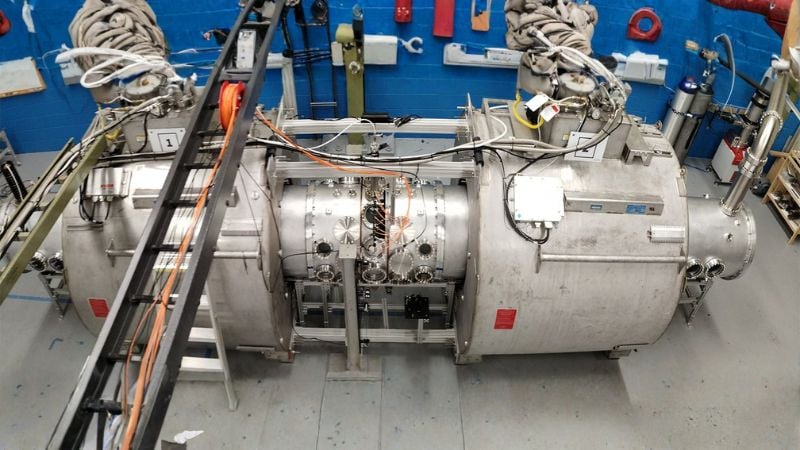
CMFX uses superconducting magnets and a high-voltage central conductor to study rapidly rotating plasma. Image used courtesy of University of Maryland Institute for Research in Electronics and Applied Physics
Different Take on Magnetic Confinement
Scientists have studied magnetic mirrors for decades. In a conventional mirror machine, plasma sits inside a long magnetic field that becomes stronger near each end. Charged particles moving along the field can be reflected toward the center when they reach those stronger regions.
A longstanding problem has been keeping enough particles from escaping through the ends. Mirror plasmas can also develop instabilities that worsen confinement, which helped push much of fusion research toward other designs.
CMFX tries to address those limitations by spinning the plasma. A high-voltage conductor running through the center of the machine creates an electric field across the plasma. With the axial magnetic field, the E×B drift drives the plasma around the chamber.
At high rotation speeds, centrifugal effects make it harder for particles to escape through the ends, while differences in flow speed can help control some plasma instabilities. The rotation also heats the plasma, which could reduce the amount of separate heating equipment (and power) a future reactor would need.
The idea is to get more than one benefit from the same mechanism instead of relying on separate systems for each job.
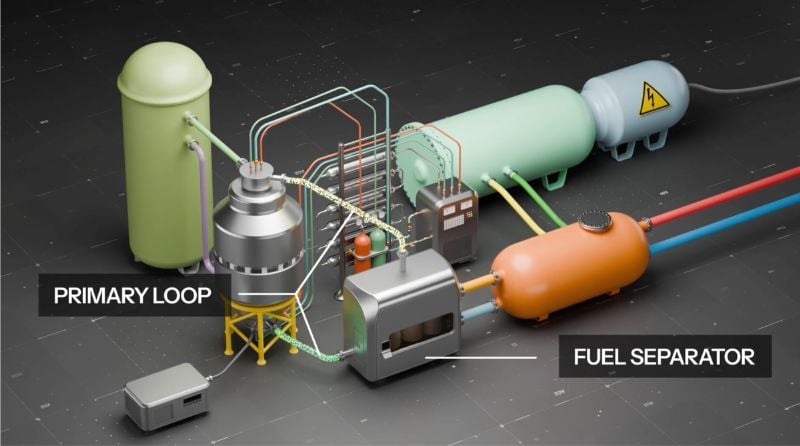
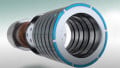
A model of Terra Fusion's system. Image used courtesy of Terra Fusion Energy
Testing the CMFX Concept
The question is whether those advantages show up in an actual plasma. CMFX was built to test that. A 2026 paper describing the machine details two repurposed superconducting MRI magnets that create fields of up to 3 tesla at its ends, along with a high-voltage system rated at 100 kV and 100 kW.
Researchers have maintained stable discharges for as long as 10 seconds and say longer pulses should be possible. According to the team, CMFX is the first centrifugal mirror to use superconducting magnets.
An earlier Nuclear Fusion study examined neutron production during deuterium experiments. CMFX reached a peak measured rate of 8.4 million neutrons per second at 65 kV. The researchers cautioned that the detector setup and limited counts made it difficult to determine with high confidence how much of the signal came from thermonuclear fusion.
Learn how the centrifugal mirror works. Video used courtesy of University of Maryland Physics Colloquium
Using a plasma model, the group calculated a triple product of 1.9 × 10^17 keV·s/m³. The triple product combines density, temperature, and confinement time, giving researchers a way to compare changes in the machine’s fusion performance.
CMFX remains far below the conditions needed for a power-producing reactor. The measurements show fusion-relevant plasma conditions, not net energy-producing fusion.
A 2026 follow-up paper tested different ways of feeding deuterium into the plasma. Using several short gas injections during a discharge, CMFX was operated at up to 70 kV. Neutron measurements reached 15 million per second, while the model estimated ion temperatures approaching 950 eV.
What Comes Next
CMFX is still a long way from producing useful power. A larger machine would need higher plasma density and temperature, along with sustained operation, while also dealing with heat, neutron damage, and the stresses placed on components near the plasma.
The high-voltage system is especially important because the central conductor must keep working under far more demanding conditions than in the current experiment. The superconducting magnets would also need to be scaled without making the reactor too expensive or difficult to maintain.
Look inside the CMFX. Video used courtesy of Terra Fusion
Terra Fusion is now trying to move that work forward with fresh capital and an expanded engineering team. Vectors Capital invested in the company earlier this year. Terra Fusion has also been hiring engineers with backgrounds in fusion and high-voltage systems, according to a recent job listing.
That next machine will be the more important test, as CMFX has already shown that the basic approach can produce stable, rapidly rotating plasma and measurable neutron emission. Terra Fusion still has to show that the same concept works at much higher plasma densities and temperatures, with sufficient confinement, while sustaining the machine for much longer periods.