Facebook
 Google
 GitHub
 Linkedin
Advancing Fusion, Space Power, and a Mile-Deep Nuclear Reactor
Fusion, underground reactors, and space nuclear systems move ahead in Wisconsin, Kansas, and orbit.
Nuclear development is pushing in new directions—from fusion in Wisconsin to reactors a mile underground, and power systems built for space.
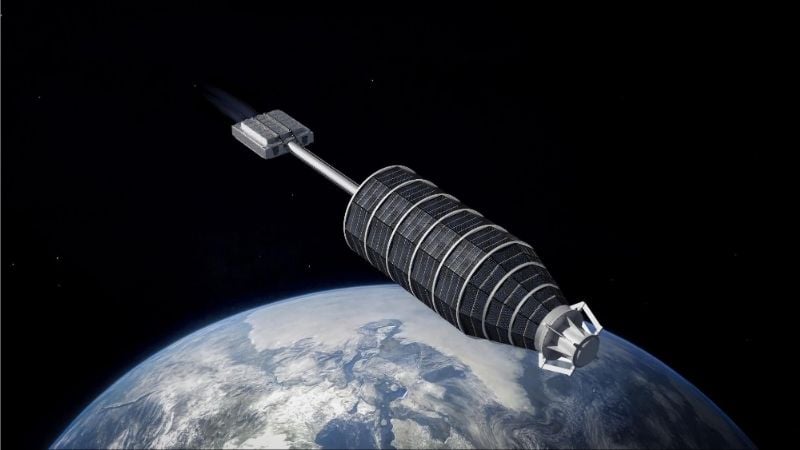
Rendering of Antares' nuclear reactor in space. Image used courtesy of Antares
200-MW Fusion Plant Explored for Wisconsin via Strategic Partnership
Madison Gas and Electric (MGE) and Realta Fusion are teaming up to explore a 200-MW fusion power plant in Wisconsin.
Madison-based Realta Fusion is advancing its CoSMo fusion platform, a compact and modular design based on magnetic mirror confinement. Unlike toroidal machines such as tokamaks, a magnetic mirror confines plasma in a linear chamber. The magnetic field increases sharply near the ends of the device, causing some charged particles traveling along the field lines to reverse direction rather than escape.
For its planned power systems, Realta is developing a tandem-mirror configuration, which places a central fusion plasma between specialized end sections intended to improve confinement. High-temperature superconducting magnets allow the system to generate stronger fields in a comparatively compact geometry.
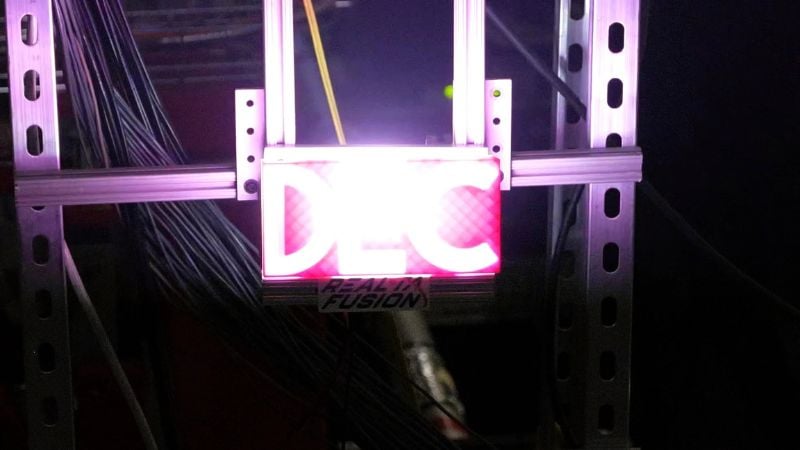
Realta's energy conversion demo. Image used courtesy of Realta Fusion
In June, Realta and the University of Wisconsin-Madison also demonstrated direct energy conversion on the Wisconsin HTS Axisymmetric Mirror system, using an electrostatic converter to turn energy from charged particles leaving the plasma into electricity.
Separately, two 2025 studies examined the physics of Realta’s tandem-mirror approach: One combined detailed modeling of the tandem mirror's end sections and central plasma with machine learning optimization. The calculations indicated that a system with a 50-meter central cell could reach a scientific fusion gain above Q=5. Here, Q measures fusion power produced relative to the power supplied to heat the plasma, but it doesn't represent net electricity delivered by a power plant.
The modeling also indicated that the concept would need to control plasma instabilities to operate as intended.
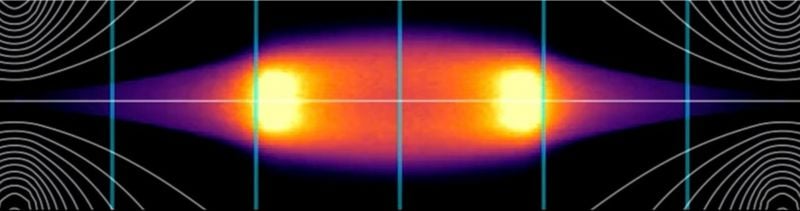
Realta's plasma simulator. Image used courtesy of Realta Fusion
Realta's partnership with MGE includes a direct equity investment from the utility's parent company in the first phase, with the utility contributing equipment, engineering, and technical expertise while helping move the project through siting, permitting, grid interconnection, and financing.
The investment supports MGE's broader decarbonization strategy. The utility is targeting net-zero carbon electricity by 2050 and, separately, net-zero methane emissions from its natural gas distribution system by 2035. MGE reports it has reduced electric supply carbon emissions by more than 40% from 2005 levels, with a target of at least 80% by 2030.
The deal also builds on Realta's July selection of a former Oscar Mayer complex in Madison for The Realta Forge. The company plans to lease roughly 250,000 square feet there for the R&D facility, where it intends to build its next magnetic mirror prototype, Hammir.
Learn more about Realta's direct energy conversion demo. Video used courtesy of Realta Fusion
Underground Nuclear Reactor Bags DOE Safety Design Approval
The Department of Energy (DOE) has approved Deep Fission’s Nuclear Safety Design Agreement (NSDA) for its Gravity Nuclear Reactor, a small modular pressurized water reactor to be installed in a mile-deep borehole underground in Kansas.
With this approval, the project will advance through further DOE evaluation and authorization under the Reactor Pilot Program, with Deep Fission ultimately seeking NRC licensing to convert its demonstration reactor to commercial operation.
Deep Fission must still complete subsequent DOE safety reviews, including preliminary and final safety analyses and operational-readiness steps, before the pilot can begin nuclear operation.
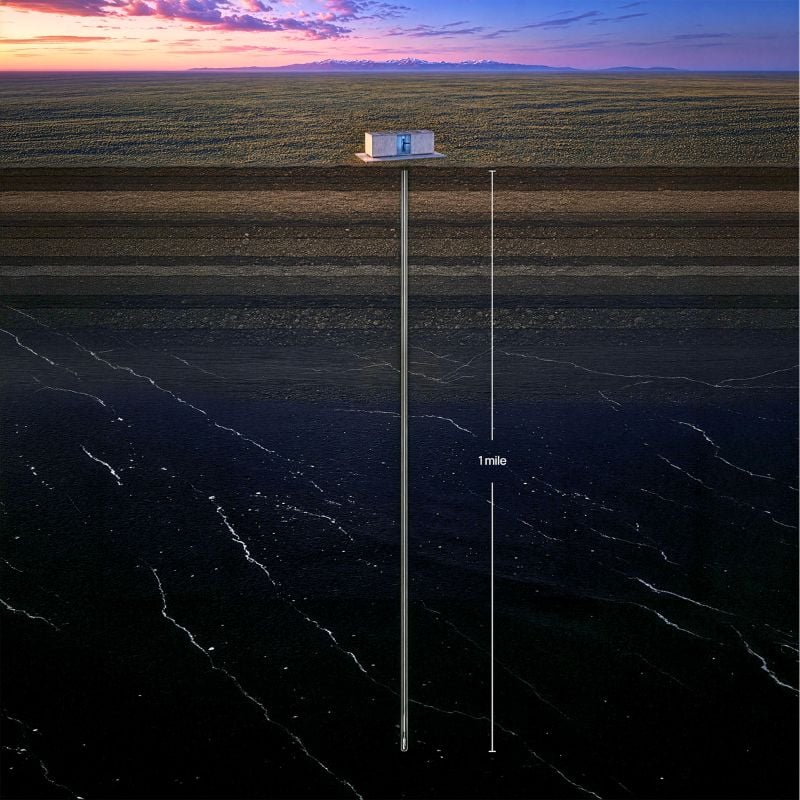
Borehole shelter rendering. Image used courtesy of Deep Fission
Deep Fission broke ground last December on its pilot project at the Great Plains Industrial Park in Parsons, Kansas. The company has since completed a 6,000-foot well to gather geological, hydrological, and thermal data, and delivered a prototype reactor canister to the Parsons site.
The next major site test calls for a 2,500-foot non-nuclear borehole used to study underground thermal behavior and demonstrate deployment of major reactor components. Deep Fission also reported a separate emplacement test in which crews lowered a 20-foot reactor canister 100 feet into a 34-inch borehole and retrieved it using commercially available drilling equipment.
Technically, the concept retains conventional PWR fuel and coolant principles while changing where much of the nuclear system is installed. Deep Fission envisions vertical, steel-cased boreholes about 30-50 inches in diameter extending a mile underground. At that depth, the water column above the reactor would create about 160 atm of hydrostatic pressure—approximately the pressure required by a conventional PWR primary system—while also providing a substantial water inventory for thermal management.
Low-enriched uranium fuel heats water circulating through a closed primary loop, which transfers heat through an underground heat exchanger to a separate loop connected to surface power conversion equipment.
Deep Fission's underground plans. Video used courtesy of Deep Fission
Placing the reactor at depth provides shielding and physical separation from the surface, while underground emplacement can reduce exposure to hazards such as severe weather, wildfire, and aircraft impact. Deep Fission also proposes scaling a plant by adding individual reactor boreholes, with clusters capable of reaching hundreds of megawatts.
The development program must still validate large-diameter drilling at the required depth, borehole and casing integrity, component emplacement, subsurface thermal behavior, and long-term materials performance under reactor operating conditions.
Antares Plans Extended Test for Space Reactor
Antares has landed a $161 million strategic award from the Air Force as part of a program calling for a nuclear ground test of its R1-S reactor, followed by integration with a spacecraft to support flight certification ahead of launch.
The space-focused R1-S draws on the company's terrestrial R1 architecture but uses different materials and operating conditions, along with a heat-rejection system designed for the space environment.
The company also plans to use Mark-1 to supply an operational system supporting ground-to-space activities. The electricity-producing reactor is expected to run for more than six months in 2027 while coupled to Antares' closed nitrogen Brayton power-conversion system. In the closed cycle, the reactor transfers heat to circulating nitrogen, which drives the power-conversion machinery before being cooled, compressed, and recirculated instead of discharged.
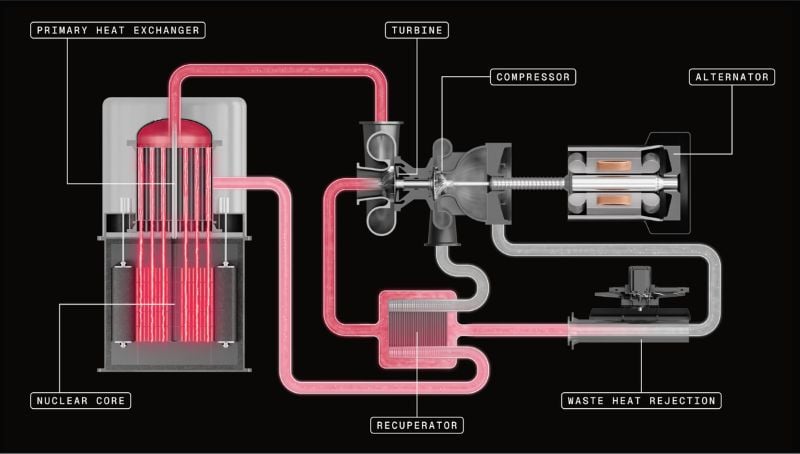
How Antares' nuclear reactor works. Image used courtesy of Antares
Antares stated that sustained nuclear-generated electricity could give Space Force spacecraft more energy for maneuvering and other mission demands while supporting power-intensive payloads. Potential applications the company cited include directed-energy systems, onboard computing, and electromagnetic warfare equipment.
Antares' terrestrial R1 design uses HALEU TRISO fuel compacts in a prismatic graphite core. Passive sodium heat pipes transfer energy from the core to a heat exchanger, which feeds a closed nitrogen Brayton cycle that recovers waste heat to improve efficiency. The company is targeting electrical outputs from about 100 kW to 1 MW, operating for six-plus years.
In June, Antares' Mark-0 microreactor achieved initial criticality at Idaho National Laboratory under DOE's Reactor Pilot Program. It was a fueled, zero-power demonstration used to test reactivity control without generating electricity.
The company's development roadmap calls for initial customer deployments beginning in 2028, including projects planned for military sites.