Facebook
 Google
 GitHub
 Linkedin
TI Unveils Multiaxial Current Sensor for EV Traction Inverters
Texas Instruments has just released a first-of-its-kind coreless, multiaxial architecture that provides 20 times greater accuracy in traction inverter systems.
Today, Texas Instruments (TI) released the TMCS2100-Q1 sensor, the industry’s first multiaxial coreless Hall-effect current sensor engineered specifically for electric and hybrid-electric vehicle traction inverters. By simultaneously evaluating horizontal and vertical magnetic fields, the device works alongside a proprietary algorithm to break the traditional trade-off between physical size and measurement accuracy.
This dual-axis approach delivers up to 20 times the precision of single-axis coreless alternatives, limiting displacement error to less than 1% under 0.4 mm of mechanical movement and 0.25% at 0.1 mm. Maintaining tight signal integrity across diverse thermal environments and dynamic load conditions, the sensor enables smoother powertrain torque loop control, reduces unwanted drive noise, and optimizes energy efficiency to extend driving range.
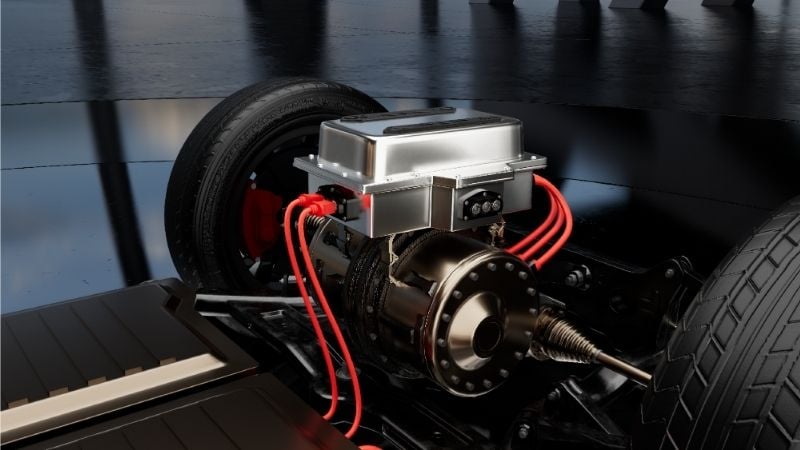
TI’s TMCS2100-Q1 multiaxial coreless Hall-effect current sensor is designed for HEV and EV traction inverters. Image used courtesy of TI
Balancing Accuracy and Size
Automakers are continually seeking ways to increase EV and HEV range, which often means creating lightweight vehicles. At the same time, the transition to an 800 V architecture demands higher-precision traction inverter current sensors. Engineers often face the dilemma of balancing accuracy and size.
A magnetic (C-core) is precise but adds weight and size, which can reduce driving range. On the other hand, the lighter, single-axis coreless alternatives aren’t as accurate because they are more vulnerable to stray magnetic interference and small positional changes between the sensor and conductor. Displacement and crosstalk can cause measurement error to exceed 20%
The TMCS2100-Q1 sensor addresses this issue with its compact, coreless design and high measurement accuracy. It can simultaneously measure magnetic fields across both horizontal and vertical axes, significantly reducing vibration-induced errors. By reducing measurement error and minimizing magnetic crosstalk, the sensor maintains accurate current measurement and prevents torque ripple.
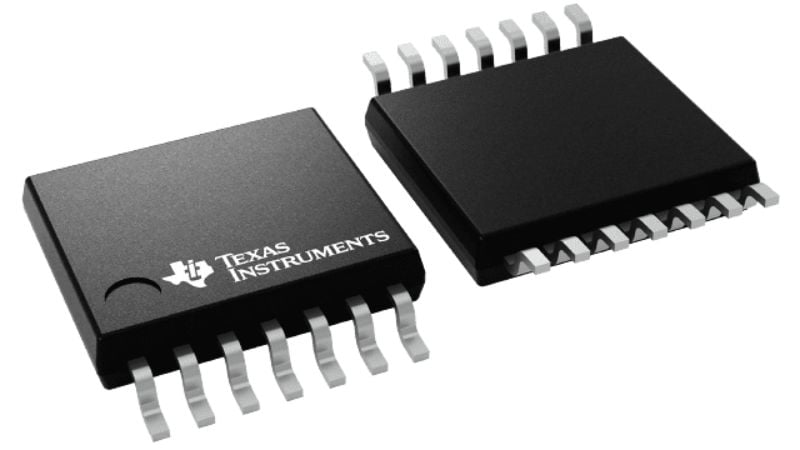
The TMCS2100-Q1. Image used courtesy of TI
Eliminating Busbar Changes
Hall-effect current sensors operate by detecting the magnetic field generated by the electrical current in the busbar connecting the traction inverter to the motor.
Typically, differential coreless current sensors have depended on physical busbar alterations. Designers must cut notches, slices, or holes into the solid conductor to guide flux lines. These mechanical cuts can complicate thermal management and restrict layout flexibility.
Instead, the TMCS2100-Q1 mounts directly over standard, unmodified busbars, preserving existing thermal dissipation paths and simplifying heat sink mounting. This flexibility helps engineers optimize crowded PCB layouts.
Eliminating heavy C-core magnetic frames reduces overall inverter mass, boosting power density across the powertrain assembly. Additionally, multiaxial sensing reduces magnetic crosstalk between motor phases, achieving more accurate current measurement.
Implementing the TMCS2100-Q1
With the TMCS2100-Q1 Hall-effect current sensor, designers can resolve the trade-off between size and accuracy. The multiaxial coreless sensing offers engineers greater thermal flexibility and layout options, potentially leading to lighter, more efficient powertrains.
More details are available in TI’s technical article, Smooth Operators: How Multiaxial Hall-Effect Current Sensors Deliver Precise Torque Control.
The TMCS2100-Q1 Hall-effect current sensors are now available through TI. Resources include the TMCS2100EVM evaluation module, the TMCS2100CHAREVM characterization module, and the TIDM-02014 reference design.