Facebook
 Google
 GitHub
 Linkedin
Smarter Power Grids: IoT Brings Efficiency and Innovation
While some challenges remain, IoT-enhanced smart grids make management easier and streamline renewable energy integration.
Smart grids use various Internet of Things (IoT) technologies to improve reliability, resilience, and efficiency. These technologies are designed to monitor, control, and optimize grid operations to ensure a more responsive and dynamic power grid.
Sensor network and data collection provide the foundation for IoT-enabled smart grids. They allow real-time monitoring of grid performance, energy consumption, and environmental conditions. Data communication networks transmit the data to operators to enable real-time decisions. IoT-connected devices are helping to usher in the age of smart grids, allowing more advanced operations. However, several challenges remain associated with their integration.
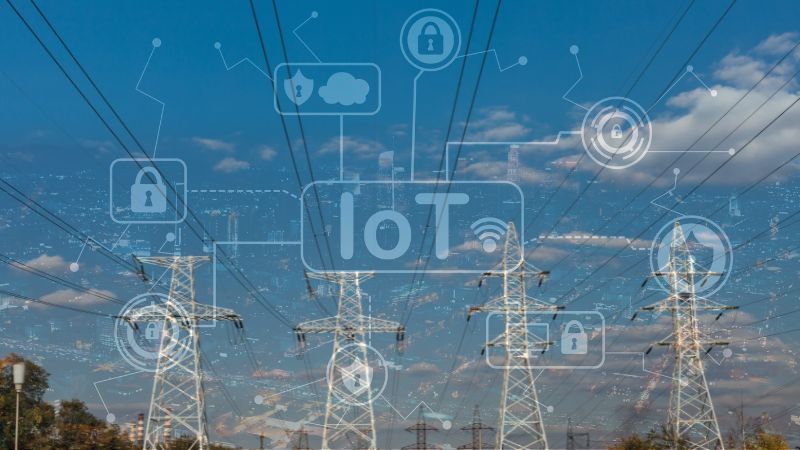
IoT smart grid. Adapted from images used courtesy of Canva
Challenges of Integrating IoT into Smart Grids
The main challenges of integrating IoT devices into the grid are:
- Interoperability and scalability
- Data management and security
- Reliability and resilience
- Environmental impact
- Power quality
Since smart grids use IoT devices from many manufacturers with different communication protocols, it’s difficult to ensure interoperability across all devices. As the number of IoT devices in the grid scale up, this challenge will become greater, so it must be tackled head-on by implementing common communication and data exchange standards.
From a data management and security perspective, IoT devices generate massive amounts of real-time data. Managing, storing, processing, and analyzing this data presents big challenges. Additionally, performing data collection and management operations requires many devices to be connected. In addition to interoperability issues, these communication networks become more susceptible to cyberattacks due to more potential entry points for hackers. New technologies connected to the wider grid network don’t always have robust cybersecurity protocols in place.
Smart grids must also ensure the devices and the wider system remain operational in all scenarios, including natural disasters, cyberattacks, and equipment failure. They should be resilient and reliable enough to withstand all eventualities, which poses a big technical challenge. Additionally, while smart grids improve energy efficiency, sustainable manufacturing and disposal practices must be implemented for IoT devices to avoid impacting the environment negatively in other ways.

IoT-enabled smart grid architecture. Image used courtesy of Tabassum et al.
Power quality issues can arise due to the integration of IoT devices. These include harmonic distortion, voltage fluctuation, transient disturbances, and low power factor issues. These all result from different factors―such as non-linear loads, rapidly changing loads, intermittent power, switching events, and fault conditions in the grid―but need to be monitored and addressed to ensure that the grid remains reliable, efficient, and safe at all times.
Uses of IoT Technology in Smart Grids
Despite the technical challenges, IoT devices bring many features to the energy grid. A major benefit is improved monitoring and control capabilities. IoT-enabled sensors provide real-time data to monitor grid changes and respond to them quickly. Both distribution management systems and supervisory control and data acquisition systems have enabled smart grids to provide more efficient, reliable, and responsive operations. The combination of advanced sensors, IoT communication networks, and automated control systems provides a higher level of monitoring and control in smart grid networks.
Integrating IoT devices also enables smart grids to perform predictive maintenance operations, reducing grid downtime by identifying potential issues before they arise and scheduling downtime at an optimal time. Maintenance can be planned in advance rather than waiting for an unexpected outage. Machine learning algorithms are significant in predicting equipment failure.
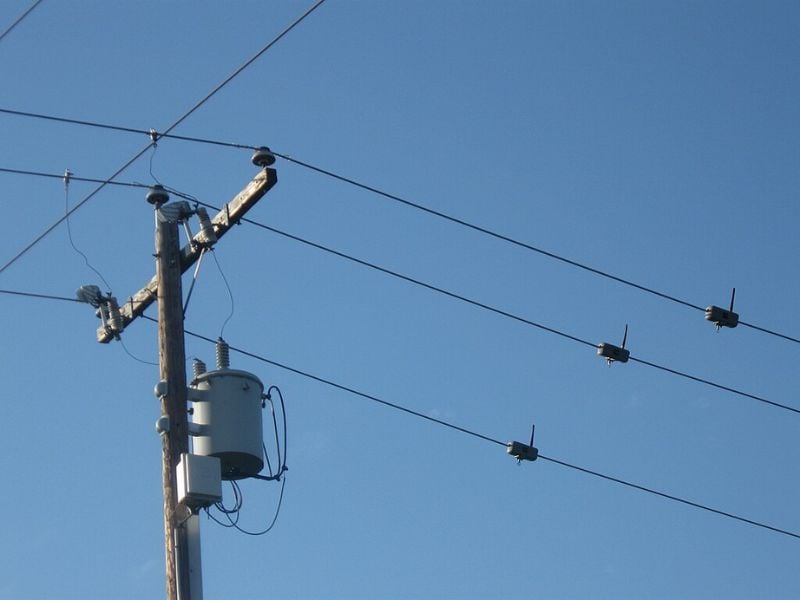
Powerline sensors. Image used courtesy of Wikimedia Commons
IoT devices can also facilitate demand response programs in the grid by detecting real-time energy consumption patterns, enabling operators to dynamically balance loads and improve energy efficiency. These demand response programs can also integrate weather data to forecast energy demand and manage the renewables and other distributed energy resources attached to the grid, such as electric vehicles, to maintain grid stability and efficiency. IoT technologies also help integrate new renewables into the grid.
The Keys to Efficient IoT-Enabled Smart Grids
Deploying sensor networks across the grid, coupled with data processing techniques, allows IoT-enabled grids to manage the voltage, current, temperature, and power quality to prevent failures. The data processing and storage techniques are crucial for transmitting and analyzing the data to improve grid performance and reliability. These IoT-enabled technologies form the backbone of smart grids.