Facebook
 Google
 GitHub
 Linkedin
Research Explores Safer Battery Energy Storage System Options
Three studies promise safer, more sustainable, and higher-performance alternatives to today’s lithium-ion battery technology.
Battery innovation is accelerating on multiple fronts as researchers seek to overcome today's energy storage systems' performance, cost, and sustainability barriers.
A University of Adelaide team has demonstrated a dual-salt electrolyte stabilizing aqueous zinc batteries across extreme temperatures and long cycles. Meanwhile, computational modeling shows that amorphous cathodes could unlock magnesium’s higher energy density potential. And in China, scientists have unveiled a tea compound-based regeneration method that restores degraded cathodes to near-new condition.
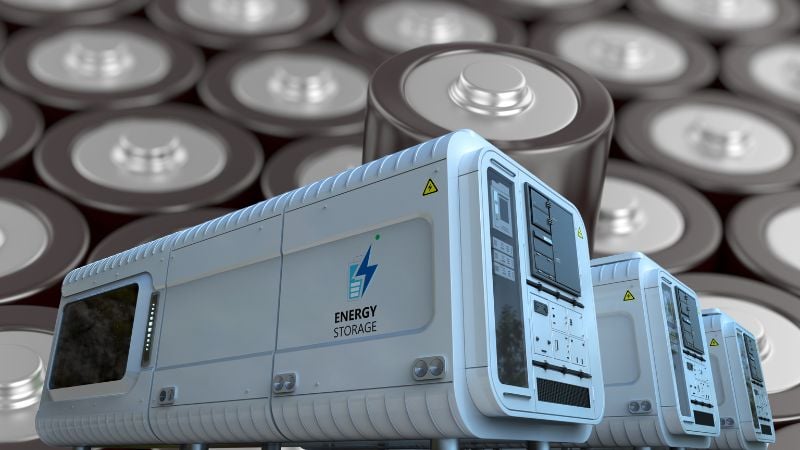
Battery research could lead to better-performing energy storage. Adapted from images used courtesy of Canva
Dual-Salt Electrolytes Advance Aqueous Zinc Batteries
University of Adelaide researchers and collaborators have introduced a decoupled dual-salt electrolyte that fundamentally improves aqueous zinc battery stability and performance. By pairing zinc sulfate and zinc perchlorate (Zn(ClO4)2), the electrolyte separates functions. Sulfate ions accumulate at the Zn/electrolyte interface, stabilizing water and protecting the metal surface, while perchlorate ions dominate the bulk liquid, disrupting hydrogen-bond networks to enhance ion transport and suppress freezing. This decoupling delivers high ionic conductivity (15.1 mS/cm) and exceptional zinc plating/stripping reversibility (99.97%) even at extreme conditions down to -40°C.
Pouch cell tests showed the electrolyte’s practical potential, with Zn//NaV3O8 cells retaining 93% of capacity after 900 charge-discharge cycles at 25°C and maintaining full capacity over 3,000 cycles at -40°C. Beyond cycling life, the batteries demonstrated ultra-low daily self-discharge (0.13%) and stable operation across -40°C to +40°C. Unlike “lean-water” or hybrid organic formulations, the decoupled dual-salt electrolyte remains non-flammable, affordable, and sustainable, preserving the intrinsic advantages of aqueous systems. With zinc’s abundance, low cost, and environmental profile, this electrolyte design offers a scalable path to long-life, safe, and grid-ready aqueous zinc batteries.
Amorphous Cathodes for Magnesium Batteries
Recent research highlights amorphous vanadium pentoxide (V2O5) as a promising cathode material for magnesium batteries, offering an alternative to lithium-ion systems constrained by supply chains and energy density. Unlike crystalline frameworks, amorphous materials lack long-range order, creating “flatter” potential energy surfaces that accelerate ion movement. Using ab initio molecular dynamics (AIMD) and machine-learned interatomic potentials, researchers showed that magnesium diffusivity in amorphous MgV2O5 is up to 105-107 times higher than in crystalline counterparts. This substantial mobility gain comes with only a modest 10-14% drop in intercalation voltage.
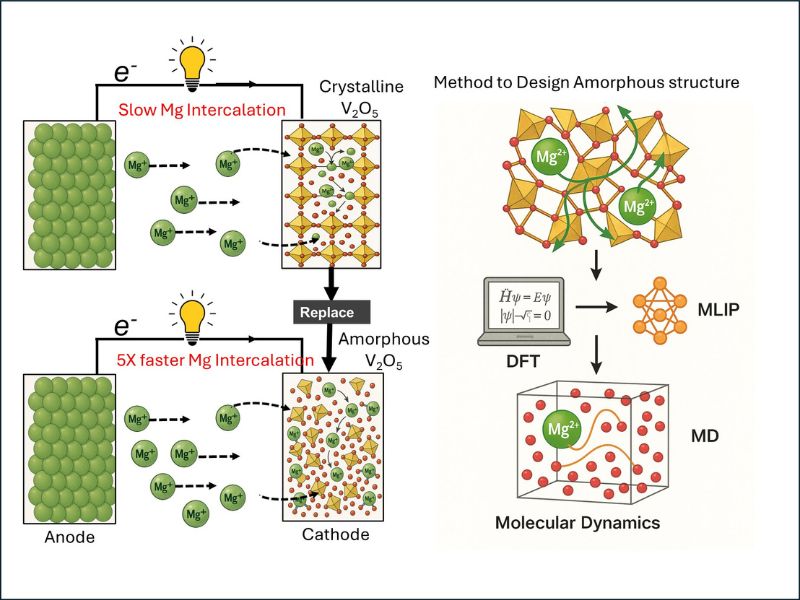
Amorphous structures make ions move faster. Image used courtesy of Indian Institute of Science
To balance accuracy with computational efficiency, the team combined density functional theory datasets with machine learning models to simulate the behavior of amorphous V2O5 at scale. These models allowed them to capture realistic ion transport dynamics that conventional methods struggle to compute for disordered structures. Compared to crystalline cathodes, the amorphous design enables much faster magnesium ion insertion and release, addressing the main bottleneck in commercializing Mg-based systems: slow ion kinetics. While experimental validation of amorphous cathode stability remains challenging, the study demonstrates a new computational pathway for accelerating battery material discovery.
Tea Polyphenols Enable Direct Regeneration of LiFePO4 Cathodes
Hefei Institutes of Physical Science researchers and collaborators have developed a direct recycling method for degraded LiFePO4 cathodes using natural tea polyphenols as electron donors. Unlike conventional hydrometallurgical or pyrometallurgical recycling, which only recovers raw elements, this strategy restores the electrochemical functionality of spent cathodes. The hydroxyl groups in tea polyphenols reduce Fe3+ back to Fe2+, reversing the degraded FePO4 phase into LiFePO4 and eliminating Li-Fe anti-site defects. Supplemental lithium salts further aid reconstruction, reopening rapid Li+ diffusion channels and fully recovering bulk composition and structure.
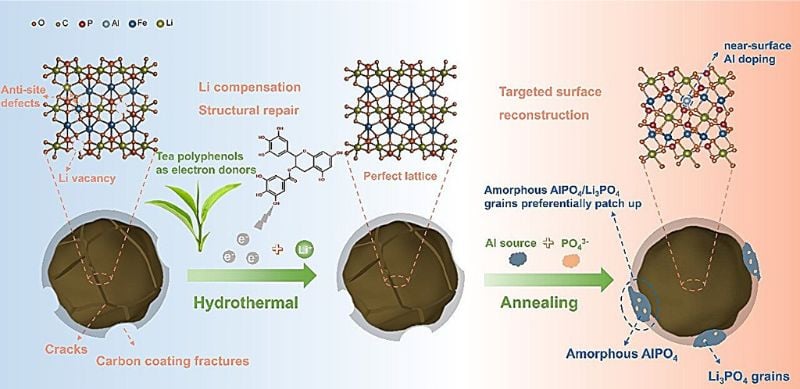
A schematic diagram of the direct repair and regeneration mechanism for the retired LiFePO4 cathodes. Image used courtesy of Advanced Materials
To repair damaged surface carbon layers, the team introduced an aluminum source during regeneration. This produced targeted composite coatings of AlPO4 and Li3PO4 at defect sites, rebuilding efficient dual electron-ion transport channels. Partial aluminum doping within the LiFePO4 lattice added structural stability, suppressing iron migration without sacrificing energy density. The regenerated cathodes demonstrated restored rate performance and extended cycling life, achieving performance comparable to fresh materials. With low energy input, scalability, and reliance on abundant natural compounds, this approach offers a sustainable and cost-effective pathway for recycling retired power batteries.