Facebook
 Google
 GitHub
 Linkedin
Industry White Papers
Efficient Energy Utilization: A Key Role in Battery Management Systems
Apr 30, 2025 by Shanghai Yongming (YMIN)
The increasing push to reduce global dependence on fossil fuels and shift toward greener technologies has led to a surge in the adoption of solar and wind energy for residential power with battery storage, the development of battery-powered mobility (e-mobility) solutions, and the use of portable equipment such as power tools. Energy storage systems (ESS) are a prerequisite for power backup in the case of a brownout or blackout cutting off power to critical infrastructure. Given their high energy density, batteries are the go-to technology for ESSs that can be used in tandem with alternative options such as supercapacitors, hydrogen fuel cells, and uninterruptible power supplies (UPSs).
Batteries involve critical design considerations, requiring real-time monitoring and control to optimize battery parameters and ensure they achieve their expected lifespan. The worst-case scenario for batteries is thermal runaway and explosion, which can lead to catastrophic consequences. This potential risk highlights the need for stringent functional safety measures in the battery management system (BMS). The BMS consists of distinct functional hardware and software blocks to effectively manage the battery within an EV, a renewable installation, or a backup power system. As with any power management system, capacitors play a key role in BMS design for filtering, cell balancing, and as DC-link capacitors for integration with wind/PV inverters in renewable applications, as well as traction inverters in EV applications. This article discusses the role of capacitors in BMSs and how YMIN capacitors are ideally designed for these systems.
What Is a BMS?
Figure 1 illustrates how BMSs are required to monitor and control each battery cell, as well as the entire battery pack, for parameters such as temperature, voltage, current, state of charge (SoC), state of health (SoH), and state of power (SoP). The continual feedback from the battery also allows the BMS to process algorithms that minimize battery degradation and safety risks. For instance, in the case of a faulty cell, the BMS can send a signal to trigger a relay that disconnects the cell. Or, if a thermal runaway event is detected, multiple measures can be deployed by the BMS, such as:
- Severing the connection to the battery, reducing the potential spread of the runaway
- Using an active cooling system at full force to halt the reaction
- Activating an automatic fire suppression system to release non-conductive agents to smother the affected area
The sensors, actuators, control circuitry, processing power, and underlying algorithms vary depending on the type of application.
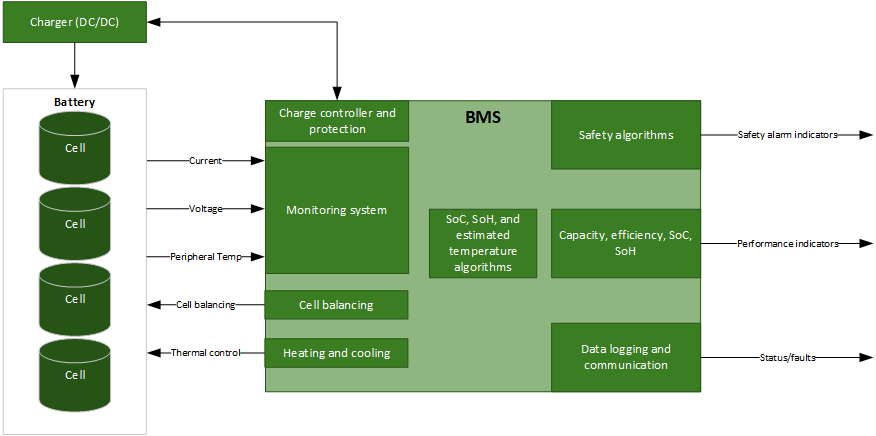
Figure 1. Block diagram of BMS monitoring parameters, such as current, voltage, and measured temperature, to ascertain the estimated temperature, SoC, and SoH. All estimations are processed by the algorithms for communication and control.
The Role of Capacitors in BMS
Filtering
The DC/DC converter can be integrated within the BMS to enhance power capabilities, improve charge/discharge efficiency, and provide battery protection. A filter capacitor is often necessary at the input of a DC/DC converter for noise elimination. Positioned at the input, the filter capacitor helps reduce ripple current and stabilize the DC input voltage.
DC-Link
The power and communication signals from the BMS go to a load, and this load varies based on the application. For a PV application, the load may be an inverter for AC output to a residence. Here, the BMS controls the power flow between the PV installation and the ESS. For an EV, the load may be a traction inverter used to drive a motor such as an induction motor (IM), permanent magnet synchronous motor (PMSM), or brushless DC (BLDC) motor. A DC-link capacitor is required at the output of the DC/DC converter to smooth out high-frequency ripples and filter out unwanted harmonics, thereby reducing noise. Figure 2 presents a conceptual block diagram of this for solar applications, where the DC-link capacitors must be large enough to avoid the transmission of DC-link voltage variabilities into the PV voltage and remove the high-frequency voltage ripple.
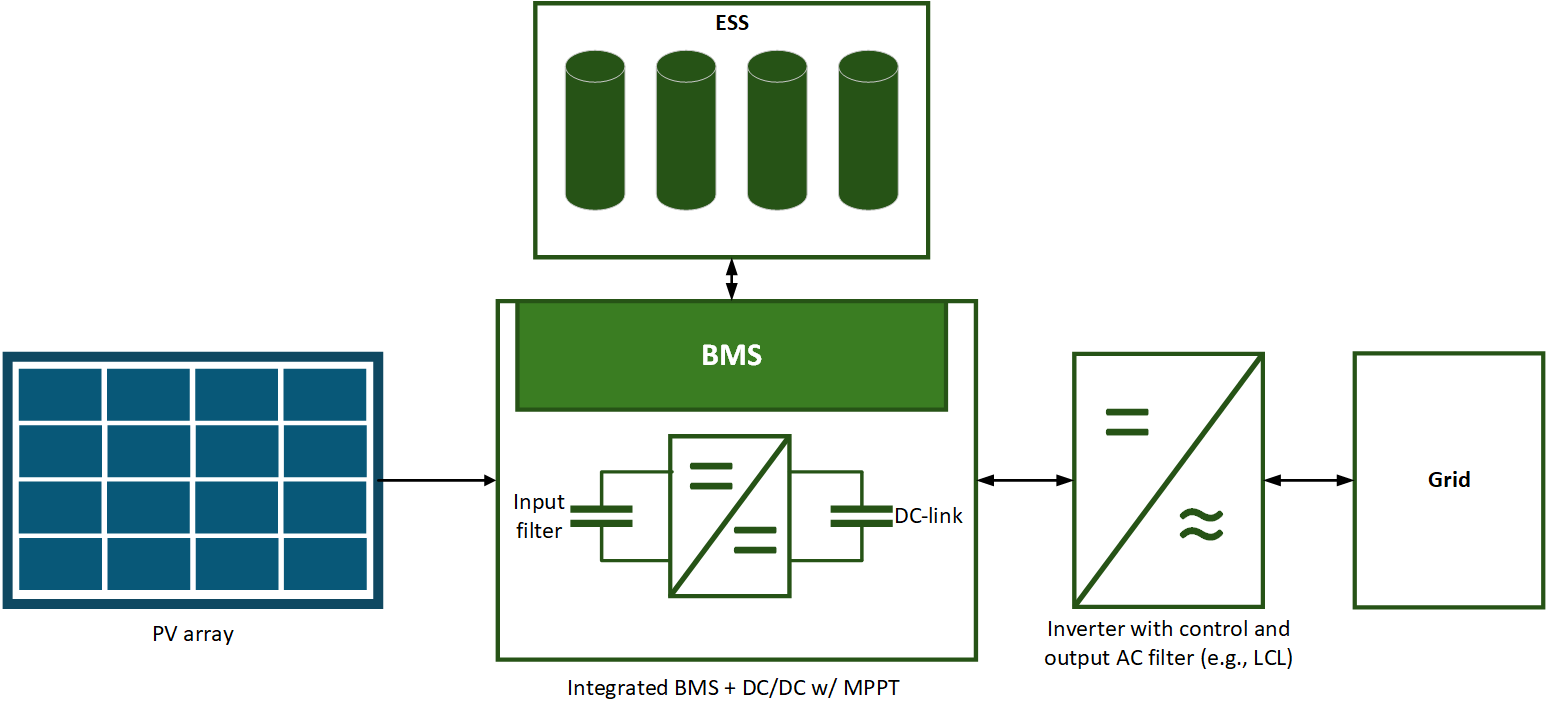
Figure 2. Sample block diagram for a PV installation using an integrated BMS and DC/DC converter with input filter and DC-link capacitors.
Cell Balancing
Battery ESSs (BESSs) require cell balancing to mitigate the negative effects of individual unbalanced cells, which can reduce the overall capacity and lifespan of the BESS. Differences in charge/discharge rates between the cells result in an unequal SoC, and because the cells are connected in series within the battery pack, this imbalance lowers the overall battery voltage.
Deploying passive and active cell-balancing techniques helps decrease this negative impact on the BESS. Passive cell balancing can involve fixed and switched shunt resistors to prevent cells from being overcharged. You can see in Figure 3 how active cell balancing uses either a switched capacitor or a single switched capacitor topology. This capacitive cell balancing shuttles energy between the cells to balance their SoC to the same level. Alternative cell-balancing techniques include converters to set SoC.
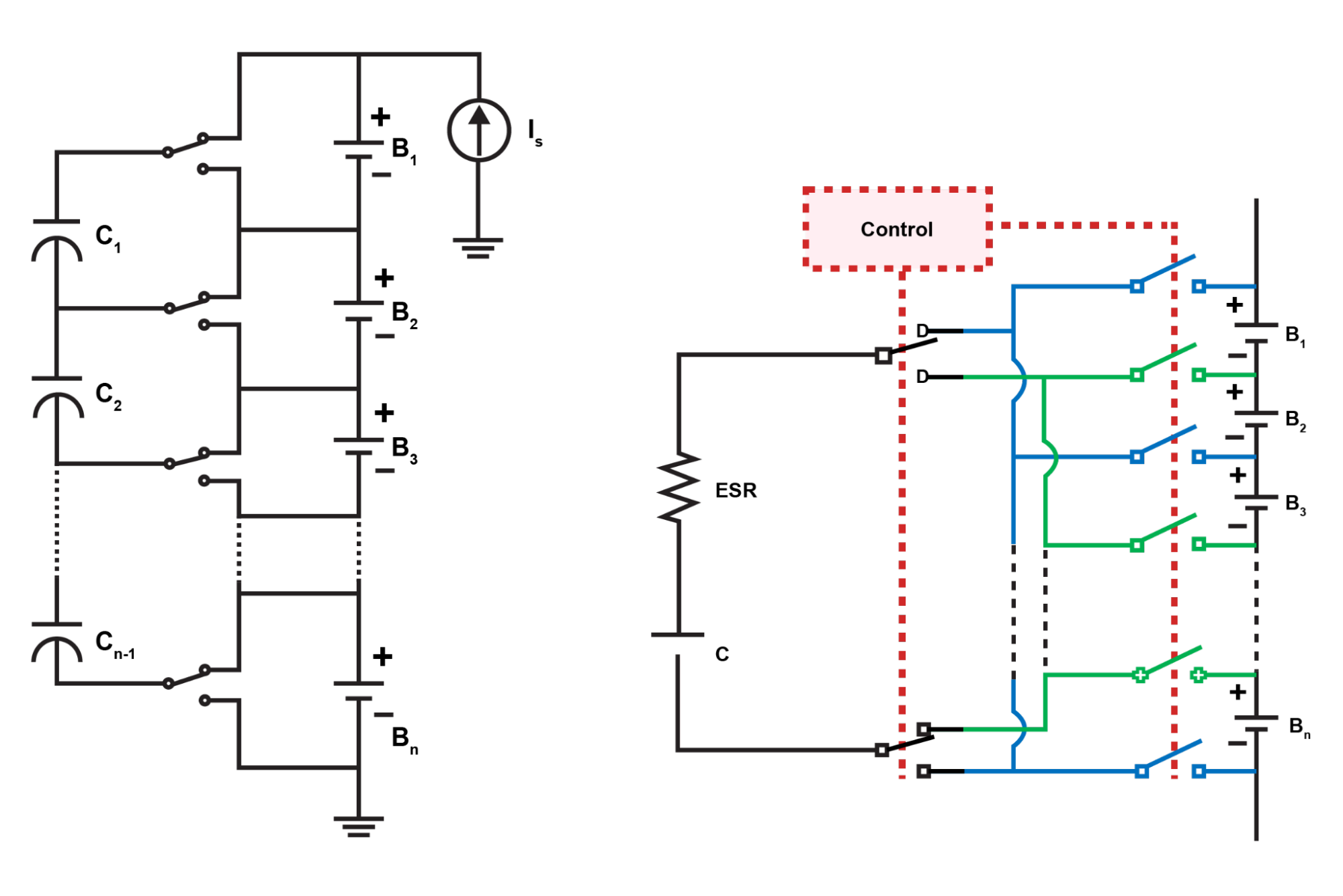
Figure 3. Active cell balancing techniques using capacitors with a switched capacitor topology (left) and single switched capacitor topology (right).
YMIN Capacitor Benefits in BMS
High Capacitance and Lifetime Density
YMIN offers a range of capacitors for BMS applications, including leaded aluminum electrolytics, surface mount (SMD) aluminum electrolytic capacitors, and SMD polymer hybrid aluminum electrolytic capacitors (PHAEC).
The V3M alternative of SMD aluminum electrolytic capacitors offers a lifetime of 2000 hours at 105oC. These are low-profile, small-form-factor, and low-impedance components that are AEC-Q200 compliant and suitable for high-density automated assembly. They have a high capacitance density, and when the load connected to the BMS requires a large current instantly, the capacitor can release more stored energy on demand. This quality makes it ideal for active cell balancing topologies that require a high capacitance density to maximize energy transfers between cells while still minimizing both capacitor size and balancing time.
Long Lifetime and High Ripple Suppression
YMIN’s PHAEC, the automotive-qualified VGY, has the advantages of both aluminum electrolytics and organic electrolytic capacitors, offering a reasonably high capacitance with a low ESR that is temperature and frequency stable. This combination makes it less susceptible to ripple currents and enables a longer lifetime of a guaranteed 10,000 hours at 105oC. A high ripple current resistance is important for filter capacitors to reduce EMI and harmonics, ensuring a steady voltage is delivered.
Leaded electrolytic capacitors, such as the LKL, offer higher capacitance ranges (up to 4700 µF) and rated voltages (10-450 VDC). The LKL series leverages the inherently higher capacitance density of aluminum electrolytics, but it still faces similar temperature- and vibration-related considerations. When operating above its rated temperature for extended periods, the electrolyte solution within the capacitor vaporizes, leading to a drop in capacitance and an increase in ESR. Excessive vibrational strain may also tamper with the sealing materials, causing more leakage and failure. To bypass this, you must ensure the capacitors operate well within their rated voltage and temperature and with minimal ripple current.
The Arrhenius equation is a useful tool in estimating the lifetime of aluminum electrolytics:
$$L = L_0 \times 2^{(T_m - T)/10}$$
where:
- L is the estimated lifetime of the capacitor at operating conditions
- L0 is the lifetime of the capacitor, as stated on the datasheet
- Tm is the rated temperature, as stated on the datasheet
- T is the estimated internal temperature of the capacitor
This equation leads to the common rule of thumb that the operational lifetime is doubled for every 10oC reduction in temperature. Remember, there is a multiplier for ripple current, as this causes the capacitor to self-heat. The LKL series is rated for up to 5,000 hours at 130oC. This is a high-rated temperature, giving the system a longer lifespan.
Strong Overvoltage Resistance
Aluminum electrolytic capacitor solutions have the highest rated voltage, and hybrid solutions (PHAEC) are close behind. A high-rated voltage is necessary in DC-link capacitors to better handle the power fluctuations of the load and source. While it is important to make sure the selected capacitor functions within its safe operating conditions, YMIN capacitors have a strong overvoltage resistance.
Conclusion
Various capacitor technologies are often needed to effectively support their diverse functions within BMS circuitry. This includes filtering, DC-link, and cell-balancing roles. YMIN specializes in designing high-reliability capacitors for the stringent requirements of BMSs. With through-hole and SMD aluminum electrolytic variants, as well as AEC-Q200 compliant hybrid formulations, these cost-effective capacitors offer a high capacitance density, rated voltage, low ESR, and an extended lifespan. For more information, take a look at this paper explaining the key role of YMIN capacitors in battery management systems.