Facebook
 Google
 GitHub
 Linkedin
Google Turns to Nuclear as Fusion Progresses
Could advanced nuclear reactors and fusion prototypes meet carbon-free energy demands?
With 24/7 dispatchable power and no carbon emissions, advanced nuclear reactors are an increasingly attractive resource to balance supply and demand from variable wind and solar generation.
How is Google using advanced nuclear reactors for sustainability? Video used courtesy of Google
Small modular reactors (SMR) are gaining traction for their potential to replace coal plants and offset volatility from renewables. As the name suggests, SMRs’ capacity (up to 300 MW) is smaller than conventional gigawatt-scale nuclear plants, but their factory-assembled design offers advantages for construction and scalability.
Although recent inflation and other financial setbacks have slowed advanced reactor development, companies are still progressing on prototypes to prove the technology’s real-world potential.
The market’s latest developments include an SMR power supply deal with Google, a liquid metal-cooled prototype, European design concepts, and a report on harnessing photonics instruments for fusion control.
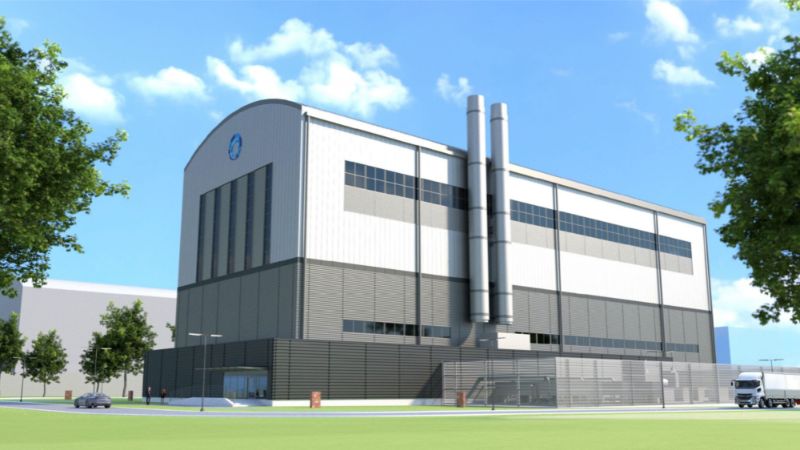
Rending of Hermes, Kairos’s low-power demonstrator reactor. Image used courtesy of Kairos Power
Google will help Kairos Power bring its first SMR online in 2030. By 2035, the tech giant could receive up to 500 MW from Kairos’s SMRs, which will be located in areas serving its data centers.
Artificial intelligence is driving massive surges in energy consumption across Google’s data centers, impacting its 2030 target to reach net-zero emissions across its operations. Google’s data center demands are the largest contributor to its Scope 2 emissions, a category representing 24% of its carbon footprint.
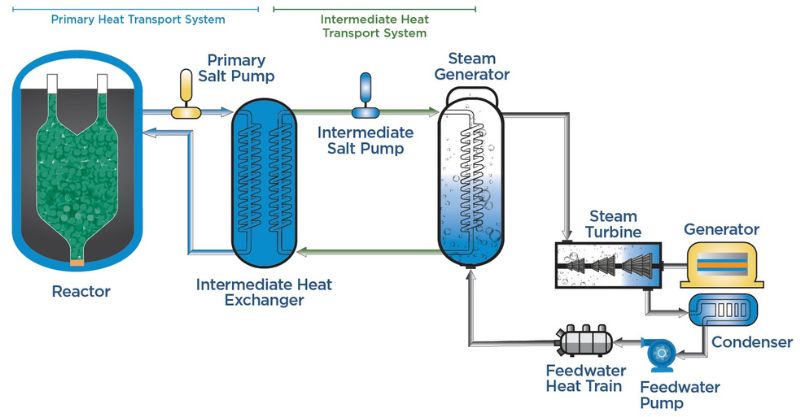
Kairos’s salt-cooled reactor concept. Image used courtesy of Kairos Power
SMRs’ small size and modular design reduce construction timelines and enable flexibility for deployment in more locations— valuable opportunities for Google’s data centers. The company estimates that clean firm technologies like SMRs could reduce costs by 40% compared to using only wind, solar, and lithium-ion battery storage.
Kairos’s molten salt-cooled SMR utilizes ceramic pebble-form TRISO particle fuel to transfer heat to a steam turbine. The company plans to complete several tests to improve efficiency in its Hermes demonstrator, starting with a thermal power level of 35 MW before scaling up to 320 MW for future commercial reactors. Hermes is under construction in Tennessee and will begin operating in 2026.
100 kW-Scale Fusion Prototype Unveiled
Washington-based Zap Energy recently unveiled Century, a 100 kW liquid metal-cooled fusion test platform integrating three design elements: plasma-facing liquid metal walls, pulsed power supplies, and a system to mitigate electrode damage from neutron fluxes and extreme heat.
Zap’s technology fires high-voltage power pulses every 10 seconds for several hours. Air-cooled heat exchangers then remove plasma absorbed by the liquid metal. Century marks one of the largest tests involving a plasma-facing liquid metal-lined chamber, demonstrating 1,080 consecutive plasmas in under three hours.
Zap Energy harnesses sheared-flow-stabilized Z pinch, a phenomenon where electric fields form a high-power magnetic force that compresses matter. This electromagnetic approach avoids superconducting magnets and lasers, enabling a smaller design.
The company recently raised $130 million to support the project’s commercialization, drawing high-profile investors like Soros Fund Management, Bill Gates’s Breakthrough Energy Ventures, Chevron Technology Ventures, and Shell Ventures.
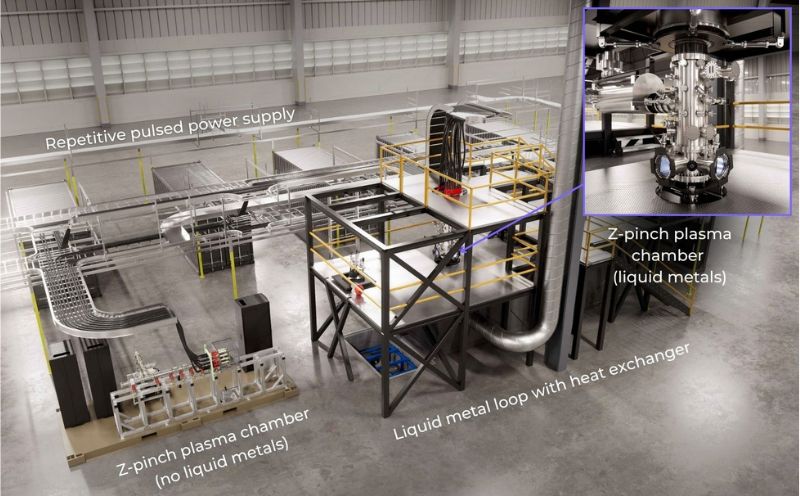
Zap Energy’s Century demonstration unit. Image used courtesy of Zap Energy
In 2025, the platform will slowly ramp up to 100 kW of average input power, the equivalent of concentrating the power draw of 75 homes into a water heater-sized chamber.
Century’s initial configuration circulates 154 pounds of liquid bismuth, though future iterations will scale that to over a ton. Full-scale plants will incorporate several 50 MW Zap Energy modules each.
Learn about Zap Energy’s Century project. Video used courtesy of Zap Energy
SMR Support From European Stakeholders
The European Industrial Alliance on SMRs has selected nine projects for a working group to assess the next steps for deploying SMRs in Europe by the early 2030s. The group involves SMR designers, utilities, energy-intensive users, and research and financial institutions. Each project will have the opportunity to work with interested collaborators.
Selectees include the most advanced prototypes, like NuScale’s VOYGR powered by a 77 MW light-water module, the first SMR design certified by the U.S. Nuclear Regulatory Commission. Another design from Rolls-Royce represents the most advanced design in Europe, with enough capacity to generate up to 470 MW.
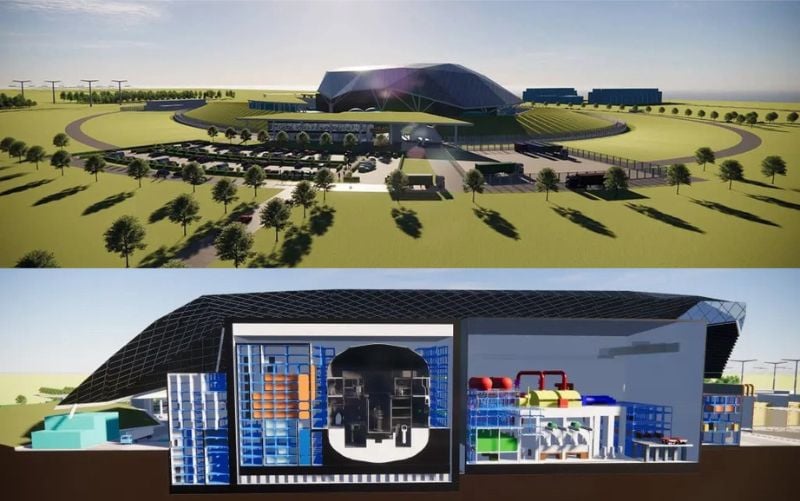
Renderings of Rolls-Royce’s SMR plant design. Images used courtesy of Rolls-Royce
Others include the 100-MW Thorizon One molten salt reactor, Last Energy’s 20-MW Project Quantum SMR, EDF’s dual-unit Nuward design, and ORLEN Synthos Green Energy’s BWRX-300 SMR with GE Hitachi, and Calogena and Steady Energy’s CityHeat project that can be integrated into district heating networks. The alliance also selected two lead-cooled designs: newcleo’s lead fast reactor and the EU-SMR-LFR project, led by four European partners.
Photonics in Advancing Fusion Technology
Photonics21, a 4,000-member association of research institutes and industry stakeholders, has released a report assessing photonics’ advantages for optimizing nuclear fusion processes. The light-harnessing mechanism can control fusion plasmas with high precision and manage extreme temperatures via laser and optical technologies.
Existing photonics technologies—such as advanced thermographic cameras to detect electrical faults, LiDAR to boost wind turbine efficiency, and lasers to improve solar cells—can be reapplied to monitor and control extreme conditions in fusion plants.
The report highlights critical technical gaps. Most fusion approaches focus on heating deuterium and tritium to 100 million °C, but these two isotopes are not abundant. While highly energetic neutrons are fusion’s target product, they also weaken surrounding materials. If the fuel becomes too hot inside the vessel, it must be suspended using magnetic, electric, or electrostatic confinement.
Photonics-based instruments can address these challenges by manipulating extremely hot combustibles. Lasers, for example, can confine and compress the temperature and pressure to induce fusion. They can also serve as advanced control systems for high-precision component manufacturing.
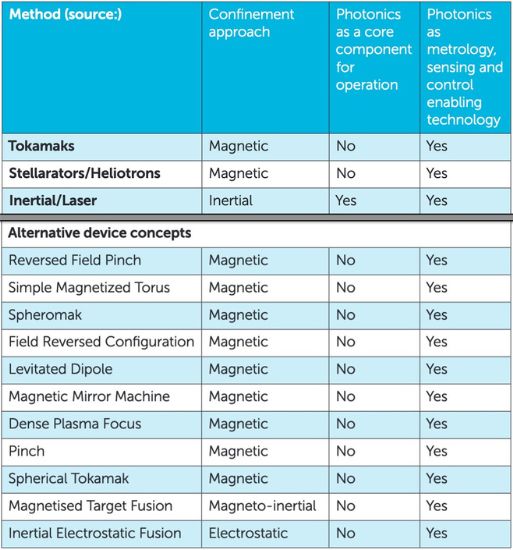
List of nuclear fusion confinement concepts. Image used courtesy of Photonics21 (Pages 9 and 10, Table 1)
Inertial confinement fusion, which shoots synchronized laser pulses around a solid deuterium and tritium (D-T) mixture to compress it, could benefit from photonics tools by facilitating pressure changes corresponding to temperature and density. Photonics21 noted that megajoule-scale laser facilities could compress the D-T fuel pellet, and advanced optical mirrors and other components like metrology instruments and amplifiers can control and synchronize the laser beams.
The report also covers magnetic confinement fusion, in which tokamak and stellarator devices harness a powerful magnetic field to confine plasma. Tokamaks are better at maintaining extreme plasma conditions, while stellarators keep temperatures stable.