Facebook
 Google
 GitHub
 Linkedin
(Cold Cut) Fusion With Mayo? Condiment Creates Nuclear Stability
Researchers found mayonnaise can simulate conditions of a nuclear fusion reaction.
Nuclear fusion promises virtually limitless power with minimal environmental impact. Yet, despite significant progress, including recent breakthroughs in energy output, practical fusion power remains elusive. The field faces numerous challenges, from containing super-heated plasma to managing material degradation under extreme conditions. Yet, scientists continue to innovate methods to achieve commercially viable fusion.
Watch the rotating wheel scientists used to test mayonnaise in fusion (the Rayleigh-Taylor instability experiment). Video used courtesy of Lehigh University
For researchers at Lehigh University, the breakthrough was mayonnaise. They used the common condiment to understand the complex fluid dynamics during fusion reactions. Their achievement could address some obstacles holding back fusion technology.

Could mayonnaise assist with the nuclear fusion process? Adapted from images used courtesy of Wikimedia Commons and Adobe Stock
Nuclear Fusion Fever
Nuclear fusion occurs when atomic nuclei combine to form heavier nuclei and release enormous amounts of energy.
Fusion produces no carbon dioxide or harmful emissions. Its fuel sources, hydrogen and lithium, are abundant on Earth. Scientists have aimed to create the phenomenon by fusing isotopes of hydrogen, typically deuterium and tritium, under extreme conditions.
To achieve fusion, these nuclei must overcome their mutual electrostatic repulsion, which requires temperatures of around 100 million K—hotter than the sun's core. At these temperatures, matter exists as plasma, a state where electrons are stripped from atoms. Containing and controlling this superheated plasma is one of the greatest challenges in fusion research.
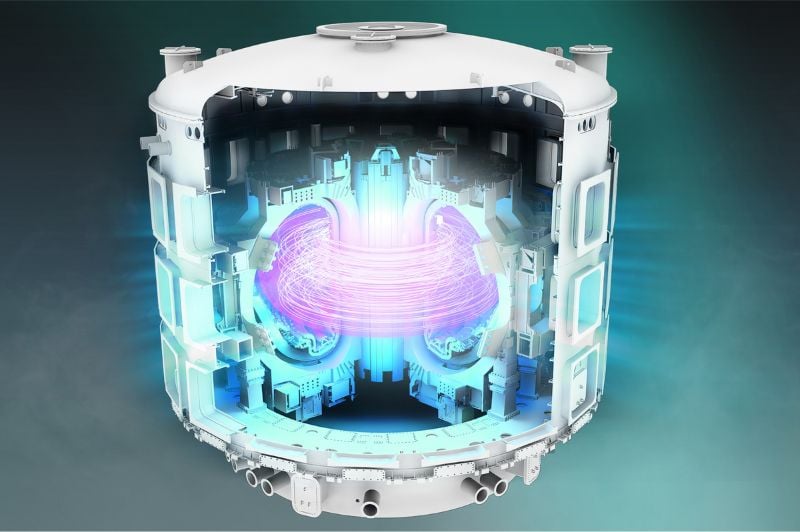
Fusion research in a tokamak. Image used courtesy of ITER
Two main approaches to fusion are being pursued: magnetic confinement, which uses powerful magnetic fields to contain the plasma in devices like tokamaks, and inertial confinement, which uses lasers or ion beams to compress and heat tiny fuel pellets. Both methods face significant hurdles, including plasma instabilities, material degradation from intense neutron bombardment, and the need for more energy input than output to sustain the reaction. The Rayleigh-Taylor instability (RTI), a phenomenon where fluids of different densities mix unpredictably under certain conditions, is a particular concern in inertial confinement fusion.
The Rayleigh-Taylor Fusion Riddle
Researchers at Lehigh University used mayonnaise to study complex fluid dynamics crucial for inertial confinement fusion.
The team tackled the challenge of the Rayleigh-Taylor instability, a major hurdle in achieving stable fusion reactions. RTI is seen in soft materials with substantial resistance to deformation. The elastic-to-plastic transition threshold, where material properties change significantly, has received limited attention. To study this, the scientists chose mayonnaise as a model substance due to its unique properties. It behaves like a solid but flows when subjected to pressure gradients.

Schematic of the rotating wheel, including a rotating disk (a), LED light (c), counterweights (d), mirrors (e), and camera (f). The test section is at (d). Image used courtesy of Lehigh University
Using a rotating wheel facility to simulate fusion plasma conditions, the team observed that mayonnaise undergoes distinct phase transitions, from elastic to plastic behavior, before flowing unstably. The team non-dimensionalized their data to bridge the gap between mayonnaise and actual fusion materials, allowing behavior predictions in real fusion capsules despite material differences.
Fusion’s Future
The ingenious use of mayonnaise to study nuclear fusion challenges is a testament to the potential of unconventional approaches in tackling complex scientific problems. While this experiment does not necessarily bring us directly closer to commercial fusion power, it offers a unique perspective on understanding fluid dynamics in extreme conditions. The journey toward practical nuclear fusion remains challenging, but leveraging such creative techniques could open doors to breakthroughs that might eventually transform the energy landscape.