Facebook
 Google
 GitHub
 Linkedin
Future Planning: Handling the Accelerating Energy Demand
Energy demand is facing unprecedented growth, and generation resources are changing. How can energy leaders handle the increase and plan for an uncertain future?
The demand for energy is growing faster than anticipated, driven by artificial intelligence, data centers, cryptocurrency, industrialization, and electric vehicle charging. Electricity demand will grow 25% over the next five years and 78% by 2050. Peak demand is expected to grow even faster, by 54% by 2050, according to ICF’s report on America’s Rising Energy Demand.
While energy leaders are developing more generation sources, increasing capacity, and implementing demand-side management, they will need to plan strategically and move aggressively to accommodate the demand, manage supply and demand, and keep electricity flowing where it is needed most.
Can energy providers keep up with future demand? Image used courtesy of Adobe Stock
‘Always On’—But Unevenly Distributed—Energy Demand
A decade ago, peak demand was more predictable: it usually happened in the evenings or in summer, when air conditioning put an extra load on the grid. Now, peak demand patterns have changed due to electrification and “always on” energy users like data centers and industrial facilities.
Moreover, in the U.S., energy demand varies widely geographically, according to ICF’s calculations. In general, states with high rates of industrialization and a heavy concentration of data centers, such as Virginia, North Carolina, Texas, and California, can expect a higher rate of peak demand increase.
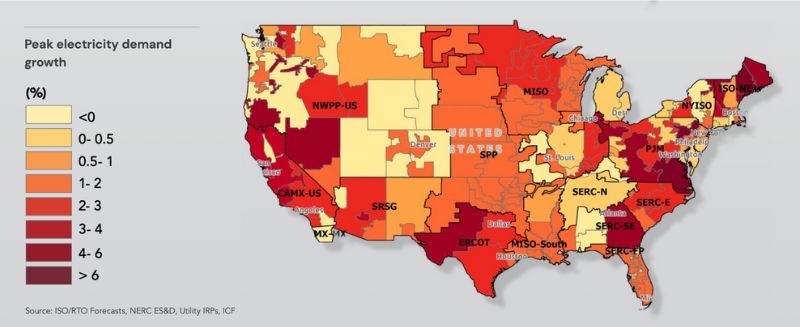
Expected energy demand growth, 2025 to 2035. Image used courtesy of ICF
The specific growth drivers vary by region. In California, data centers, electric vehicles, and building electrification will comprise 35% of demand by 2040. In Texas, cryptocurrency and mining will push about one-third of load growth. Along the East Coast, semiconductor manufacturing joins building electrification and EVs for 35% of the expected load by 2040.
Service providers will need to adapt their strategies for local needs, considering new generation, transmission upgrades, and grid management technologies.
Grid Reliability
Grid reliability for the future is a concern, but not because the U.S. is running out of energy. Instead, several factors are converging to challenge load management.
Ideally, the service margin, or the difference between generation and expected demand, should be at least 15%, and currently, the country averages around 24%, which the ICF describes as “healthy.” However, by 2030, the reserve margin could drop significantly, depending on supply chain and other issues.
While new generation sources are developing quickly, transmission and distribution systems are not growing as quickly. New projects are already experiencing years-old delays in interconnection requests. That could increase or worsen if trends continue.
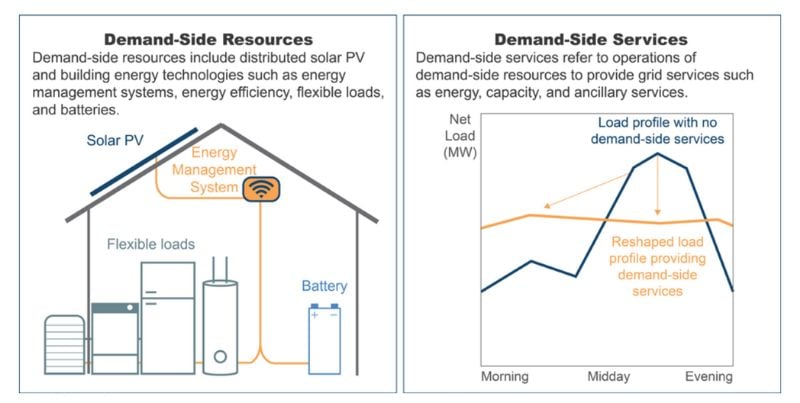
Demand-side management makes use of behind-the-meter resources to balance loads. Image used courtesy of National Renewable Energy Laboratory
Many utilities are increasing capacity and saving costs by implementing programs such as demand-side management. These can promote more efficient use of behind-the-meter sources such as rooftop solar and virtual power plants. The ICF report advises that since these strategies are faster and easier to implement, they could manage up to 8-10% of demand increases, though unpredictability remains.
The Changing Energy Mix
The ICF’s modeling shows that generation capacity will need to increase by 3.3% each year in the next quarter-century in order to meet demand. Grid-scale renewable energy, particularly solar and battery storage, will dominate future generation growth, according to the ICF report. Nuclear generation is expected to increase, while fossil fuels, with the exception of coal, will continue to be important energy sources.
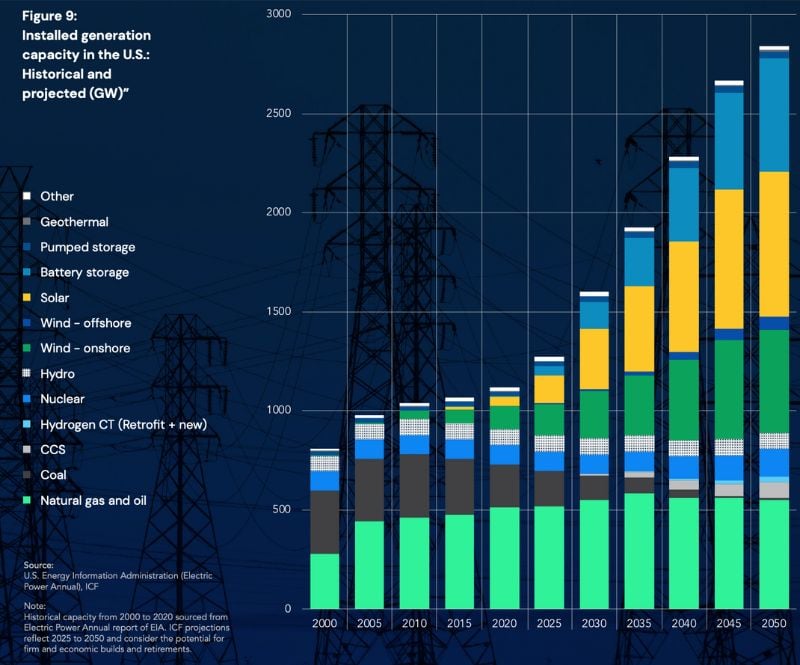
Projected new generation. Image used courtesy of ICF
The development of small modular reactors and investments by technology giants such as Google and Microsoft have boosted interest in nuclear generation. However, the ICF pointed out that nuclear energy still faces challenges such as high costs vs. revenues, obtaining nuclear fuel, waste disposal, and public approval.
The ICF report notes that new power plants can only meet demand if local grid infrastructure can handle the increased electricity flow. Many local grids sorely need upgrades and expansion, yet building new infrastructure is expensive and takes time.
Meanwhile, the ICF report says utilities “need to squeeze every last amp out of their existing infrastructure.” Using strategies such as dynamic line rating can help providers adjust power flow.
What Energy Stakeholders Can Do Now
The ICF report concludes with recommendations for utilities, energy developers, and state energy offices.
For utilities, the main priority is planning, which includes:
- Understanding local impacts of demand and resources
- Using modeling and data analysis to map out future scenarios
- Implementing demand-side programs
The ICF states that opportunities for energy investors are strong, but they should consider:
- Energy demand and economic conditions
- Incentive programs
- Careful site selection based on grid capacity, resources, and regulations
State energy offices must also plan ahead, with emphasis on:
- Analyzing supply and demand, emerging challenges, affordability, and reliability
- Determining needed changes in energy policies and informing state legislators
- Encouraging public and private partnerships
Overall, strategic planning is key to meeting future demand, yet many uncertainties and unpredictable influences persist. All stakeholders must be ready for changes in a dynamic and diverse energy future.