Facebook
 Google
 GitHub
 Linkedin
AI Optimizes Grid Power Flow
Researchers have developed an AI model using multi-fidelity graph neural networks to manage power fluctuations and unpredictable changes in power demand.
Power grid management is one of the most significant logistical challenges in the rapid rise in renewable energy. Since wind and solar power fluctuate significantly, power sources can be intermittent and unpredictable. Demand is similarly unpredictable—what happens when 10 million new electric vehicle owners decide to power up one night?
Grid management systems need solutions to manage this supply and demand uncertainty. At the University of Virginia, a research team has built an artificial intelligence model using multi-fidelity graph neural networks (GNN) to help manage utility grid complexity. The model uses various data sets, including high-fidelity data that is more accurate but often harder to obtain and low-fidelity data that is less accurate but easier or cheaper to acquire.
This multi-fidelity GNN model leverages both data types so the grid can maintain accuracy, improve operational efficiency, and quickly reroute power due to problems like power line failures.
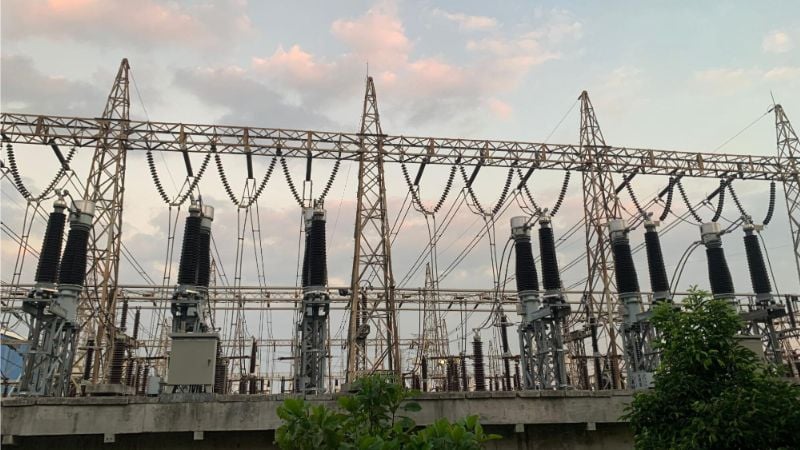
Substation. Image used courtesy of Adobe Stock
Managing Power Flow and Renewable Energy Sources
The most pressing problem in grid management is power flow. Power flow analysis involves calculating how electricity moves from sources (generators) to loads (consumers) while maintaining system stability and operational efficiency. This process aims to ensure electricity is delivered safely across the network without exceeding the voltage or capacity limits of transmission lines and transformers. However, increasing amounts of renewable energy and the rise in electric vehicle usage are introducing high uncertainty levels in both power generation and demand. These uncontrollable power sources are edging out natural gas and coal, which are more easily controlled. As demand grows, grid management becomes increasingly complex.
Renewable sources are inherently variable and dependent on weather conditions, leading to unpredictable fluctuations in power generation. Simultaneously, the increasing electrification in sectors like transportation contributes to erratic demand patterns. These changes challenge traditional optimal power flow (OPF) methods, which use deterministic approaches that struggle to account for dynamic variations in real-time conditions.
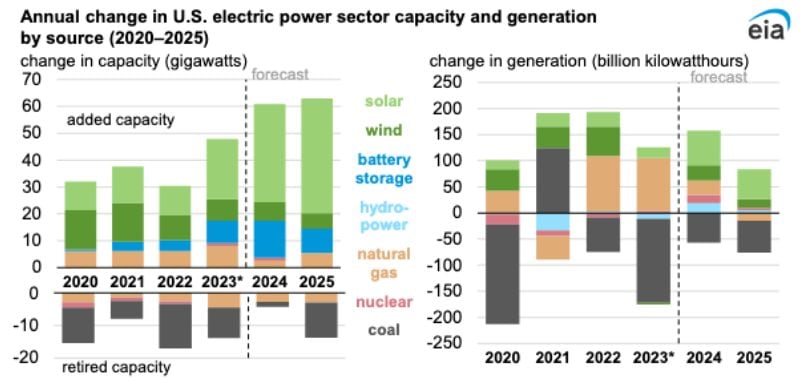
Renewable sources are surpassing fossil fuel generation. Image used courtesy of Energy Information Administration
Traditional methods like Newton-Raphson for Alternating Current Power Flow (ACPF) are often computationally intensive and unsuitable for real-time adjustments; grid management decisions often have to be made quickly at the moment. Without AI, it was impossible to use computationally intensive techniques to inform these decisions. Simplified models such as Direct Current Power Flow (DCPF) can reduce computational burdens but lack the precision needed for accurate predictions in complex networks.
The need for extensive scenario evaluations under uncertainty further complicates the OPF problem, increasing computational demands and making real-time optimization impractical with conventional approaches. These limitations highlight the need for adaptive, computationally efficient models to maintain optimal power distribution while managing the challenges of renewable integration and unpredictable demand.
High Accuracy and Low Computational Cost With Multi-Fidelity Graph Neural Networks
The University of Virginia’s AI model uses enhanced multi-fidelity graph neural networks (EMF-GNN) to address these challenges by incorporating low-fidelity and high-fidelity data in power flow calculations. In the EMF-GNN model, a low-fidelity GNN first estimates phase angles. Then, a high-fidelity GNN refines these estimations using ACPF, achieving accuracy and computational efficiency.
By leveraging graph structures, EMF-GNNs can model buses (i.e., power stations or substations) as nodes and transmission lines as edges, allowing them to dynamically adjust to changes in grid configuration like power line failures and generator outages. This adaptability ensures robustness under various grid conditions and enhances real-time responsiveness. Incorporating GNNs with AI has significantly improved computational efficiency compared to slower traditional non-GNN-assisted methods.
In the EMF-GNN, the low-fidelity model generates initial estimates rapidly, while the high-fidelity model corrects these approximations. This two-tiered process minimizes errors and computational requirements by focusing on high-fidelity processing where it’s needed most.
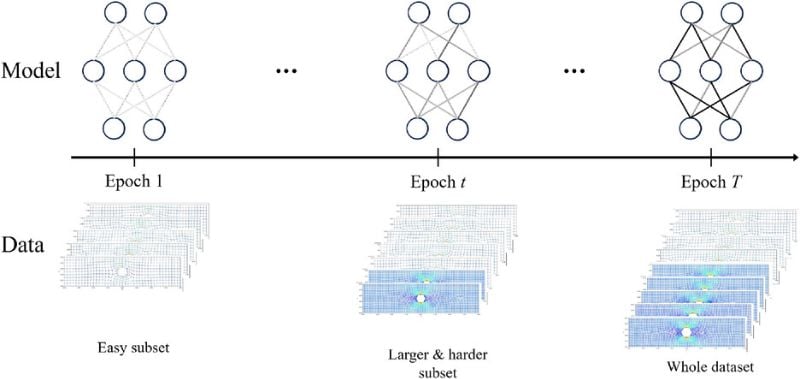
The EMF-GNN combines easy and harder data. Image used courtesy of Taghizadeh et al.
In a power landscape with increasingly uncertain power supply and load demand, the EMF-GNN-assisted model can handle these variables, ensuring optimal and resilient solutions under unpredictable conditions. Without the addition of GNN modeling, the computation time would have reduced feasibility. The UVA team has taken an important step toward a future where AI is adapted and combined with other innovations to meet the power challenges of tomorrow.