Facebook
 Google
 GitHub
 Linkedin
What’s Driving Demand for Hydrogen Fuel Cells?
Hydrogen fuel cell technology is expected to soar by the decade’s end, according to a BCC Research report.
Demand is growing for fuel cells in vehicles and for other uses, according to a BCC Research analysis. Fuel cell electric vehicles (FCEVs) are popular for enabling zero tailpipe emissions, while data centers are deploying hydrogen fuel cells as a cleaner backup power source than traditional diesel generators. Demand is also growing for fuel cells in clean energy applications powered by renewable (green) hydrogen.
The global market for fuel cell stacks is projected to reach $2.4 billion by late 2029, charting a 13% compound annual growth rate from $1.1 billion in 2023, according to BCC’s report. The projections are driven by continued demand for fuel cell electric vehicles (FCEVs), supportive policy incentives, technical advancements, and rising adoption across data centers.

Hyundai's NEXO FCEV model. Image used courtesy of Hyundai
Fuel Cell Hot Spots
The transportation sector is expected to lead fuel cell use through 2029, as auto giants continue to invest in FCEV R&D and production. That includes major players like BMW Group, which will debut its first series-production FCEV in 2028, partnering with Toyota on powertrain development. Hyundai has also introduced its next-generation NEXO mid-size SUV, which boasts several fuel cell stack enhancements delivering 16% higher gross power and improved durability and low-temperature operability.
About 92% of global FCEVs are concentrated in South Korea, China, the U.S., and Japan, with the Asia-Pacific region leading a 68% share, followed by North America (19%) and Europe (8.6%). FCEV adoption remains limited in the U.S., which has about 18,671 FCEVs on the roads today (as of June 2025), according to sales data compiled by the Hydrogen Fuel Cell Partnership.
Sales have slowed in recent years, falling to 611 in 2024, compared to four-digit annual metrics in each of the preceding three years before then. This is partly because refueling infrastructure is centralized in California, home to 50 retail stations. Hawaii is the next-closest state, albeit with just one station.
Emerging Technology Trends: Bipolar Plates and PEM
Bipolar plates remain a critical component of fuel cells, managing current, temperature, and water within the stack. As the name suggests, they act as the carrier plates for both poles.
New materials and coatings are challenging traditional designs. For example, Schaeffler’s coated metallic bipolar plates unlocked a 20% gain in power density over previous generations, as the coating supports a high level of conductivity over the fuel cell's lifetime. Australia-based Siltrax has introduced silicon-based bipolar plates to replace traditional graphite or metallic materials, enabling enhanced power density, performance, durability, and resistance to corrosion and high temperatures.
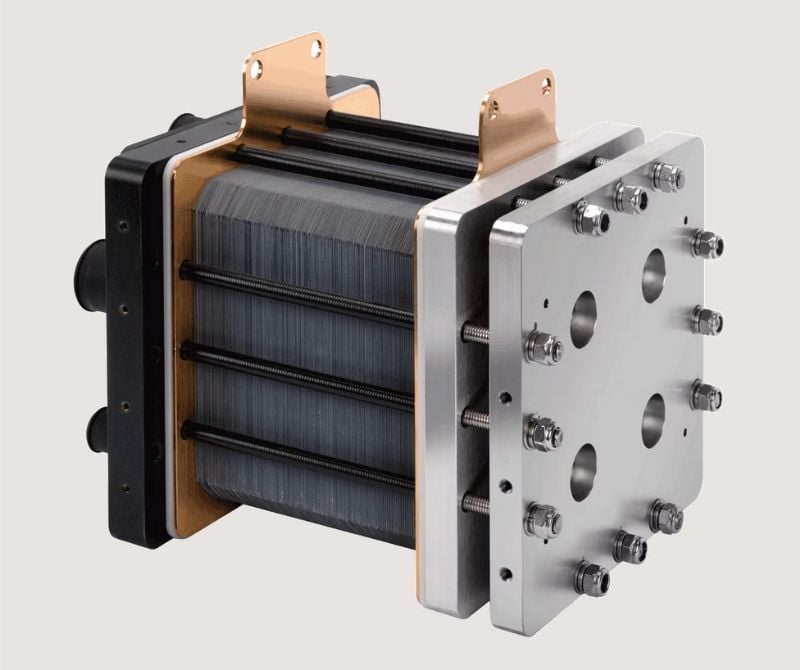
Siltrax's silicon-based bipolar plate technology was first introduced in 2024. Image used courtesy of Siltrax
BCC Research also cited developments in high-temperature proton exchange membrane (PEM) fuel cells (HT-PEMFCs), which operate at 150-250°C and offer up to 50-60% efficiency, higher carbon monoxide tolerance, and simpler heat management. Companies like ZeroAvia are developing HT-PEMFC systems for hydrogen-electric aircraft, citing better durability and lower operating costs as key results.
R&D and Fuel Cell Innovation
Hydrogen remains the fastest-growing fuel type, and ongoing R&D is focused on reducing storage and transport costs. Solid oxide fuel cells, for example, are being refined to minimize degradation and improve material performance at high temperatures.
Last year, 575 global patents were published for fuel cell stack technologies, led by Hyundai, Kia, Toyota, Bloom Energy, and Honda, each claiming a share of at least 5%. BCC Research noted innovations across multiple end-markets, such as Nvidia's energy-efficient liquid-cooled data centers, Zero Emission Industries Inc.'s portable fueling system, and Renew Power Systems' modular microgrids. Additional patents cover hydrogen-system control devices (Toshiba Energy Systems and Solutions), solid oxide fuel cells optimized for peak shaving (Bloom Energy), and methanol-to-hydrogen emergency generators (Zhejiang Benyuan Alcohol Hydrogen Tech Co. Ltd.).
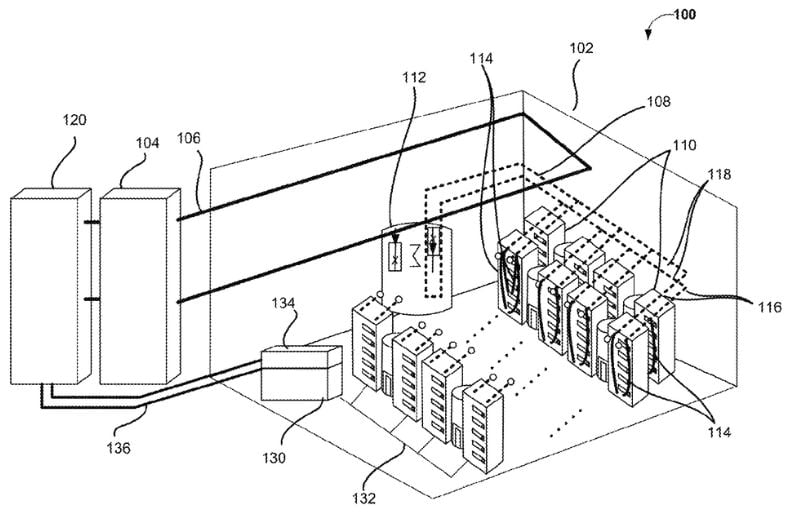
Nvidia's liquid-cooled data center design. Image used courtesy of the U.S. Patent and Trademark Office
Fuel cells generally operate at 40% to 60% efficiency, requiring continuous oxygen to produce electricity. Controlling heat from the reaction can boost this efficiency to 85% via high-performing balance-of-plant components like advanced air management systems. The U.S. Department of Energy is researching such a system, leveraging two-stage filtration to deliver ultra-purified air into the stack.
Challenges Remaining: Refueling, Catalysts, and Logistics
Platinum is the primary catalyst for PEM fuel cells. Catalysts remain a major cost barrier, accounting for nearly two-thirds of a stack's total price.
BCC Research covers efforts exploring graphene as a support material. Graphene's high surface area, corrosion resistance, and strong conductivity make it more durable than other commercially available catalysts, while also matching their performance. A 2020 study in Nanoscale demonstrated through accelerated stress tests that graphene-based catalysts offer a 30% reduction in activity loss.
Underdeveloped refueling infrastructure is an ongoing challenge, as developers face high upfront costs globally. Hydrogen production is a relatively small cost compared to the capital investment needed to build and operate refueling stations. Producing hydrogen from natural gas costs as low as $0.5-$1.70 per kilogram, while sourcing green hydrogen from renewable energy is substantially higher, at $3-$8/kg.
As a result, the prices consumers see at the pump are substantially higher due to the cost of station equipment. In California, end-user prices reached $13 to $16/kg in 2019, according to Argonne National Laboratory. Half stems from equipment like compressors, dispensers, and on-site storage, while distribution accounts for another 35%. Hydrogen production represents only 12-15% of the final price.
Since Argonne's report, prices have skyrocketed over the past five years. California's retail hydrogen pumps hit a record $34.55/kg in September 2024. At the same time, light-duty FCEV sales have slumped as consumers increasingly prefer battery-electric vehicles.
Storage, which is critical during low-demand periods, adds even more complexity. Underground storage is the cheaper option, while metal hydrides are more advanced but still expensive and volume-limited, according to BCC Research.