Facebook
 Google
 GitHub
 Linkedin
Google Builds Data Center With World’s Largest Iron-Air BESS
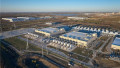
Google’s data center in Minnesota will be powered by renewable energy and backed by a 300 MW iron-air battery energy storage facility.
Artificial intelligence, cloud storage, and smart technology infrastructure are all generating massive amounts of information that data centers must process and secure. In turn, data centers are proliferating worldwide, overwhelming local grid capacities.
Google, like other technology giants, is constructing data centers and developing the energy infrastructure to serve them. In Minnesota, Google is developing a new data center backed by 1.6 GW of renewable energy and the world’s largest 300 MW iron-air battery.
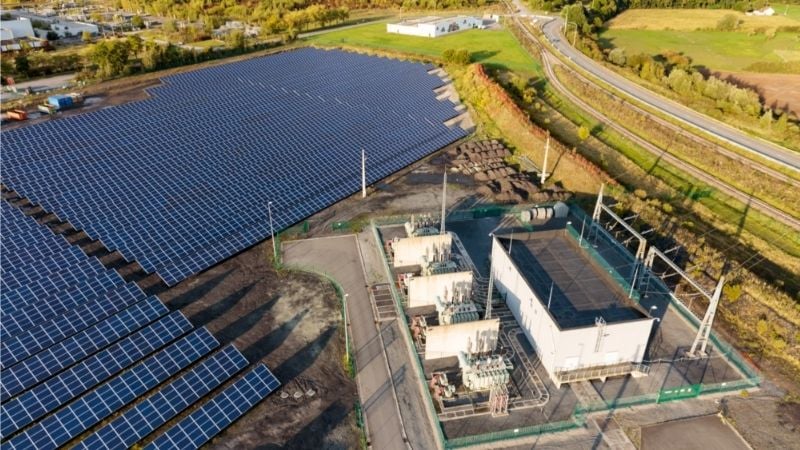
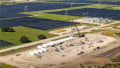
A Google data center in Belgium with solar power. Image used courtesy of Google
Xcel Energy Providing Renewable Power
For the new data center development, Xcel Energy will build 1.6 GW of on-site renewable energy systems, including 1.4 GW of wind power and 200 MW of solar power. The electricity generated by both renewable systems will be fed into a large-scale battery energy storage system (BESS) from Form Energy, enabling delivery for over 100 hours when necessary.
The installation will include a Clean Energy Accelerator Charge (CEAC), a regulatory tariff that will fund the new infrastructure without causing issues with regulators or raising user rates. The CEAC is an extension of a previous tariff, called the clean transition tariff, which Google first developed in Nevada.
Xcel Energy will also receive a $50 million investment for its Capacity*Connect Program to improve grid reliability. Adding renewable energy to the local grid will increase Xcel’s carbon-free energy mix to over 70%.
Form Energy Bringing Iron-Air Battery Capabilities
Form Energy will provide a 300 MW/30 GWh iron-air battery to balance the renewable energy. It follows the company’s first grid-scale battery, which provides 150 MW and 1.5 MW per hour, in Minnesota for the Great River Energy utility. The Google battery will use a similar system but has double the capacity. At 30 GWh, this new 100-hour battery will be the largest operational battery (by GWh) in the world.
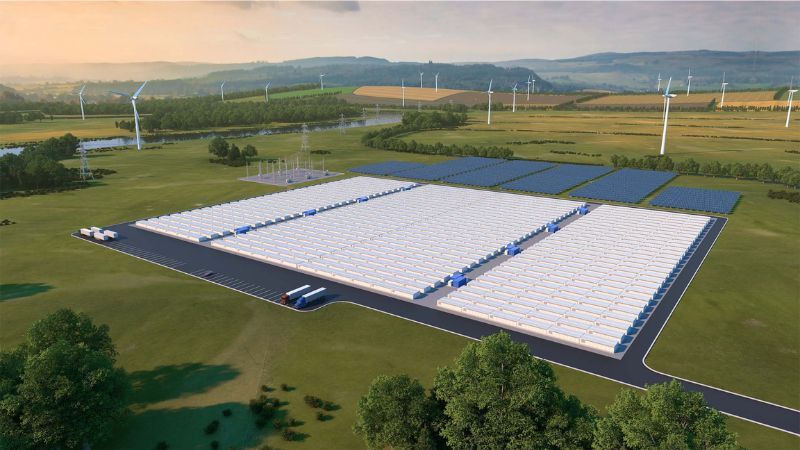
Concept of renewable energy and BESS development. Image used courtesy of Great River Energy
Iron-Air Batteries and Data Centers
Iron-air batteries are heavy and return only 50-70% of the energy used to charge them, compared to 90% for lithium-ion batteries. However, iron-air batteries have several advantages for utility-scale BESS.
Weight is not an issue for iron-air systems because they are stationary. They are also cheaper and can store energy at less than one-tenth the cost of Li-ion batteries. Iron-air batteries also contain no heavy metals; iron is less expensive and easier to obtain than lithium. The batteries don’t experience thermal runaway, and they are easily recyclable.
Iron-air batteries are also long-lasting, providing power for 100 hours in case of grid problems or outages. For data centers, this long operating time is crucial as outages can cause data loss or equipment damage.
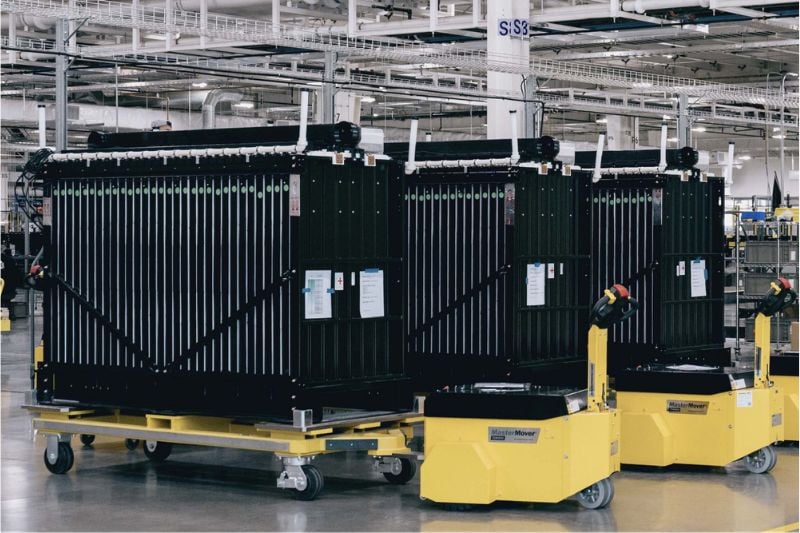
Form Energy’s iron-air battery technology. Image used courtesy of Form Energy
The BESS will store energy during times of high renewable energy production and low energy demand. When the grid experiences high demand, including over multiple days, the BESS will distribute stored energy to the grid to improve resilience and reliability. While utility-scale Li-ion batteries also do this, iron-air’s main advantage is the length of time they can provide backup power.
The iron-air batteries work on the principle of reverse rusting, where the iron metal is oxidized and deoxidized. When the battery is discharged, oxygen is taken in from the air around the battery. The oxygen flows over the surface of the iron, rusting it and generating electricity in the process.
When the battery is charging, an electric current passes through, deoxidizing the rust back into metallic iron and releasing oxygen outside the battery. This cycle is repeatable and provides energy for days.
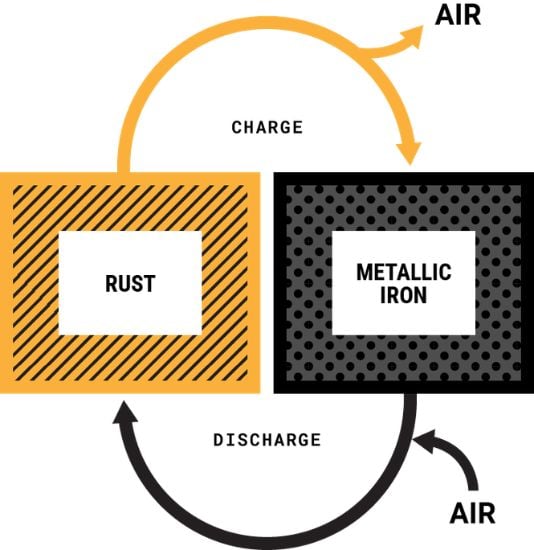
Reverse rusting process. Image used courtesy of Form Energy
Form Energy’s battery modules contain many individual battery cells. Each cell contains iron and air electrodes, along with water-based, non-flammable electrolytes. The modules are also grouped into large modular systems and housed in a shipping container that is also modular. Hundreds of containers are combined to create MW-scale power storage systems.
While effective for utility storage, they require large amounts of space and are not suitable for all applications.
Google’s Role in the Collaboration
The Minnesota data center will be Google’s first in the state and will support some of Google’s core business services, including Google Workspace, Google search engine, Google Maps, and YouTube.
Google will cover all associated costs of installing the new systems in line with Minnesota’s regulatory and legislative requirements for large-load systems. Google is also implementing the CEAC to prevent shifting costs to local customers and fund the Capacity*Connect Program.
Google’s approach demonstrates a cleaner, more affordable way to build data centers that meet future growth and energy needs.