Facebook
 Google
 GitHub
 Linkedin
Examining Fuel Cells for Transportation
Fuel cells are an increasingly attractive option in transportation, offering an alternative to fossil fuels and helping reduce greenhouse gas emissions. Fuel cell electric vehicles offer certain advantages over battery electric vehicles, particularly for long-distance travel, due to quicker refueling and greater range potential.
This article is published by EEPower as part of an exclusive digital content partnership with Bodo’s Power Systems.
In electrolysis, electricity splits water into hydrogen and oxygen, producing hydrogen at the cathode and oxygen at the anode in a 2:1 ratio (H2O). Conversely, hydrogen combines with oxygen (from air or pure sources) in a hydrogen fuel cell to produce an electrical current, with water and heat as the only by-products.
While fuel cell technology is often viewed as being modern, it dates back to the first prototypes built by the scientists Sir Humphrey Davy and Sir William Grove in the early 19th century. In the 1960s, practical hydrogen fuel cell technologies were developed to power welding equipment, agricultural tractors, and even space missions. A significant hurdle to their further development was designing durable interface technology to separate the gases from the liquid electrolyte in the cell. The interface needed to be gas-permeable, electrically conductive, and resistant to both electrolyte corrosion and the heat generated. Today, constructions using proton exchange membranes (PEM) have largely addressed these issues, making stacked fuel cells a viable option for clean, efficient power across multiple sectors like transportation and residential energy.
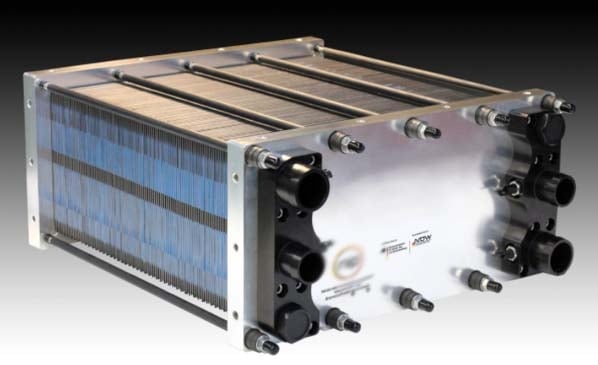
Image used courtesy of Bodo’s Power Systems [PDF]
Fuel Cells in Transportation
Fuel cells are an increasingly attractive option in transportation, offering an alternative to fossil fuels and helping reduce greenhouse gas emissions. Fuel cell electric vehicles (FCEV) powered by hydrogen are now being produced by many major automakers, such as BMW, Toyota, Honda, and Hyundai. FCEVs offer certain advantages over battery electric vehicles (BEV), particularly for long-distance travel, due to quicker refueling and greater range potential.
High-pressure hydrogen refueling stations operate similarly to traditional fuel pumps, whereas BEVs often require lengthy charging stops or larger, heavier batteries. This makes fuel cells ideal for applications in long-haul trucking, buses, and other heavy-duty transport, where rapid refueling, lighter weight, and extended range are key factors. As a result, FCEVs are increasingly focused on trucking and railway applications, while clean fuel cell-powered buses and trams can already be found in many urban areas. Additionally, small-scale FC units can be easily retrofitted to refrigerated containers and trailers, avoiding the need to have continuously running diesel engines to keep perishable goods cold.
Fuel cells are electrochemical devices that convert the chemical energy from a gaseous fuel, often hydrogen, directly into electrical energy. This process occurs in a reaction chamber, or “cell” (Figure 1). When hydrogen serves as the fuel, the process resembles electrolysis in reverse.

Figure 1. Electrolysis Cell vs Fuel Cell Schematic. Image used courtesy of Bodo’s Power Systems [PDF]
Hydrogen fuel cells are also being applied in stationary power systems, powering buildings, industrial sites, and even entire communities. Fuel cells are inherently scalable: adding more cells increases voltage, expanding cell surface area increases current, and connecting multiple stacks in parallel boosts power. However, as individual cells generate relatively low voltages (0.5-0.8V), fuel cells are typically stacked together to deliver useful output voltages of 200 V-300 V with high current (hundreds of amps) to simplify the construction (Figure 2).

Figure 2. Fuel cell stack construction. Image used courtesy of Bodo’s Power Systems [PDF]
Portable power applications are another promising use for fuel cells, particularly in the military, medical, and consumer electronics fields. Fuel cells provide longer operational times than traditional batteries, an advantage in remote, off-grid, or emergency situations. The U.S. military, for example, is exploring small-scale fuel cells to power field equipment, reducing soldier's dependence on heavy battery packs.
Despite recent advances, fuel cell energy still faces inherent technical challenges that hinder widespread adoption. Addressing these challenges is essential for hydrogen fuel cells to play a significant role in our energy transition.
The Reaction Time Problem
Since fuel cells generate power through a chemical reaction involving two gases, there’s a delay between gas supply and power output as the fuel permeates through the stack (Figure 3). For fixed stationary applications, this delay is manageable. However, for hydrogen fuel cell vehicles, even a brief reaction delay is unacceptable, so fuel cell-powered vehicles also use high-voltage (HV) batteries for immediate power and acceleration. These HV batteries can, however, be relatively small as they are continually recharged by the fuel cell stack.

Figure 3. Fuel Cell Stack Reaction Time. Image used courtesy of LEMTA - University of Lorraine and Bodo’s Power Systems [PDF]
Another challenge is an emergency stop. Unlike fuel-burning engines that can be quickly turned off, fuel cells need to be flushed out to remove the reaction gases to stop producing power. This makes shutdown a relatively slow process.

Figure 4. RECOM’s Modular 5x15kW (75 kW) Fuel Cell DC-DC Converter. Image used courtesy of Bodo’s Power Systems [PDF]
DC/DC Converters in Fuel Cell Systems
DC/DC converters address both the reaction delay and shutdown issues while managing the interface between the fuel cell and battery pack.
They:
- Act as boost converters, converting the fuel cell‘s low-voltage, high-current output to a higher-voltage, lower-current battery charging output
- Stabilize the startup and shutdown ramps and mitigate any load transients, providing the stable charging voltage required by the battery pack
- Track the fuel cell’s maximum power point (MPP), adjusting it based on load, time, and temperature to maintain optimal efficiency
- Disconnect the fuel cell stack abruptly in emergencies
- Monitor battery voltage and current, preventing overcharging or deep discharge and safely handling any battery faults
- Integrate with the vehicle’s CAN-bus communication system for centralized monitoring and control
The modular 15 kW DC/DC solution from RECOM offers up to 75 kW by connecting five modules in parallel, making it suitable for heavy-duty applications like trucks, marine vessels, railway rolling stock, and high-power off-grid EV charging stations. This converter has a nominal 150 VDC input, but it operates across a 46 to 275 VDC range with a peak efficiency of around 94%. The output voltage can be set between 200 V and 800 V to match the traction battery, with a maximum input current of 500 A and a maximum output current from 85 A to 220 A. An onboard microcontroller manages input and output voltage monitoring to within ±2% of the set voltage and ±5% of the set current. The solution is also shock and vibration ECER100 conform, while integrated ECER10 EMC filters allow for drop-in installation in automotive applications.
Liquid cooling enables a compact design and wide operating temperatures, with the 75 kW unit measuring just 750 x 400 x 200 mm. The DC/DC converter operates at full power between -40°C and +50°C ambient temperatures, with built-in short circuit, output overcurrent, output overvoltage protection, and automatic shutdown if the cooling system fails.

Figure 5. Modular 75 kW DC/DC converter. Image used courtesy of Bodo’s Power Systems [PDF]
Each 15 kW module employs a two-stage, four-phase interleaved boost converter, allowing efficient operation across a wide range of input and output voltages. Digital control ensures accurate monitoring of all currents and voltages, maintaining peak performance under all load conditions and ensuring a rapid response to any faults.
The architecture is modular and versatile, allowing for optimization for different output voltages or power requirements from 15 kW up to 75 kW. Parallel connections between units also allow scaling, enabling configurations up to 225 kW, ideal for high-power off-grid BEV chargers.
The J1939 CAN-Bus interface connector provides a wired emergency shutdown and alarm signal as well as a digital interface.
Fuel Cell Future
Fuel cells offer a versatile and promising pathway toward a cleaner, more sustainable energy landscape, representing a crucial step toward the decarbonization goals required to address climate change. When paired with programmable kilowatt DC/DC converters, fuel cells offer practical solutions to sectors that are hard to electrify, and hydrogen fuel cell vehicles can help reduce our over reliance on BEVs and excessive stress on the electrical grid.
This article originally appeared in Bodo’s Power Systems [PDF] magazine.