Facebook
 Google
 GitHub
 Linkedin
Utilities Leverage the Potential of the Residential Battery Boom
Virtual power plants allow utilities to use these behind-the-meter assets to help meet peak demand and increase grid stability,
Residential battery installations have set a record this year, with 673 MW of battery storage capacity deployed in the first quarter of 2026, according to the U.S. Energy Information Administration. This pace has many utilities asking: How can these emergency backup systems become active grid assets?
While this energy resource is decentralized and often unseen and unreported, grid operators are recognizing great potential to tap into these batteries to manage peak demand by using virtual power plants (VPPs) to network thousands of home systems.
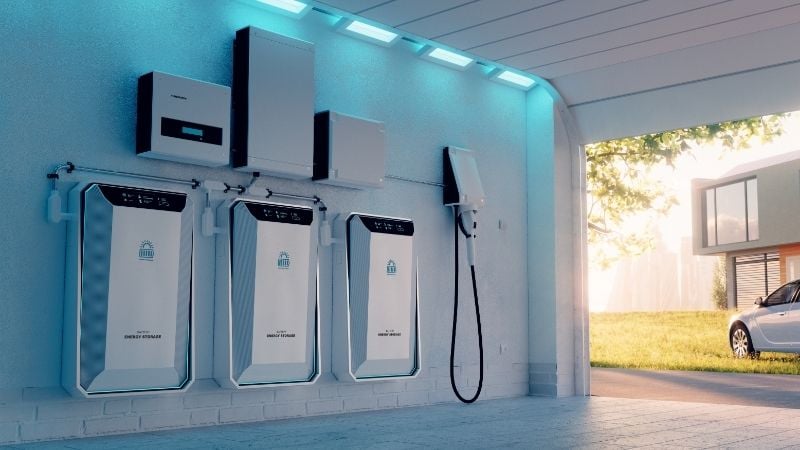
Concept of residential battery with EV charger. Image used courtesy of Adobe Stock
Unprecedented Growth in Home Storage
The surge of home batteries is highly concentrated in states with high solar adoption and shifting regulatory landscapes. California and Hawaii are leading the nation in new installations, while Texas and Arizona have also seen significant adoption. All four states are providing incentives for battery adoption, including rate reductions, rebates, and bill credits.
Additionally, rooftop solar companies are bundling home-based batteries with installed systems or offering similar promotions. Federal tax credits may also apply.
The collective capacity of these distributed systems is quickly reaching a scale that impacts regional transmission planning.
Grid Disruption Versus Asset Integration
The sudden influx of home batteries presents a dual reality for electrical infrastructure, acting as both a localized challenge and a grid-balancing tool. When uncoordinated, thousands of independent systems exporting power simultaneously can create voltage instability on local distribution circuits.
However, many power grids are successfully mitigating these disruptions by accessing battery energy through a VPP. Last year, the total domestic household storage capacity enrolled in VPP programs grew by 153%, according to an Ohm Analytics report.
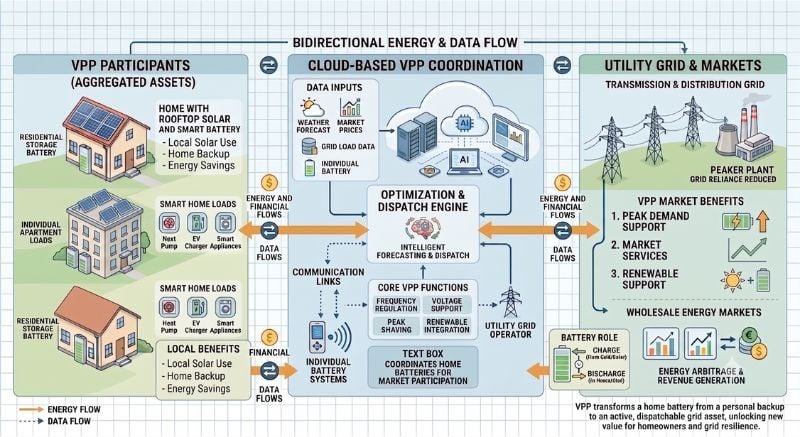
The residential battery’s role in a VPP. Adapted image used courtesy of Gemini
One notable deployment in California showed that a fleet of roughly 100,000 home batteries could reliably deliver 539 MW of electricity during a two-hour grid stress test. This coordinated injection of power exceeds the output of a standard natural gas peaker plant, providing immediate relief to transmission lines and balancing authorities during peak demand.
Operational Requirements for Utility Utilization
Utilizing residential batteries requires specific technical capabilities and formal agreements between utilities and consumers. The systems must support bidirectional operation, allowing the inverter to switch between charging and discharging in response to external signals.
Grid operators must also secure explicit permission from homeowners, who typically sign agreements outlining how and when their batteries can be accessed. Most programs allow participants to establish a reserve capacity threshold to ensure their homes retain backup power for localized outages.
Continuous cycling of batteries to support the grid may also impact the battery, as constantly charging and discharging to handle regional frequency or voltage fluctuations can accelerate mechanical degradation. Studies indicate that batteries subjected to frequent grid-balancing duties experience a 9-14% faster capacity loss over a 10-year operational lifespan, according to a 2025 study in Applied Energy.
Several service providers are actively pioneering these frameworks across different regional markets. Regional transmission organizations like ISO New England allow aggregations of behind-the-meter batteries to participate directly in wholesale capacity markets under Federal Energy Regulatory Commission Order 2222.
At the retail distribution level, Green Mountain Power in Vermont uses its Bring Your Own Device program to network customer-owned batteries via automated software signals, successfully lowering regional demand spikes without requiring investments in new substation infrastructure. Major industry aggregators like Tesla, Sunrun, and Renew Home have also formed partnerships to integrate hundreds of thousands of individual household systems, targeting the delivery of over 16 GW of distributed power to utilities and data centers.
It’s Not Just Residential
Businesses are also adopting battery storage to serve as power backup, either to supplement or replace generators. These batteries can be scaled to accommodate the business’s power requirements. A typical residential battery can supply 10 to 15 kWh of electricity, but stacking multiple units can achieve up to several hundred kWh. Businesses may also be eligible to participate in VPPs.
As batteries grow significant in the energy landscape, they are becoming yet another behind-the-meter resource for power grids facing increasing demand as the world electrifies.