Facebook
 Google
 GitHub
 Linkedin
Battery Boom: Global Gigafactories on the Rise
Battery production is ramping up worldwide.
Battery manufacturers are scaling up capacity to meet growing demand in energy storage, electric vehicle charging, and data center power applications.
Recent developments include two gigafactories in the U.S. and Europe, a cobalt sulfate refinery in Canada, and a battery innovation center. Here’s the latest.
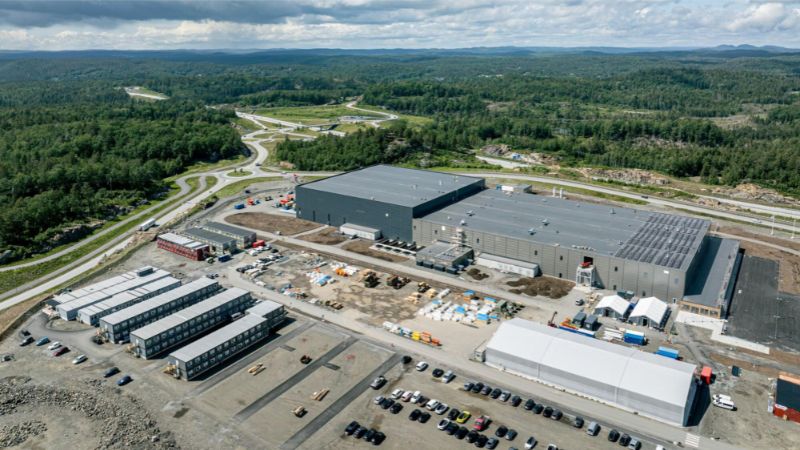
Morrow Batteries’ new gigafactory in Europe. Image used courtesy of Morrow Batteries
Europe Debuts First LFP Gigafactory
Morrow Batteries has opened Europe’s first gigawatt-scale lithium iron phosphate (LFP) battery plant in Norway. With 1 GWh of capacity, the site will manufacture up to 3 million battery cells annually for energy storage and heavy-duty mobility applications.
ABB, Siemens, and other major players own the four-year-old company. It has made significant strides with its first LFP product, boosting its cycle life by 30% and energy density by 10%. LFP batteries are increasingly popular for their inexpensive makeup and high thermal stability, minimizing thermal runaway risks. Tesla, Ford, and Rivian have switched to LFP technology, and Nissan revealed it will do the same by 2026.
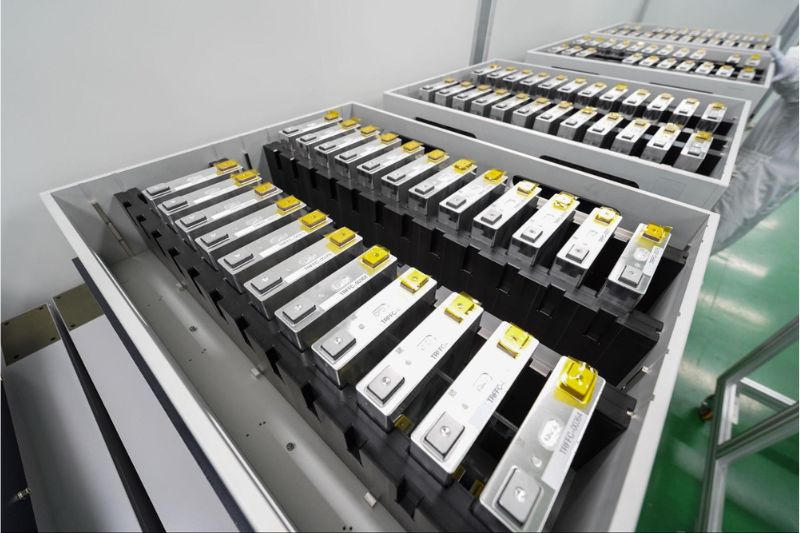
Morrow Batteries’ completed LFP cells. Image used courtesy of Morrow Batteries
Morrow’s 355,209-square-foot factory will initially produce LFP and nickel manganese cobalt (NMC) batteries, the two chemistries dominating today’s market. Next, it will expand to prismatic cells featuring lithium nickel manganese oxide, a high-voltage cathode material. Morrow will divide the offering into two generations, targeting ferries, trains, and battery energy storage systems. The company aims to eliminate the need for cobalt and reduce nickel content by up to 60% compared to conventional NMC batteries.
Last year, Morrow shipped thousands of sample cells to prospective customers for testing and validation. It has secured supply agreements with key players like Nordic Batteries (for 5.5 GWh of LFP BEV batteries) and Eldrift (1.5 GWh for energy storage solutions). It also signed a contract with Stena Recycling to handle scrap from its Norway factory.
Sodium-ion Battery Plant in North Carolina
Natron Energy revealed plans to build a $1.4 billion, 1.2 million-square-foot gigafactory for sodium-ion batteries in eastern North Carolina. With 24 GW of annual production, the facility marks a significant expansion from Natron’s current 600 MW capacity at its newly opened plant in Michigan.
The California-based company, backed by prominent names like ABB and Chevron Technology Ventures, will produce batteries for EV charging and grid storage systems, data center backup power, and other applications. Its Prussian blue electrode chemistry enables fast charging and power delivery with no friction, unlocking a 50,000-plus cycle life. Natron claims its product surpasses lithium-ion batteries in power density and recharging speed. It also replaces lithium, cobalt, nickel, and copper with aluminum, iron, manganese, and a sodium electrolyte.
Natron’s blue electrodes store and transfer sodium ions faster than competing technologies, with lower internal resistance and no thermal runaway. It also avoids strain during charging/discharging, with 10x faster cycling than lithium-ion batteries.
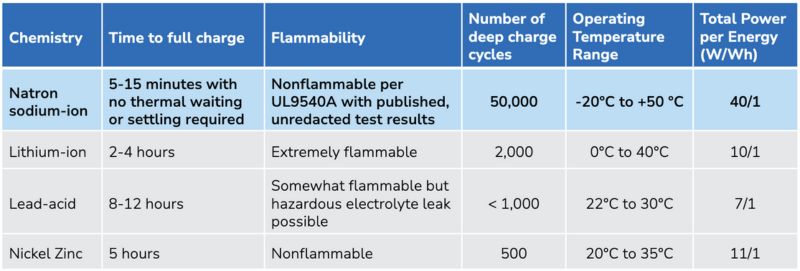
Natron’s sodium-ion battery performance vs. other leading technologies. Image used courtesy of Natron Energy (Page 5)
Natron offers its BluePack battery for 48 V to 480 V applications like EV charging, hybrid energy storage systems, and microgrids. Its 480 V BlueRack 250 battery cabinet can be used in data centers and on- or off-grid backup power systems, recharging fully in under 15 minutes. The BlueTray 4000 rack-mounted battery pack can discharge in 30 seconds, depending on the load, and provides backup power for data center and telecom markets.
Cobalt Sulfate Refinery Grabs DoD Support
The U.S. Department of Defense (DoD) awarded Canada-based Electra Battery Materials $20 million to complete a hydrometallurgical cobalt sulfate production plant in Ontario. Once commissioned, the $250 million project will refine 6,500 tonnes of cobalt from sulfate annually, supporting over a million EVs. South Korean battery giant LG Energy Solution will purchase 80% of the capacity in the first five years.
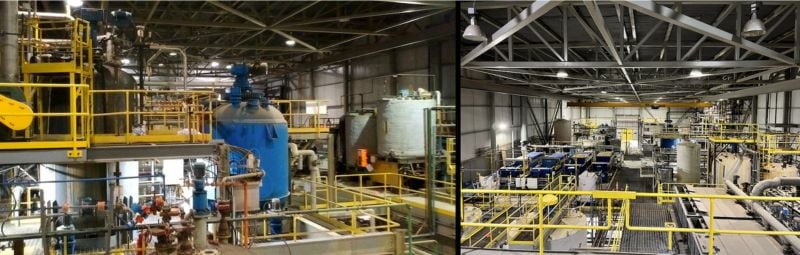
Interior views of Electra’s Ontario refinery. Images used courtesy of Electra Battery Materials
The refinery is located relatively close to several upcoming precursor cathode active material plants, including in the U.S. Funding such facilities is part of the DoD’s goal to shore up a supply network for a key precursor in large-capacity batteries for defense and EV systems. The facility would be North America’s first refinery for cobalt sulfate, the active ingredient in lithium-ion batteries. China currently dominates each phase of the supply chain, including 85% of battery-grade cobalt sulfate and 62% of mine materials for cobalt chemical refining.
Electra’s hydroelectric-powered refinery marks the first North American production site for battery-grade cobalt and nickel sulfate. Once fully commissioned, it will supply about 5% of the global demand for battery materials.
Innovation in Dry Electrode Coating
Chemical giant Chemours has opened a battery innovation complex in Newark, Delaware, where engineers will test next-generation lithium-ion battery technologies with increased performance and efficiency for EVs and hybrid vehicles.
The facility will scale Chemours’s novel dry electrode coating process for lithium-ion battery production. Its existing Teflon fluoropolymer binders support solvent-free electrode fabrication. Dry electrode coating is an attractive alternative to wet, slurry-based processes that emit hazardous vapor during drying.
Dry processing runs materials through shear mixing, calendaring, and lamination, enabling higher loading without cracking. In addition to shortening production lines by 75%, Chemours’s dry electrode approach reduces energy consumption by up to 47% by eliminating solvent recovery and improving battery performance.