Facebook
 Google
 GitHub
 Linkedin
Transmission Line Construction Too Slow To Meet Future Demand
While energy demand escalates, new line construction has slowed to the lowest level in a decade.
U.S. high-voltage transmission construction (345 kV and above) has slowed to a crawl, well below the pace needed to meet rising demand, reduce grid congestion, and maintain grid efficiency. That's according to a new analysis from Americans for a Clean Energy Grid, which reports that 2024 was one of the slowest years in the past decade for high-voltage transmission buildout.
Notably, the report includes an update citing the latest Federal Energy Regulatory Commission (FERC) data, released on July 1. The U.S. built 888 miles of new high-voltage transmission infrastructure in 2024—334 miles of 345 kV and 554 miles of 500 kV lines. That's far from the 2013 peak, when annual construction approached 4,000 miles.
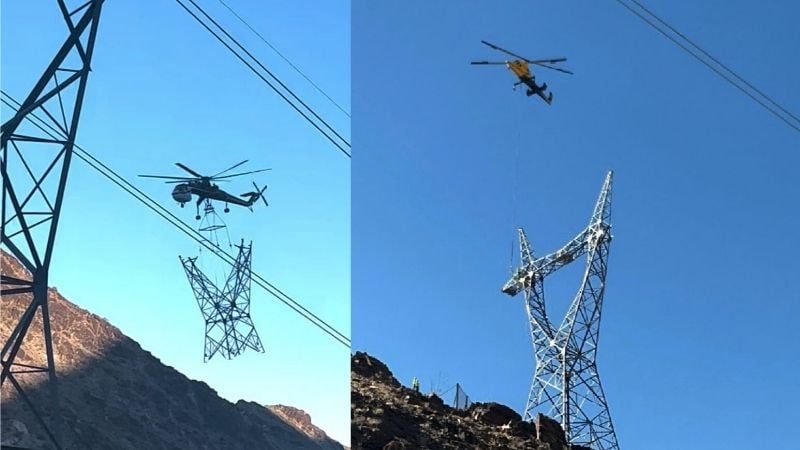
The Ten West Link that connects California and Arizona was built in 2024. Here's a section under construction, aided by a helicopter. Images used courtesy of CAISO
Building Too Slowly for Energy Demand
The pace remains far too slow to meet rising demand, keep costs down, and sustain U.S. leadership in power-intensive sectors like AI data centers and advanced manufacturing. From 2020 to 2024, the U.S. averaged 536 new miles of high-voltage lines annually, compared to 942 miles from 2015 to 2019, and 1,781 miles from 2010 to 2014.
The Department of Energy estimates that the contiguous U.S. transmission system needs to at least double by 2050—2.1 to 2.6 times—to meet demand while maintaining reliability and keeping costs low for consumers. In its report, Americans for a Clean Energy Grid notes that even a conservative approximation of those findings translates to roughly 5,000 miles of high-capacity transmission lines each year.
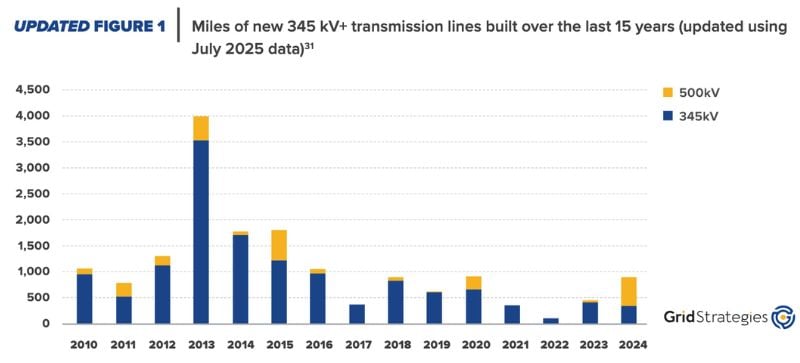
New 345 kV and 500 kV transmission lines from 2010 to 2024. Image used courtesy of Americans for a Clean Energy Grid
Why Is More Transmission Needed?
High-capacity transmission expansion can ease grid congestion and unlock cost savings for utilities and users. According to Americans for a Clean Energy Grid, a 765 kV line can provide the same amount of power for 75% less cost per MW than lower-voltage options, such as 230 kV lines.
Expanding transmission improves reliability during extreme weather and supports rising demand from AI data centers and advanced manufacturing. Interregional projects are critical to meeting these needs. Although weather disruptions and resource needs vary from state to state, no single region can meet future reliability and cost goals alone, and the ability to share capacity long-distance across states greatly improves resilience during grid stress events.
Last year, the North American Electric Reliability Corporation's Interregional Transfer Capability Study recommended adding 35 GW of interregional transfer capacity by 2033 to meet reliability needs and improve resource adequacy under extreme conditions.
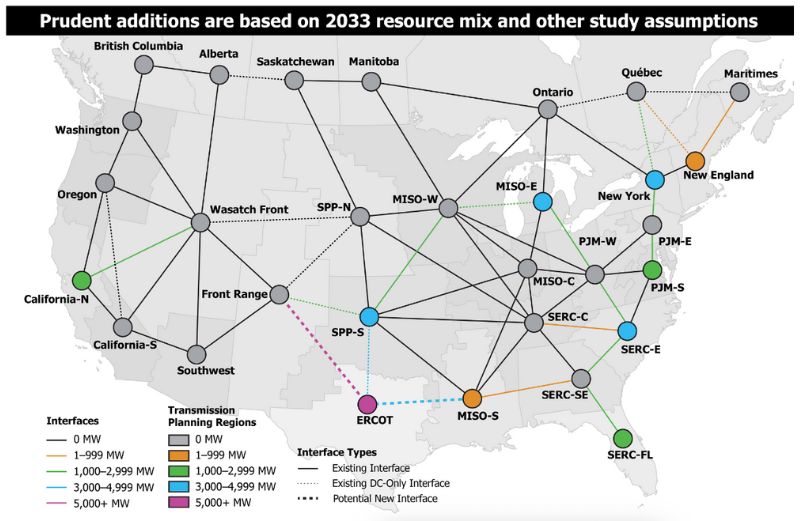
2033 interregional transmission needs. Image used courtesy of NERC
Notable Transmission Projects in 2024
Most of 2024's new transmission mileage came from a handful of large projects, including the 125-mile, 500-kV Ten West Link between California and Arizona, enabling 3.2 GW of transfer capacity across state boundaries. When the project was completed last year, CAISO reportedly had more than 7 GW of renewable resources seeking interconnection to the bulk transmission grid via the Ten West Link.
Other notable transmission expansions included the 102-mile Cardinal–Hickory Creek 345 kV line in Iowa and Wisconsin, the 33-mile 345-kV Roundup–Kummer Ridge line in North Dakota, and a pair of Duke Energy Florida projects totaling 38 miles of 230 kV lines. Texas was particularly busy in late 2024, with six projects building 57 miles of 138 kV and 345 kV lines.
FERC's latest Energy Infrastructure Update reports that in early 2025, just 62.5 miles of transmission projects had been completed through April, with most being 345 kV lines (nearly 50 miles), followed by ≤230 lines (10.9 miles). Only 1.8 miles of 500 kV lines were completed, through Entergy Louisiana's Wise-Bayou Labutte Transmission Project.
_and_estimates_for_high-probability_completions_by_2027_(right).jpg)
Past and present transmission project activity (left) and estimates for high-probability completions by 2027 (right). Image used courtesy of FERC
Looking ahead, FERC estimates that 2,356 miles of proposed transmission projects have a high probability of entering service by 2027, but only 145 miles of that total are expected to be at 500 kV. The majority of new lines are at ≤230 kV (1,212 miles) and 345 kV (999 miles).