Facebook
 Google
 GitHub
 Linkedin
The Surprising Impact of Sugar on Flow Batteries
Researchers have found that adding sugar to the electrolyte has some astonishing results.
Due to its intermittency, renewable energy resources require large-scale battery energy storage systems (BESS) to store excess energy during the day and when the wind is blowing and return it to the grid when conditions are less favorable for energy production. Lithium-ion batteries, which power cellphones, laptop computers, and electric vehicles (EVs), are getting all the headlines for energy storage, but they are not the only technical solution.

Researchers use sugar to improve battery life. Image used courtesy of Pexels
The advantage of lithium-ion batteries over other electricity storage systems is their high energy density. They can store a large electrical charge in a relatively lightweight device, making them the only real choice for mobile devices and products like EVs. But storing electricity generated by wind turbines and solar farms is a stationary application. One promising option is the flow battery.
What Are Flow Batteries?
Flow batteries use large containers containing an electrolyte pumped through a reaction cell. When the flow battery charges, the cell adds electrons to the electrolyte as it pumps from one storage tank to the other. When the flow battery discharges, the electrolyte is pumped back to the original tank, and the electrons are removed in the reaction cell and can be used to provide energy to the grid.
Flow batteries are bulky and heavy, so they are not good for mobile electricity storage like a lithium-ion battery, but their capacity depends on the size of the electrolyte storage tanks, so they can be made in almost any size and can be big enough to cover a football field if vast amounts of energy need to be stored. The electrolyte depends on the chemistry of the flow battery, but in some cases, can be water-based, reducing the risk of fire often associated with lithium-ion batteries.
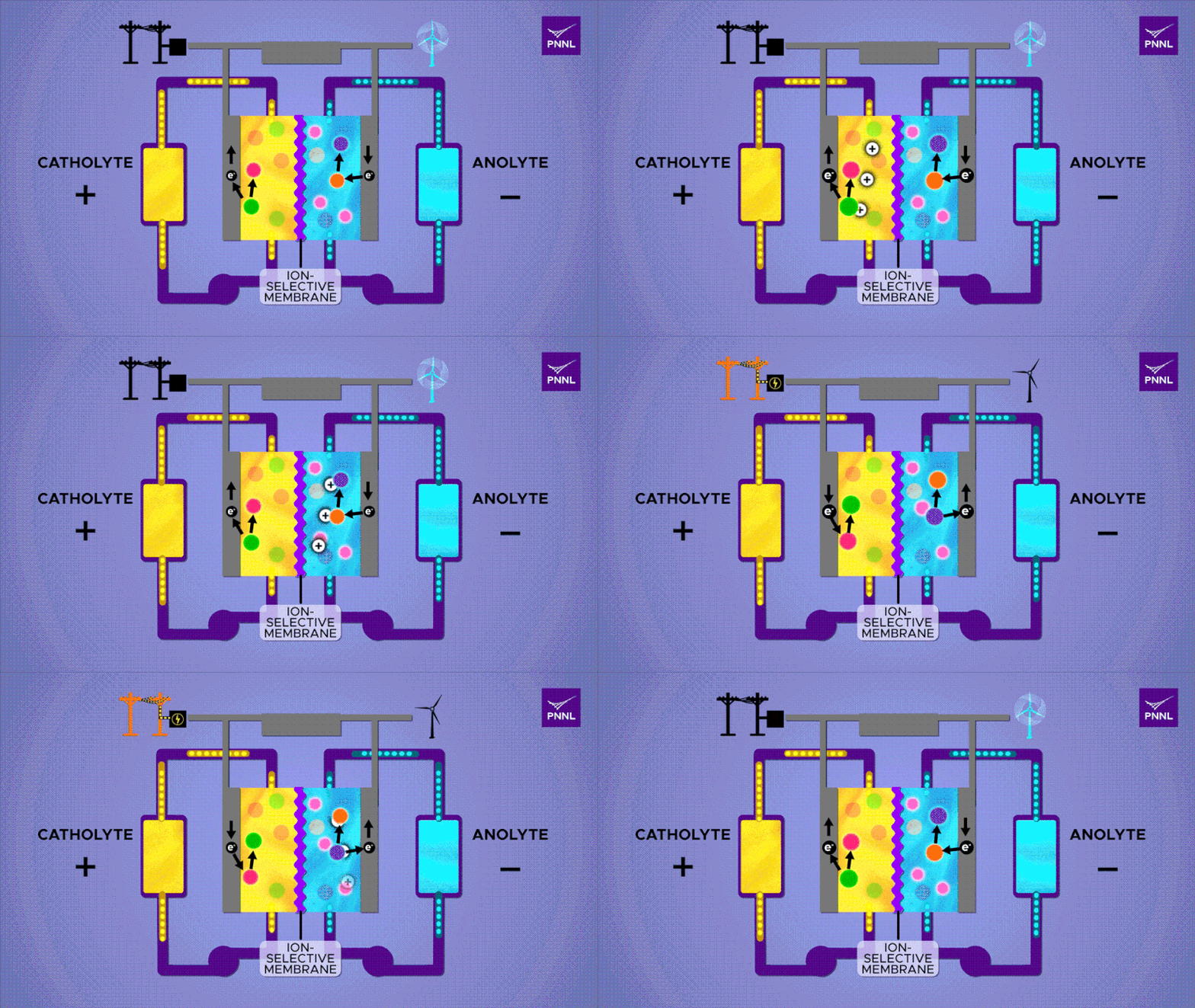
Flow batteries store energy in liquid electrolytes (shown in yellow and blue). PNNL’s flow battery uses a simple sugar derivative called β-cyclodextrin (pink) to speed up the chemical reaction converting energy stored in chemical bonds (purple to orange) and releasing energy (electrons) to power an external circuit. A parallel reversible process (red-green) in the positive catholyte solution balances the positive and negative charges during charge and discharge. Image used courtesy of PNNL
Existing flow batteries use minerals like vanadium that are relatively scarce and hard to mine. Therefore, research teams worldwide seek less expensive, more environmentally friendly materials to use as flow battery electrolytes.
PNNL’s Sweet Spot
The Department of Energy’s Pacific Northwest National Laboratory (PNNL) has published the details on a flow battery that uses a dissolved simple sugar called β-cyclodextrin, a derivative of starch, as a part of its electrolyte. The material has been found to boost battery longevity and capacity. The sweetener works in a water-based electrolyte by accepting positively charged protons to help balance the movement of negatively charged electrons out of the electrolyte as the battery discharges. The β-cyclodextrin acts as a catalyst, so while it speeds up the electrochemical reactions in the battery, it does not get used up in the process.
The researchers worked on the proper ratio of chemicals for their flow battery until they reached a point where it was providing 60 percent more peak power. They then spent a year cycling the battery between charging and discharging—during that period, the battery lost almost none of its recharging ability and discharging capacity.
What’s Next for Flow Batteries?
In previously published work, PNNL described its patented design for its fluorenone-based electrolyte. Although that organic industrial material made a good basis for an aqueous (water-based) flow battery electrolyte, it needed a boost to speed up its charging and discharging capability. The β-cyclodextrin is providing that boost.
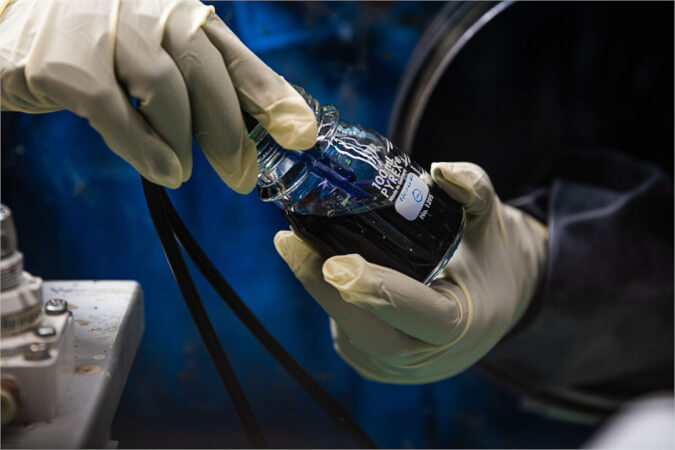
Researcher working on next-gen flow battery. Image courtesy of Andrea Starr | Pacific Northwest National Laboratory
The PNNL research team is experimenting with other compounds similar to β-cyclodextrin, but that might further improve flow battery performance. One disadvantage of the current sweetener is it increases the electrolyte viscosity—less than ideal for moving the liquid electrolyte from one tank to another. Researchers are looking for smaller, starch-based additives that might provide the same performance benefits while allowing the electrolyte to flow freely.